Casa Entre Muros: A House Between Walls

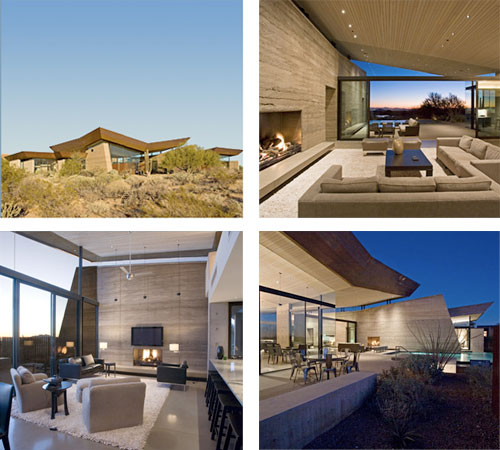
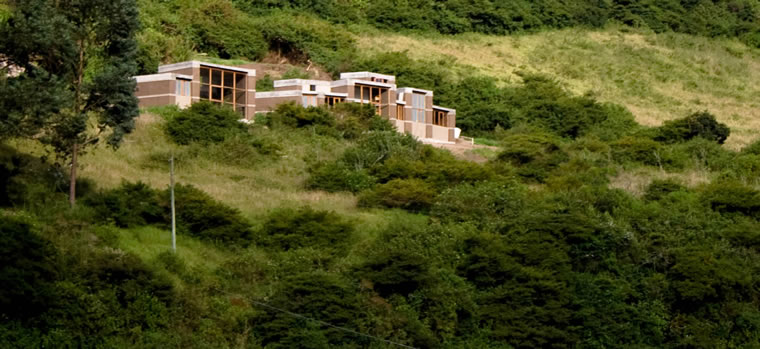
The Casa Entre Muros, built in Tumbaco, Quito, Ecuador and designed by al bordE Arquitectos (David Barragán and Pascual Gangotena), was generated from the starting point: “There is always another way of doing things and another way for living”. Far from the pollution of the city, the house is set in the hillside of the Ilaló volcano in a indomitable land. It’s limited by two streams opened to the landscape of the valley. A cut in the sloping land helps to generate a platform for the project and also to get enough raw material to build the massive party walls.

The waving form as a result of this cut in the land, defines the position and order of every wall. The succession of rammed earth walls and the different heights of the roof caused the division of the house even for the activity or the user. To avoid the domino effect, the party walls break their parallelism solving the structure and strengthening the character of each space within. A long corridor is used as an element that isolates the project from their immediate neighbours and reinforces the autonomy of every space.

This architecture aims to highlight the nature of the material elements that compose it, promoting the aesthetic, formal, functional and structural qualities as well as the maximum respect of the environment.
A Housing Market Built on Mud Takes Off, and Then Goes Thud

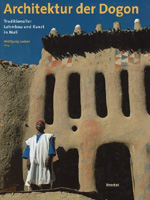
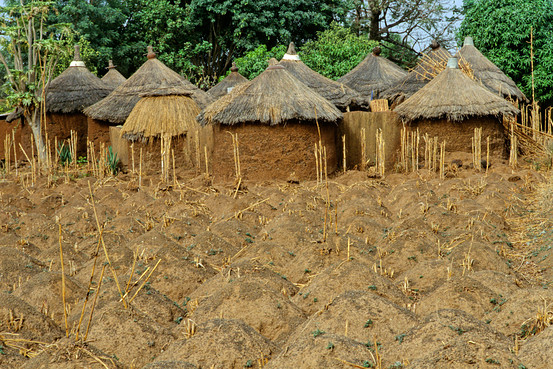
The West African village of Nionsomoridou , Guiea doesn’t have running water or electric lights. Most people get here by walking barefoot along a dirt path. The remote mountain community has one up-to-the-minute feature, though: a housing bust. Rents had risen in recent years, and local residents and home builders let their enthusiasm get the better of them, turning out a spate of new construction. Now, rows of newly built houses stand empty in the village, and rents have been cut in half. So far, not so different from Miami or Phoenix. Except that these homes are one-room, windowless mud-brick huts, and the rent is about $6.50 a month.

For centuries, Nionsomoridou faced no risk of a housing-market crash, because it didn’t have a housing market. There were no unused houses. If a son married and needed room for children, his relatives put up a new hut next door, on village land that is communally owned. Then came the global commodities boom, with far-reaching effects on Nionsomoridou, situated deep amid lushly forested mountains rich in gold, diamonds and one of the world’s largest virgin iron-ore seams.

New Deal Rammed Earth

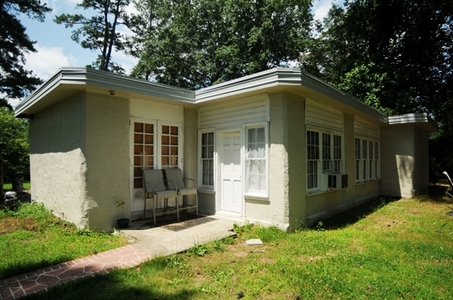
The rammed earth houses on Rosemary Road in Mount Olive, Alabama, were built in the 1930s. They were constructed with dirt, taken from the site, which was mixed with red-rock aggregate and tamped between wooden forms. The homes were built as part of a New Deal Resettlement Administration homestead community. The surprisingly sophisticated one-story houses, designed by architect Thomas Hibben, are reminiscent of the low-slung, prairie-style houses designed by famed architect Frank Lloyd Wright. The government was not sure of the lasting quality of these rammed earth homes and required that they be located at the back of the project, so as to not be too visible if they collapsed, but all the rammed earth houses of Mount Olive are still standing today. Images of the buildings at the time of their construction can be found here.

Radiolaria Pavilion

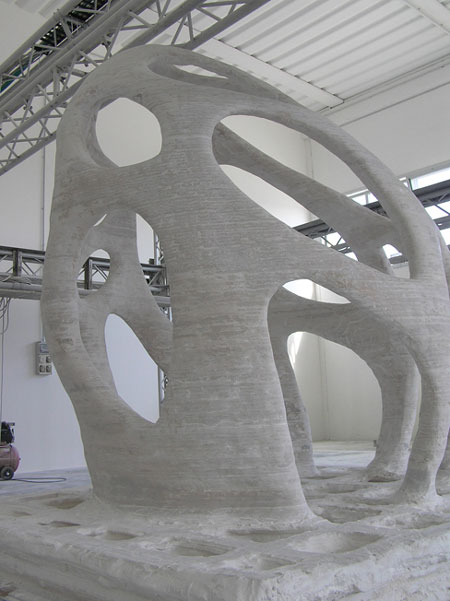
Andrea Morgante, founder of Shiro Studio, has collaborated with D-Shape to produce the Radiolaria pavilion, a complex, free-form structure produced using the world’s largest 3D printer. Measuring 3 x 3 x 3 metres, the structure is a scale model of a final 10-metre tall pavilion to be built in Pontedera, Italy, in 2010. D-Shape developed the first large-scale stereolithic printer in 2008 aiming to offer architects the design freedom that rapid prototyping allows them but has so far been confined to scale models. When D-Shape commissioned Andrea Morgante the design for the first large-scale structure to be printed the ultimate aim was to produce a geometry that could be self-supporting and demonstrate the capabilities of this innovative technology: being made of artificial sand-stone material and without any internal steel reinforcement the pavilion’s design and execution had to be intrinsically resilient to several static stresses.

The printing process takes place in a continuous work session: during the printing of each section a ‘structural ink’ is deposited by the printer’s nozzles on the sand. The solidification process takes 24 hours to complete. The new material (inorganic binder + sand or mineral dust) has been subjected to traction, compression and bending tests. The results have been extraordinary and the artificial sandstone features excellent resistance properties. Effectively this process returns any type of sand or mineral dust back to its original compact stone state. The binder transforms any kind of sand or marble dust into a stone-like material (i.e. a mineral with microcrystalline characteristics) with a resistance and traction superior to portland cement, to a point where there is no need to use iron to reinforce the structure. This artificial stone is chemically one hundred percent environmentally friendly.

Más es Menos: Construir en Barro—Una Arquitectura de Futuro

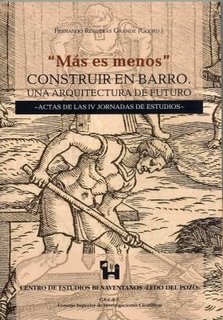
“Más es menos”. Construir en barro. Una arquitectura de futuro, que se edita con la colaboración del Ayuntamiento de Benavente y la Obra social de Caja España, consta de 192 páginas con abundancia de ilustraciones a color. En el índice figuran los títulos de las diez conferencias pronunciadas por los expertos invitados (antropólogos, historiadores, arquitectos y promotores), precedidos de una presentación a cargo del coordinador, en la que se detalla el desarrollo de las jornadas.

Earth Architecture Ranked 20th Most Popular Architecture Blog on Earth

The blog Eikongraphia has recently announced its annual ranking of architecture blogs. This year Earth Architecture debuts at #20. Thank you to everyone who stops by to read about architecture made of earth. I know that this information would not be disseminated without the support of the people who curate blogs much higher in the list such as BLDG BLOG, Archidose, Subtopia, and a few that are top blogs on my own ranking like Archinect and HTC Experiments.

Red Earth

Experimental Historian, friend and colleague, David Gissen, discusses Earth Architecture and makes an argument for red earth. He writes:

“In arguing for a red earth, I’m not arguing that earth holds an innate leftist proletarian politics in its chemical composition, nor am I completely arguing for the social construction of earth. I am arguing that our engagement with earth offers the possibilities for new liberatory ways of understanding space, that remain tied to earth’s commonness.

A powerful concept of red earth, tied to its ubiquity and free nature, might be found in the roots of much red thought — Marx himself. In his Critique of German Ideology, Marx understood earth (as concept and thing) as the base of political economic philosophy. In one of his most famous passages, he wrote “In total contrast to German [idealist] philosophy, which descends from heaven to earth, we here ascend from earth to heaven.” Marx saw earth (both soil and “the earth”) as the base of his philosophy because it was the defacto element that contained the material and ideological possibilities of society (its nourishment, production, and metaphysics). For Marx, earth contains the conditions of society by society. Earth not only delivers the grains grown by a farmer, but when a person digs his shovel into earth to grow something he or she becomes “a farmer.” When a person binds the earth into bricks he or she becomes “a builder.” The earth is social matter and structure, how we engage with it repeats existing structures and opens up new concepts.”

Read more at David’s blog, HTC Experiments.