Armando Guadalupe Cortés: ¿Y LA GENTE?

Cortez performing El Descanso En La Gloria, (Rest when I am Dead), 2017

Armando Guadalupe Cortés was born in Urequío, Michoacán, México and raised in Wilmington, California. He graduated with an MFA from Yale School of Art 2021 and a BA from UCLA in 2012 .  ¿Y LA GENTE? from 2020, blends sculpture and performance to explore themes of memory, myth, history, geography, experience and materiality. 

Rammed Earth Columns before the performance

¿Y LA GENTE? (And the People?)
2020
Installation and performance
Clay, earth, iron oxides, stoneware
Each pillar 64” x 24” x 24”

Film still of the performance at ASU Art Museum, 2020

During the performance of ¿Y LA GENTE? Cortes excavates the rammed earth columns surrounded by musicians and dancers of his native Mexican heritage. Once revealing a gold ceramic sculpture within each column, one resembling a nopal cactus and the other a milling stone, Cortes exits the gallery leaving the deconstructed pillars to remain for the rest of the exhibition.  

Revealed Nopal Cactus
Revealed milling stone

Through blending performance and sculpture, he is able to question the dichotomy between myth and fiction as an antonym to history. Growing up in two worlds has lead Cortés to a fantastical take on the ordinary. He incorporates the multitude of symbols and identities from his family of farmers, migrants, manufacturers, office professionals, and professors in his material palette and choice of dress. In contrasting the mythical or in this case the colorful and culturally rich materiality with his business casual clothing, he illustrates the parallelism and tension within his life and work. This re-assembling of materials and cultural symbolism is crucial to how Cortes seeks to challenging notions of spectacle and viewership.

Sources:

Artist Website: https://armandogcortes.com/Y-LA-GENTE-2020

Vimeo: https://vimeo.com/402306364?fl=pl&fe=cm

Bemis Center: https://www.bemiscenter.org/residents/armando_guadalupe_cort%C3%A9s

Australian Exhibition at Venice Biennale

Australia‘s first all-Indigenous curatorial team at the Venice Architecture Biennale brought a distinctly Aboriginal design approach to its pavilion, a calming and inclusive space focused on the theme of Home. The three main creative directors are Michael Mossman, Emily McDaniel, and Jack Gillmer-Lilley.

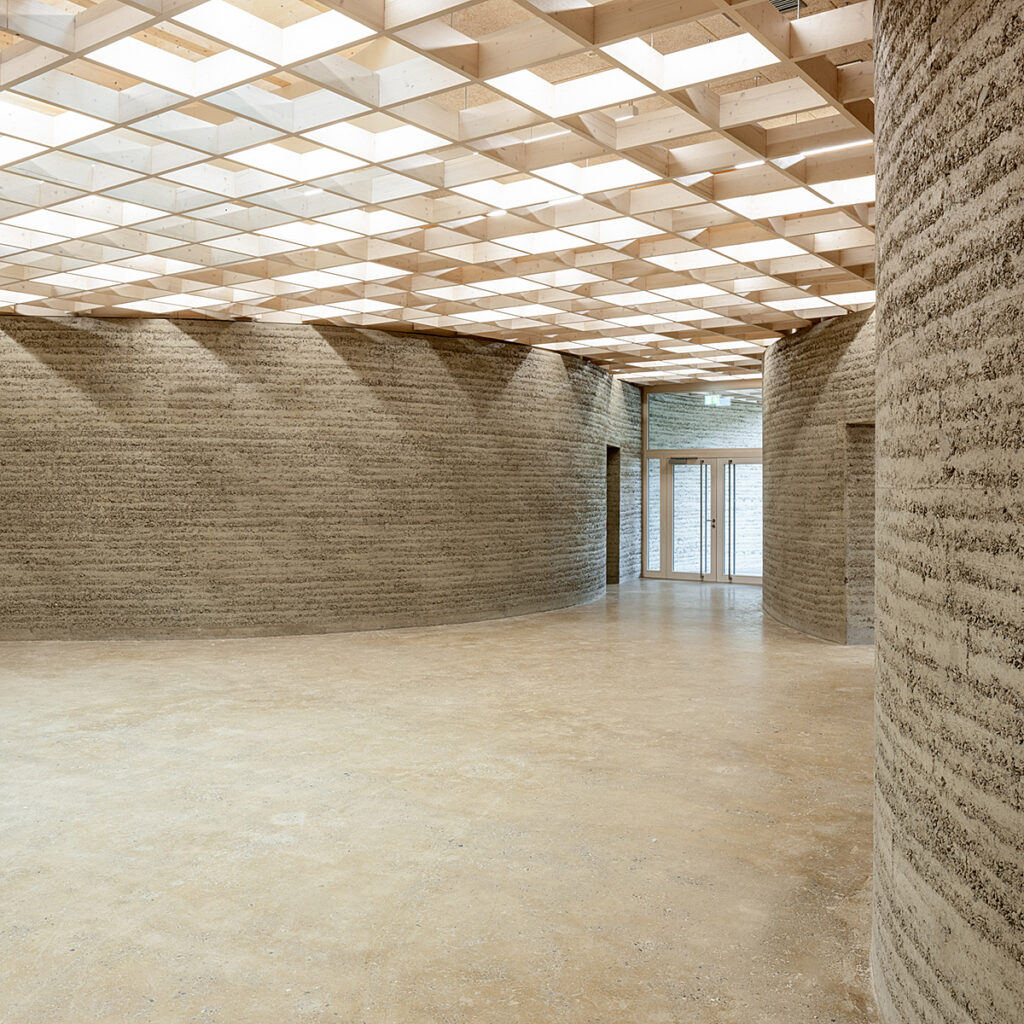
The Home pavilion is centred on a circular rammed-earth structure that serves as a gathering area and is surrounded by a display of small, sculptural objects.

Visitors to the pavilion are invited to engage in reflection while touching and holding the objects, which were created by architecture and design students from across the country in response to the idea of home.

The installation features a curved rammed earth wall and bench seat that wrap a circular, sand-filled ceremonial space at the centre of the pavilion.

The pavilion came together through the application of the Australian First Nations practice of “yarning” – a purposeful way of relating to others and sharing knowledge that often happens in a yarning circle.

The Australian pavilion centred on a circular rammed-earth structure

The student workshops began with two days of yarning, while the pavilion’s creative directors – Michael Mossman, Emily Mcdaniel and Jack Gillmer-Lilley – also took a similar approach over nine months to connect with a wider “creative sphere” of four First Nations architects and practitioners, all of whom came together to build the work in Venice with their own hands over many weeks.

They used materials entirely from Venice – mainly sand, soil and plaster – as they wanted to show respect for the land that they are visiting, rather than importing materials from Australia.


Around the structure was a display of objects made in response to reflections about home

In the student workshops, the yarning approach meant not just sharing First Nations knowledge but inviting students to reflect on their own culture and how it related to their idea of home.

The 125 students involved were asked to find artists and artworks that they connected with, to converse, journal and draw, and to consider the acts of asking for permission before using materials and taking only as much as required.

Their works – dubbed “living objects” – show a multiplicity of ways of thinking about home. A black gypsum cement orb, titled Shanshui (Prophecy), is a meditation on geology and cultural tension, while the delicate teabag sculpture, sewn together with teabag threads, honours the forgotten and quotidian.

With both the student workshops and the pavilion itself, the curators have sought to expand understanding of Australian First Nations cultural practices to something based on values and approaches rather than a set aesthetic.

“We didn’t want to bring a false sense of Australiana to the pavilion,” Kerr said. “We wanted people to be able to find their own sense of place, their own sense of belonging, their own memories and their own identity. We didn’t want to impose an emotion.”

The pavilion was Australia’s first to be curated by an all-Indigenous team

https://www.dezeen.com/2025/05/16/australia-pavilion-home-venice-architecture-biennale-2025/

https://www.unsw.edu.au/canberra/about-us/equity-diversity-inclusion/unsw-canberra-community-circle

Rafa Esparza + Beatris Cortéz :La Rebelión de los Objetos

  • The rebellion of objects,  part of Art Week 2026 in Mexico, brings together Beatriz Cortez  (Salvador, artist and scholar in Latin American Literature) and Rafa Esparza (USA, performance artist, work with installations constructed from  adobe bricks) in an exhibition conceived from their collaboration and artistic link, developed specifically to dialogue with the architecture, the collection and the territory of the Anahuacalli Museum.
  • The practices of Beatriz Cortez and Rafa Esparza share a constant concern with how historical narratives are constructed and how these affect displaced, migrant, or racialized communities. Their works propose imagining futures that are not determined exclusively by dominant discourses, but by alternative forms of knowledge, care, and relationship with the world. 

    Beatriz Cortez and Rafa Esparza
  • The exhibition proposes rethinking the collection from the perspective of memory, community, and spirituality, understanding objects not as static pieces but as carriers of energy and meaning , capable of activating new forms of relationship within the museum.
  • Through the serpent and the volcano as symbolic axes, the exhibition addresses the earthly journey, displacement —including the migrant experience— and the possibility of imagining different futures from contemporary art.
  • The rebellion of objects at the Anahuacalli Museum

    The snake as a metaphor for displacement

    One of the central themes of the exhibition is the serpent , understood as a symbol of movement, transit, and earthly journeys. In this sense , its presence alludes both to symbolic journeys within the museum and to real displacements of communities and bodies, including the migrant experience to the United States.

  • Detail of The Rebellion of Objects exhibition at the Anahuacalli Museum
    Detail of The Rebellion of Objects exhibition at the Anahuacalli Museum
    Detail of The Rebellion of Objects exhibition at the Anahuacalli Museum

    Taken together, the exhibition proposes experiencing the museum from a different perspective. Thus , the space ceases to be merely a place of contemplation and becomes an active territory where the relationships between objects, bodies, and memory remain open.

    Anahuacalli Museum in Mexico

Trina Michelle Robinson: Open Your Eyes to Water

Trina Michelle Robinson is an artist from Oak Park, Illinois who is currently working in San Francisco. Her art originates from from personal and historical archives, reflecting on her own ancestry to create immersive and deeply personal spatial encounters that materialize the complexity of emotions and layered geographies of Black migration. Her works often begin by tracing the steps of her ancestors, gathering materials from their homes and homelands, using this tactile act as a means to connect with them and gather their fractured and lost memories. In particular, she often collects dirt from these sites of personal significance, transforming that earth into a charged object within her compositions. Her installations are undefinable, hovering somewhere between an altar, a model, or a garden; a collection of objects that become spatial poetry. Trina received her MFA from California College of the Arts in 2022.
Her work Open Your Eyes to Water was exhibited in San Francisco at the 500 Cap Street Foundation and at Root Division from February-May 2026. The work is an expanded version of her previous installation titled Elegy for Nancy (2022) – a tender tribute to her oldest known ancestor, a woman named Nancy who was born in 1770s Kentucky, then still part of Virginia. Open Your Eyes to Water is a living installation tracing her years-long cross-continental engagement with family lineage and movement from Senegal, to Kentucky, Chicago, and California.


The Installation merges with the atmosphere of the gallery, charging the space with a melancholic yet restorative energy. At the center, a rammed earth block holds the room with a potent presence, atop which sits a reproduction of a will from the previous owner of her enslaved ancestors, written with handmade ink (a mixture of soil collected from Senegal and charred cedar charcoal) on paper she fabricated from cotton picked at a farm her ancestor used to be enslaved at in Oklahoma. Every mention of her ancestor’s enslavement has been redacted with sewn lines of sisal thread from Zimbabwe, reclaiming this history for herself, freeing her ancestors, speaking for them in the present moment.

The rammed earth block is composed from various soil samples from significant places tracing her family history through time and space, compressed together into a unified block, supporting a document of their liberation. The block sits in an analogous landscape of dirt and grass plumes, harkening to the various landscapes natural, agricultural, and urban landscapes her ancestors have traversed across the world.
 

Andy Goldworthy’s Clay Wall

Above: Andy Goldsworthy, ‘Red Wall’, 2025.

Andy Goldsworthy is artist known for his work with nature and ephemeral materials such as rock, wood, leaves, snow, ice, and clay, and the site specificity of his pieces. He arranges them in a way that is just beyond the realm of possibility, investigating the line between the natural and artificial.

In 1992, he covered the floor of a London gallery in clay. In 1996 he made the same work at Haines Gallery in San Francisco, but against a 14′ x 17′ wall. The work was made knowing the clay would crack, and not knowing whether the clay would stay attached, but it surprisingly stayed attached for many years, despite occasional earthquakes. This was the beginning of a line of inquiry of clay, creating works with things embedded in clay, experimenting with intentional drying and cracking,

“… to make change an integral part of a work’s purpose so that, if anything, it becomes stronger and more complete as it falls apart and disappears.

“Clay can be well-behaved and easy to work. Yet it has such a powerful impact on the landscape: it reveals its more unpredictable qualities as it dries, and this process interests me most.”

Andy Goldsworthy, Clay Wall, Haines Gallery, 1996.

Andy Goldsworthy, Clay Wall, Ingleby Gallery, 1998.


Above: Drawn Stone is piece commissioned by the De Young in 2005. It is a continuous crack running north from the edge of the Music Concourse roadway in front of the museum up to the main entrance door, inspired by California’s tectonics.

Video: Andy Goldsworthy’s Earth Wall, Presidio of San Francisco, 2014.

Video: Andy Goldsworthy Studio Visit, Tate, 2011.

A life’s artwork: 50 years of Andy Goldsworthy, BBC, 2025.

Robert Rauchenberg: Mud Muse

Robert Rauschenberg, Mud Muse, 1968–71; Moderna Museet, Stockholm, gift of the New York Collection

Mud Muse,  a kinetic artwork created between 1968 and 1971 by American artist Robert Rauschenberg,  in collaboration with engineers from Teledyne( through the Art & Technology program at the Los Angeles County Museum of Art), is a large aluminum-and-glass vat that contains an enormous amount of mud, weighing thousands of pounds. Although considered mud by standard terminology, its more appropriate content appellation is bentonite, an absorbent, swelling clay composed of montmorillonite, from weathered volcanic ash.

The mixture is stirred to a distinctive viscosity in the vat, over the course of several hours or days. The primary allure of the art piece is the bubbles produced with the aid of pulsing air valves that are located beneath the surface of the mud. This is connected to an adjacent prerecorded soundtrack that emits sound from a 1960s reel-to-reel. The sound pushes air through the valves, resulting in a physical manifestation of sound emission.  Rauschenberg imagined different audio stimuli, including traffic noises, police sirens, and, most ambitiously, real-time sounds made by visitors that would be picked up by a hanging microphone. In the end, he decided that Mud Muse, when officially displayed for the public, would “play itself,” essentially a recursive loop of the audio made by the bubbles. 
American artist Robert Rauschenberg

Rauschenberg (1925-2008), born in Port Arthur, TX, is considered a pioneer in the art scene due to his early adaptations of technology in his work, such as radios, electric lights, and clocks, as well as his more renowned printmaking works. His endeavors into kinetic art began in 1960, after meeting Swiss artist Jean Tinguely. Together, they created several kinetic works alongside engineer Billy Klüver, such as Oracle (1962–65), a sonic sculptural environment, and Soundings (1968), an immersive, voice-activated sound and light installation. This era, which was marked by technological innovation and space exploration, ultimately played a pivotal role in Rauschenberg’s creation of Mud Muse.
Gunnar Marklund(right) installing Mud Muse

In modern days,  Mud Muse acts as a tradition passed down through the years. The current installer, Gunnar Marklund, notes that “The audio equipment and its cabinet are quite old and require maintenance and repair on occasion. And there are sixty-four valves in the bottom of the pool, and they do get clogged; I have to check them every time and clean them as needed.”  Occasionally, during installation, he experiments with different music to activate the bubbling (in New York recently, ABBA). Overall, the knowledge he has gained over 19 years, he passes on to future generations. 
Mud Muse 1968–71

In recapitulation, Mud Muse acts not only as a visual experience, but one that activates hearing, smell, and touch, allowing the public to have a holistic and interactive participation with the piece.  It collides two opposing worlds of ancient material and modern technology, creating a piece of art that has withstood the tests of time and continues to bewilder audiences.

Sources:

Artchive. “Oracle – Robert Rauschenberg (1965).” Accessed March 9, 2026.
https://www.artchive.com/artwork/oracle-robert-rauschenberg-1965/

Daniel Langlois Foundation for Art, Science, and Technology. “Collection of Documents Published by E.A.T.” Accessed March 9, 2026.
https://www.fondation-langlois.org/html/e/page.php?NumPage=394

Elephant Magazine. “Rauschenberg’s Mud Muse Taught Me to Find Cohesion Even Amidst Chaos.” January 28, 2021.
https://elephant.art/rauschenberg-mud-muse-taught-me-to-find-cohesion-even-amidst-chaos-28012021/

Rauschenberg Foundation. “Soundings.” Accessed March 9, 2026.
https://www.rauschenbergfoundation.org/art/artwork/soundings

Teledyne Technologies. “EverywhereYouLook!” Accessed March 9, 2026.
https://www.teledyne.com/en-us

Tinguely Museum. “Museum Tinguely.” Accessed March 9, 2026.
https://www.tinguely.ch/en.html

Wallach, Amei. “Recalling Robert Rauschenberg.” Smithsonian Magazine, May 18, 2008.
https://www.smithsonianmag.com/arts-culture/recalling-robert-rauschenberg-49830834/

YouTube. Video. Accessed March 9, 2026.
https://www.youtube.com/watch?v=7r88iDgTd-M

YouTube. Video. Accessed March 9, 2026.
https://www.youtube.com/watch?v=Tvt-VSgPd4c

Karim+Elias: From This Earth Installation

Location:  Diriyah, Saudi Arabia
Year:  2024
Project Type:  Temporary installation / pavilion
Area:  220 m²
Architects:  Karim+Elias
Lead Architects:  Karim Tamerji, Elias El Hage
Photography:  Elias El Hage
Event Design and Coordination:  Design Lab Experience

Project Overview
From This Earth Installation is a temporary installation by Karim+Elias in Diriyah, Saudi Arabia. Completed in 2024, the 220 m² project was presented as part of Layali Diriyah and consists of a series of porous earthen screens assembled from more than 1,400 hand-sculpted spheres. Rather than treating earth as a heavy and continuous wall, the installation reimagines it as a modular, open-air spatial filter. In this sense, the project is significant not only as an installation, but also as a contemporary experiment in earthen material practice.

Site and Cultural Context
The project is deeply tied to its location. Diriyah is described by its official destination platform as the “City of Earth,” and it is presented as the birthplace of Saudi Arabia. Within this context, From This Earth operates as more than a temporary pavilion: it becomes a material response to a place historically associated with earthen building traditions. The architects state that the work celebrates Diriyah’s craft of building with earth, so the project should be understood as a contemporary reinterpretation of local architectural memory rather than as an abstract sculptural object placed in a neutral site.

Material and Construction Logic
Karim+Elias describe their broader practice as a contemporary exploration of “sculpting with sand,” using locally sourced earth, clay, and water in custom-made moulds. In From This Earth, this material approach appears through a system of over 1,400 hand-sculpted modular spheres made from local material and stacked into earthen screens. This construction logic is important because it shifts earth away from its more familiar role as a monolithic mass or thick wall. Here, earth becomes a repeated unit, a surface condition, and a space-making device. The project therefore demonstrates how traditional earth-based craft can be translated into a contemporary modular language.

Spatial Experience
The installation’s spatial effect comes from porosity. The stacked spherical modules create filtered views, partial enclosure, and changing patterns of light and shadow. Designlab Experience describes the screens as evoking the traditional mashrabiya and recalling Diriyah’s vernacular triangular wind openings and rooftop silhouettes. Because of this, the project does not simply represent earthen architecture visually; it performs some of its environmental and perceptual qualities. Air, light, depth, and visibility are mediated through the earthen surface, allowing visitors to experience earth not only as a material, but also as an atmospheric interface.

Significance to Contemporary Earthen Practice
This project is relevant to contemporary earthen architecture because it expands the definition of what an earthen work can be. It does not reproduce a traditional mud structure directly, nor does it use earth only for symbolic effect. Instead, it repositions earthen craft within a temporary cultural installation and demonstrates that earth can function as a contemporary design medium. From This Earth shows that earthen practice today can move across architecture, installation, art, and public event design while still remaining grounded in local material and cultural context.


References

  1. ArchDaily  https://www.archdaily.com/1014728/from-this-earth-installation-karim-plus-elias?ad_source=search&ad_medium=projects_tab
  2. Designlab Experience  https://www.designlabexperience.com/projects/layali-diriyah-2024
  3. Diriyah official website  https://www.diriyah.sa/en
  4. Karim+Elias official website  https://www.karimelias.com/about

Zabur in Yemen

Aljazeera

The Architecture found in Yemen is among the most sophisticated and enduring traditions in human history – a monument to the reaches that people could build to even without modern, post-industrial materials and methods. These relics, often older than 500 years old, are more at risk than ever, due to socio-political issues in yemen.

Central to this architectural tradition is the “zabur” technique, which is among a collection of practices essential to earthen architecture in Yemen, from the coursed-clay methods in the highlands to the iconic “gingerbread” fired-brick patterns found in the capital, Sana’a.

The master builders “ustads” utilize several distinct systems based on the required outcome – each varying the preparation of the earth, the firing or not-firing of that earth, and the methods of application. This allows zabur to adapt to the various features of the yemeni landscape – optimizing from the humid coastal plains to the volcanic plateaus.


NBC NEWS

In technical literature, “zabur” is defined as a direct-forming technique – utilizing wet, straw-reinforced clay soil to build walls without the use of formwork or molds. This is reminiscent of the European technique of “cob.” This definition of the term, however, is limited – and many linguists and experts of old Sana’a argue that it’s also inextricably linked to the intricate patterns of the fired-mud bricks that comprise much of the city’s facades. This intertwines the later, post-Islamic styles of decorative brick-and-gypsum towers with the ancient past’s monolithic clay walls – what I’ll call “pure zabur.”

ArabAmerica

In the northern regions, zabur remains as a pure coursed-clay tradition. The material is prepared in pits and formed into balls, which are then thrown to the master mason standing on top of the wall, who settles the material into place. In Sana’a, the zabur is the fired mud-bricks that are adorned with ornamentation drawn of white gypsum.

Tower House

These techniques allowed Yemeni to build stronger, and then eventually higher – leading to the creation of tower houses. These traditional tower houses in the old cities were set on stone foundations of basalt, on top of which carefully fitted, locally quarried tuffa and limestone up to 10 meters tall is laid. Above that, the zabur bricks are laid – and then on top of that an aged lime plaster called qadad is applied as an exterior waterproofing layer (atleast on the rooftops).

MIT Libraries

Yemeni Architecture reflects a “profound interaction between humans and their environment“(IJSDP), standing as a creative embodiment of beauty, simplicity, and the extents of human ingenuity of the past. Rapid urban development in recent years, however, has created disharmony and a detachment from societal traditions – something that looking at and preserving techniques from the past may help with reconciling.


Sources:

https://www.aljazeera.com/news/2020/10/16/mud-brick-palace-is-yemens-latest-heritage-site-facing-disaster

https://www.nbcnews.com/news/photo/yemenis-make-mud-bricks-unique-architecture-flna1c7186688

https://www.mutualart.com/Article/The-Yemen-s-mud-brick-buildings/573E9A38ED3968A1

https://www.researchgate.net/publication/387526551_Form_and_Content_in_Yemeni_Architecture_Exploring_Continuity_Mechanisms_of_Heritage_-_A_Case_Study_of_Sana’a_City

https://newsociety.com/wp-content/uploads/woocommerce_uploads/toc-excerpt/Essential-Cob-Construction_excerpt.pdf

https://dev.earth-auroville.com/stacked-earth-cob/

Traditional Yemeni Architecture: Craftsmanship and Sustainability

Robotic Ramming

Digital Futures 2025 Workshop
CAUP, Tongji University
Institute of Structural Design, TU Braunschweig

https://www.tu-braunschweig.de/ite/research#robot-aided-fabrication-of-rammed-earth-elements

June 2025

Robotic Ramming – Digital Futures 2025 was held in June 2025 at CAUP, Tongji University, and led by the Institute of Structural Design at TU Braunschweig. The workshop was directed by Dr. Samim Mehdizadeh, Joschua Gosslar, and Noor Khader under the academic leadership of Prof. Dr. Norman Hack and Prof. Dr.-Ing. Harald Kloft.

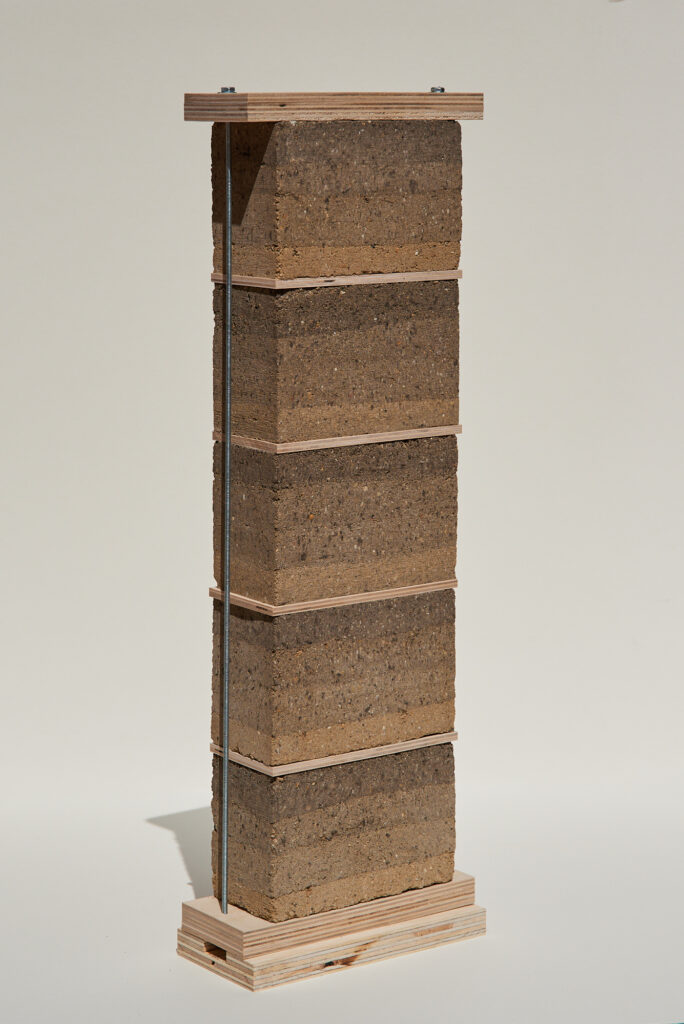
The workshop investigated the integration of robotic fabrication with rammed earth construction. Moving beyond traditional in-situ methods that rely on rigid formwork and horizontal layering, the project employed a robotic arm equipped with a pneumatic ramming end-effector. This system enabled digitally controlled compaction and expanded the geometric possibilities of earthen construction.

Participants developed a complete design-to-fabrication workflow. Using Rhino and Grasshopper, they generated toolpaths through boundary definition, sectional slicing, voxel allocation, infill pattern development, and sequential ramming strategies. Digital modeling was directly linked to material performance and robotic execution.

The workshop culminated in a large-scale demonstrator composed of three rammed earth components, each approximately the size of a Euro pallet and varying in height. The installation demonstrated scalability, structural articulation, and the potential of robotic ramming as a sustainable construction method.

A video documenting the fabrication process accompanies this article.


Cob in the UK

Cob in the UK and Ireland – England and Wales 

Historical Context-13th Century-15th Century

In the 13th Century, Cob first established as a basic technique in the UK began to evolve in practice for many years. As the development of homes changed over time cob developing into the framework of a more industrialized society in the 15th Century. This became a normal form of buildings utilizing various material mixes for more solid mass use. Established mainly in certain regions like Devon, Cornwall, Somerset and parts of East England, as well as Wales. Historically, various forms of architecture were also established in the adjacent country of Ireland where sod houses and thatch cottages which were more common practices. Along with the UK cob houses materials were used similarly in tangent and later developed in the same fashion. Location in context worked well with the mild maritime climate, clay rich soil and easily accessible materials.

Cob House in Devon England built in 1536

Cob Home in the West Country UK

Penrhos Cottage Wales 200-years-old

Phe’s House in Kilkenny Ireland

Building Techniques and Materials

Material

Historically, cob was more common in England and Wales the sandy clay material of the natural environment was a more viable option considering that stone and wood were less accessible. This allowed various mixtures to form ranging from different percentages of clay, straw and water ration. In order to create a thick more workable mixture.

The technique primarily uses a mixture of clay, sand, stone straw and water combined with a lime mortar for durability. The form was then applied molded by hand allow sculptural forms to construct characterized architectural forms.

Cornish lime mortar is an essential material used for maintaining cob structures as it allows a longevity and stability over time. The lime mortar allows for flexibility of the structure while also preventing cracking and breakage. Lime can also be fire proofing, water resistant and durable.

There are certain forms of cob that use a chalk heavy concentrate and are know as chalk cob or wychert. This gives a distinctive natural blend of materials for the walls, consisting of most of the housing in the UK during the vernacular period.

Cob Blocks-Material Mixture

Chalk Cob Wychert

Highly Skilled Labor

Hand shaped and compressed, highly skilled labor is required for the creation of cob walls and or cob bricks. The mixture is laid onto a stone foundation and does not require formwork or ramming. Construction would consist of building on top of another layer after drying and trimming for the next batch to be laid.

Heritage Cob mixtures

Generally about 24 inches thick, for walls and or brick forms creating spaces for windows inset, the overall thickness of the material allows a natural insulation during the day.

Cob Wall Basic Construction

Longevity, Maintenance and Sustainability

Longevity

Still being used in practice today the longevity of the cob wall, offers a deeper understanding of the practice for breathability, prolong building life as well as establishing a lasting sustainable practice.

Considering that the construction of these buildings were created in the 13th to 19th century enough of these buildings mixtures allowed occupation of these houses to this day.

Cob Cottage Devon UK 1400

Cob Cottage Westlington lane, Diton UK Built in 1762

Maintenance 

Cob wall repairs are common to not only keep up with the historic longevity but to address minor issues that arise before escalation and cracking. Some methods of maintenance include patching up areas affected by moisture as well as adding new coats of lime mortar for more stability and durability. This also helps keep out any newer moisture to prevent further decay over time. Though maintenance may be subjected to certain craftspeople it still is a viable form of building practice for eco based materials.

Cob Repairs Devon, England

Lime Coat for Cob wall repair

Sustainability

Emphasizing a breathable material and establishing the lime coat to prevent moisture, cob allows a breathable structure that  can regulate the internal climate and heat within  fluctuating  weather. The thermal properties as well as the breathability allows faster moving heat as well as more stability of the climate in the interior.

Along with being a thermal based building the durability against various weather events including windy, rainy and moisture rich conditions make the weather resistance a factor in preventing breakage of materials and mold content.

Considering that the materials are natural it works in harmony well with the built environment. Using these materials have minimal impact on the ecosystem as a whole and can also be considered a renewable resource.  It can cut back on carbon emissions for building and can also be a viable option for housing in the future.

Cob houses


Future of Cob in the UK

There are some craftspeople that are supporting the movement to look more into cob as a building practice for present day architecture. Bringing a contemporary use of this material there are various forms of cob that has become a more viable option for building

The Cob Specialist-looks into establishing a sustainable restoration of older cob buildings including establishing a lime mortar exterior to historic buildings

Earth Blocks- focuses on creating cob blocks as a building alternative.

Kevin McCabe- Creates new cob buildings constructed in various shapes and forms that the material previously had not been used for.

Sources:

“Phe’s House.” 2021. Philbarronshouse.com. 2021. https://www.philbarronshouse.com/.

Bevan, Nathan. 2023. “Pembrokeshire: Empty 200-Year-Old Cottage Frozen in Time.” Bbc.com. BBC News. October 26, 2023. https://www.bbc.com/news/uk-wales-67228291.

“Kevin McCabe Cob Building Specialist.” 2021. Kevin McCabe Cob Building Specialist. 2021. https://www.buildsomethingbeautiful.co.uk/.

“Home – Earth Blocks UK.” 2026. Earth Blocks UK. February 8, 2026. https://earthblocks.co.uk/.

‌“Accredited Cob Specialist (Est 1997) – the Cob Specialist.” 2026. The Cob Specialist. February 18, 2026. https://thecobspecialist.co.uk/.

Keiren. 2016. “Historical Cob • Insteading.” Insteading. February 7, 2016. https://insteading.com/blog/historical-cob-buildings/.

“Breathe. Heritage Builders.” 2026. Breathe. Heritage Builders. 2026. https://breatheheritage.co.uk/?utm_.

“Method of Cob Construction.” 2014. The Cob Wall: Sustainable Design Project. February 13, 2014. https://thecobwall.wordpress.com/method-of-cob-cnstruction/.

Gunawardena, Kan-Chane. 2008. “The Future of Cob and Strawbale Construction in the UK.” February 21, 2008. https://doi.org/10.5281/zenodo.15882872.

“Cob Building – Heritage Crafts.” 2025. Heritage Crafts. January 14, 2025. https://heritagecrafts.org.uk/craft/cob-building/?utm_.

“Traditional Building Methods for Sustainable Buildings.” 2022. Chartered Association of Building Engineers. September 2022. https://www.buildingengineer.org.uk/intelligence/traditional-building-methods-sustainable-buildings?utm_.

“Heritage Cob in Cornwall: Exploring Historical Techniques.” 2025. Legacy Restoration South West Limited. April 12, 2025. https://legacyrestorations.co.uk/heritage-cob-in-cornwall/.