Southwest School of Art & Craft, with roots dating to 1848, when the Catholic community started building the Ursuline Academy, an elite, private girl’s school, it is one of the oldest education sites in San Antonio, Texas. It was recently declared the largest and most significant example of French-influenced architecture in the state by the French Heritage Society. Early buildings on the campus were designed by famed architect Francois Giraud, the city’s first surveyor who is responsible for many of the city’s distinct buildings, including the French Gothic style addition of San Fernando Cathedral. Giraud, who was born in South Carolina to French immigrant parents, chose a construction method called pise de terre, or rammed earth, for the buildings. Skilled pise worker Jules Poinsard worked as a subcontractor on the project.
Rare Earth: The Weir Brothers
This article is published with the permission of the author, Thomas Shess, who is a San Diego based free-lance writer, who has been specializing in period homes from Adobe to Post Modern for more than 30 years. The article will appear in the March 2004 issue of San Diego By Design.
RARE EARTH
A Fifties-Era Adobe Redo in La Mesa
Southern California’s romance with red-tiled Spanish influenced architecture shows no sign of ebbing. Sharp eyed aficionados can drive any local residential street and see variation upon variation of this warm and comfortable style whether it is Mission, Monterrey, Rancho Hacienda, or Pueblo Revival. This month’s featured home in La Mesa is a fine example of Adobe construction, one of the rarer Spanish revival themes around.
When Ad/PR execs Rob Akins and Mark Berry purchased their 1957 custom adobe home in the foothills of La Mesa, the home was a diamond in the rough waiting to be given new life. The owners named their home Casa dos Palmas after the two towering palms in the back yard and set out to accentuate the warm, rustic charm of the place, with its generous rooms, multiple fireplaces, high beamed ceilings and panoramic views, by infusing an international look with contemporary furnishings, extensive art and custom lighting.
“The house was classic Weir Brothers design – soaring open beams of solid cedar, 16″ thick walls of adobe and artisan fireplaces. It was also dark, dated and with little connection to the outdoors,” said Akins. “We wanted to create a home that was an extension of the outdoors.” Removing the original 50’s patio doors and windows, the owners installed custom wood French doors and windows with bronze hardware. Simple Sautillo tile replaced dated shag carpeting, while sisal carpeting went into bedrooms and hallways. Graphic designer Berry designed the back yard with a dramatic pool, terrace, deck and outdoor dining pavilion (featured in San Diego Magazine June, 2000 issue) that takes in the 280? view of the eastern mountains. Abundant landscaping creates privacy as well as providing color to the mini-compound.
Brothers Jack and Larry Weir worked together after WWII to the 1960’s building adobe homes in Escondido, Pala, Fallbrook, Pauma Valley and La Mesa. After the war when building materials were scarce, Jack Weir built a home out of “dirt cheap” adobe bricks for his then young family. When some post war house hunter offered Jack $15,000 for that first home a thriving custom home building business using mud bricks was founded and flourished into the 1960s.
Casa dos Palmas like other thick-walled adobe structures provides an environment that is cool in the summer and warm in the winter. While adobe remains an economical building material recent adobe construction in the U.S. has seen better days. Reason is modern seismic building codes have blunted adobe construction for most of the past half century.
Recently, Akins and Berry purchased a small farm in Sonoma County, moved into their condo on Balboa Park and sold Casa dos Palmas to architect Jim Tanner and wife Annemarie Eckhardt, who split their time between San Diego and San Francisco. Tanner is partners in TannerHecht [cq]Architecture, the designers of several high profile projects in San Diego including ICON at the former Reincarnation building. As fate would have it, Tanner and business partner David Hecht have started designing Akins and Berry’s Sonoma home which features a newly planted olive grove as its focal point. Splitting their time between San Diego and Sonoma County, now Akins and Berry have the best of both worlds – a Town & Country lifestyle that suits them just fine.
Khalili Wants To Build in Space
Great site, was just reading and doing some work when I found this page
Quentin Branch Rammed Earth
Quentin Branch, the rammed earth builder for architects Rick Joy and Jones Studio, has a very informative website that includes photos, workshop offerings and video.
Frank Lloyd Wright
According to the discussion group at www.designcommunity.com, “Frank Lloyd Wright did design a berm house for a small commune who were building their own homes outside of Detroit in 1940 or 1941. Construction was begun on one house when the war intervened. The other oddity about this design was the use of rammed earth for the walls. The unfinished house was abandoned when the residents were drafted.”
The Adobe Alliance
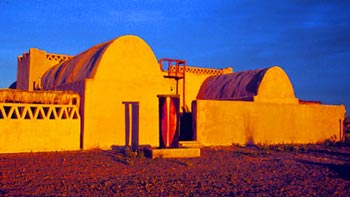
The Adobe Alliance, led by Simone Swan, is an organization whose goals are to to build low-cost energy efficient housing that is climatically and environmentally compatible and to fill widespread needs for sustainable, salubrious housing while enhancing the unique landscape of the Big Bend region of West Texas and other desert environments.
Earthquake Proof Houses Hard to Sell
Iran-born architect Nader Khalili has a technique for building earthquake-proof houses, but he is struggling to sell it to governments even though he teaches it for free and it could save countless lives.
Books By Paul Graham McHenry
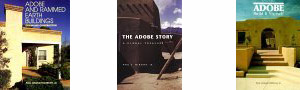
The trilogy of books by New Mexico author, teacher, and builder, Paul Graham McHenry, are a staple to the library of anyone interested in building or designing with earth.
Adobe and Rammed Earth Buildings: Design and Construction
Superadobe Iran
Iranian-born architect, Nader Khalili, now working in California’s seismic zone urged his fellow Iranians to try his “superadobe” building technique, using sandbags and barbed wire, in rebuilding the 2,000 year old quake-flattened city of Bam.
Cornerstones Community Partnerships
Cornerstones Community Partnerships, a Santa Fe-based non-profit organization, works primarily with rural Hispanic villages and Indian Pueblos in New Mexico and the southwest to restore historic structures. It encourages traditional building techniques and works to retain cultural heritage and foster civic pride through historic preservation. For the past seventeen years, Cornerstones has assisted over 300 rural Hispanic and Native American communities throughout New Mexico, Colorado, Arizona, and Texas in the restoration of their historic and cultural structures as a means for the preservation of the rich cultural heritage unique to this region. Over 50 major restoration projects, led by the community, have been successfully completed.