The New York Earth Room, 1977, is the third Earth Room sculpture executed by artist Walter de Maria, the first being in Munich, Germany in 1968. The second was installed at the Hessisches Landesmuseum in Darmstadt, Germany in 1974. The first two works no longer exist. The New York Earth Room has been on long-term view to the public since 1980. This work was commissioned and is maintained by Dia Art Foundation and is an interior earth sculpture comprised of 250 cubic yards of earth (197 cubic meters) over 3,600 square feet of floor space (335 square meters) with a 22 inch depth of material (56 centimeters). The total weight of the sculpture is 280,000 lbs. (127,300 kilos).
Nader Khalili
Iranian born Nader Khalili, California architect/author is the world renowned Earth Architecture teacher and innovator, and author. He has been a licensed architect in the State of California since 1970, and has practiced both in the U.S. and abroad. Click here to visit Khalili’s website: Cal-Earth, The California Institute for Earth Art and Architecture.
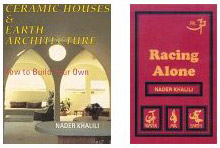
His books, Ceramic Houses and Earth Architecture: How to Build Your Own and Racing Alone document his life of searching for a method to fire mud houses and turn them to stone by firing and glazing an entire building after it is constructed from clay-earth on site.
Los Angeles Greater Metropolitan Area Adobes
Among the Things to do in Los Angeles are visit the 103 adobe sites where adobe buildings once stood, or visit the 76 extant historic adobe structures listed by region below:
Los Angles County (12)
Orange County (10)
San Diego (17)
Santa Barbara (20)
Ventura (13)
Inland Empire (4)
Rural Studio

The book, Rural Studio: Samuel Mockbee and an Architecture of Decency documents several rammed earth structures designed and built by Auburn School of Architecture students in Hale County, Alabama.
House of Earth and Light
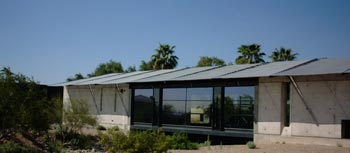
The House of Earth and Light, a private residence designed by Iraq-born, Phoenix Architect Marwan Al-Sayed uses a 3-layer fabric roof to bring tension and lightness to the thick poured gypsum walls. Computer renderings of the building show the proposed quality of the architecture. More information can be found here in an article by the Industrial Fabrics Association International (.pdf format).
Adobe Architecture
The North Texas Institute for Educators on the Visual Arts offers a concise history and explaination of adobe architecture.
David Easton

The Rammed Earth House written by David Easton, describes the beauty and grace of rammed earth construction. The photographs of different structures, both modern and ancient, by Cynthia Wright, create a breathtaking glimpse into a building technique that is as old as human history, but exactly suitable for today’s resource-conscious and environmentally friendly building needs. Rammed Earth Works, established in 1978, has distinguished itself as one of the world’s leading company in the research and development of modern earth construction technologies. Founder David Easton is the internationally recognized developer of PISE, Terratile, the Easton forming system for rammed earth and cast elements, and construction systems for engineered earth walls which are code compliant and compatible with current building trades.
Center of Gravity Hall
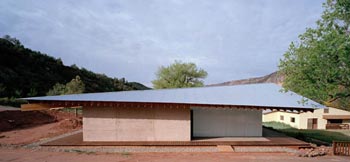
This new teaching hall for the Bodhi Mandala Zen Center in Jemez Springs, New Mexico was designed by Predock Frane Architects of Los Angeles and uses rammed earth. The project was a recipient of a 2003 AIA/Los Angeles Design Honor Award.
South Dakota Rammed Earth
Ralph Patty, Chairman of the Agricultural Engineering Department, supervised the rammed earth research at South Dakota State College in the 1920s and 1930s. Patty’s research was published internationally as well as by SDSC and the USDA Rammed Earth Walls for Buildings- 1926 :Farmers’ Bulletin #1500.
Historic South Carolina Church
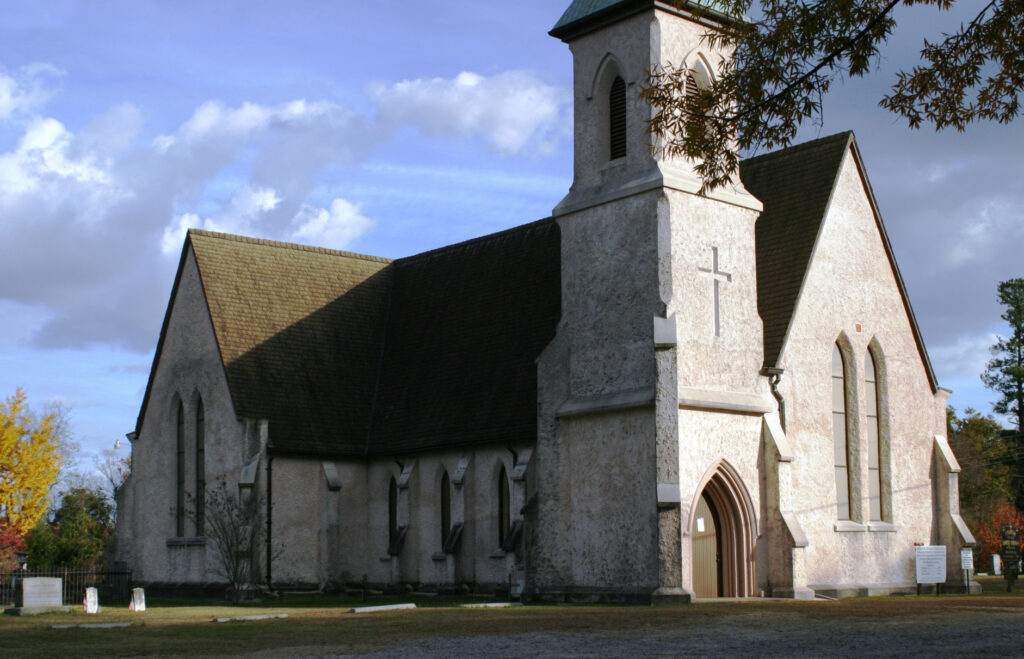
Leaders of the Church of the Holy Cross off S.C. 261 in Stateburg, a 150-year-old national landmark, sued both Orkin Exterminating Co. Inc. and Terminex Service Co. Inc. as well as an architect and contractor involved in the restoration of the church. The church, built between 1850 and 1852, was declared a national landmark in 1978. The building is of particular historic significance because of its unusual construction of rammed earth known as pise de terre.
More information available here: Holy Cross Church Restored