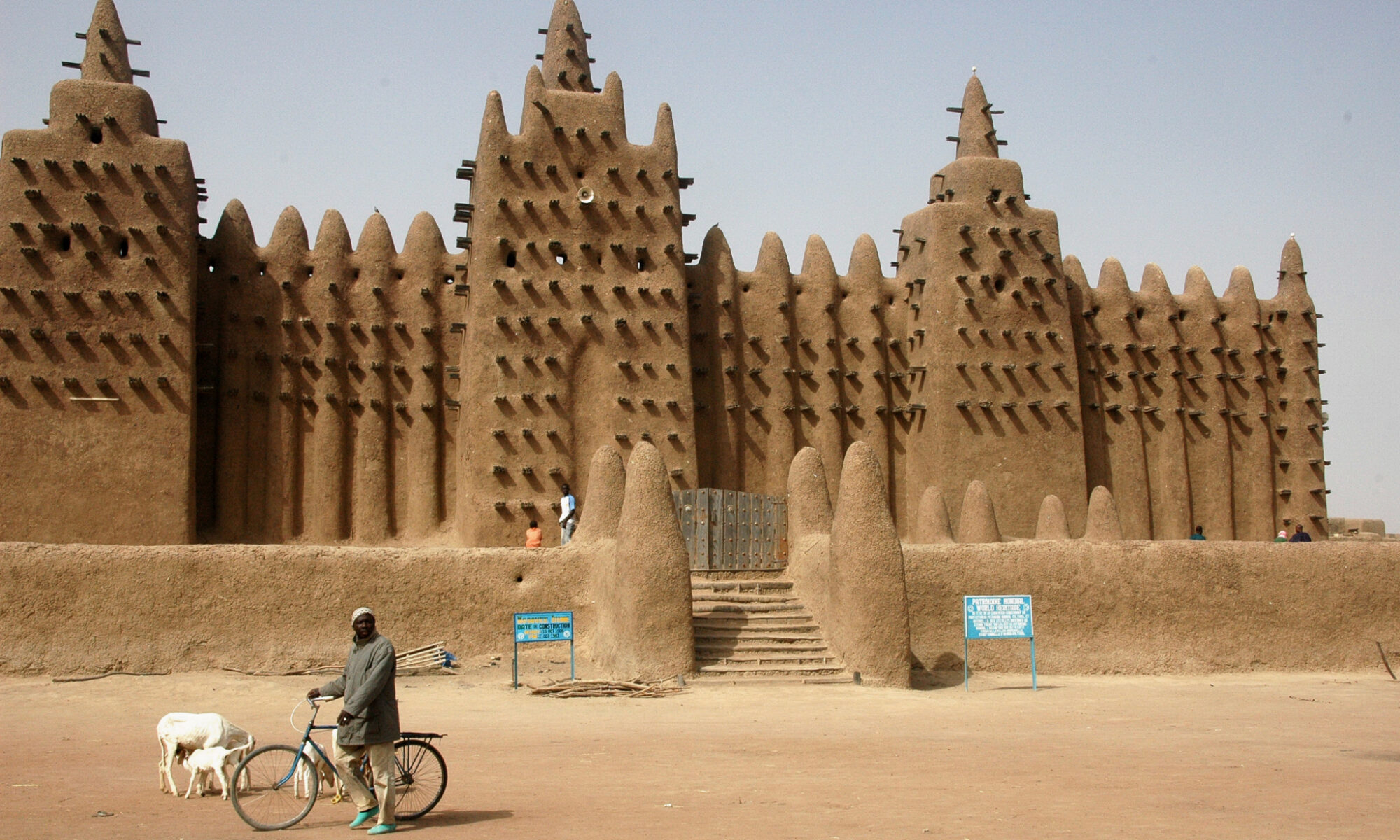
In the essay “The Renaissance of Rammed Earth” which was published in AMC Aspects magazine, January 2001, it is discussed that “Antonio Gaudi and Frank Lloyd Wright appreciated rammed earth. Gaudi showed great interest for the popular architecture. In 1884 he used rammed earth (called “tapial” in Spain) for the construction of the pavilions at the entrance to the farm of Eusebio Guell. Frank Lloyd Wright suggests rammed earth for the construction of buildings in his project for Broadacre City.”
Casa Grande
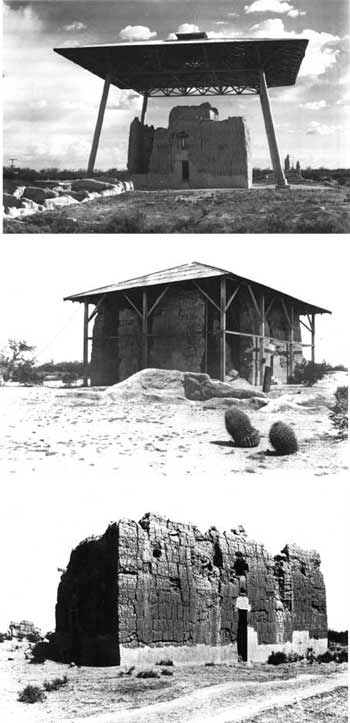
The Casa Grande Ruins were constructed in somewhere between AD 1200-1450 by the Hohokam Phoenix, Arizona, and represent a great collision in modernity and tradition. One of the most apparent restoration efforts was made in 1903 when S. J. Holsinger designed a covering for the ruins. The cover was a large galvanized, corrugated iron roof with a six foot overhang supported by 10″X10″ redwood posts embedded into the ground (middle image). The entire structure was then anchored to the ground by cables attached to each corner of the structure. In 1932 Congress appropriated funds to construct a new shelter over the ruins to protect them. The old iron roof, painted red to protect it, had deteriorated severely. In 1928, Frederick Law Olmsted Jr. who was acting as an adviser to the National Park Service, sketched a design for a new roof. “The thought at the time, however, was that a design competition should be held for the roof.” In 1932 the final Olmsted Jr. design (top image) was realized. The hip roof supported by leaning posts was consistent with Olmsted’s design and the tensile roof structure incorporated glass skylights. Completed on December 12, 1932, the structure stands forty-six feet from the ground to the eaves and was painted sage green to harmonize with the mountains and vegetation as well as provide contrast to the ruin. Images courtesy of the National Park Service.
Cob House in South Carolina
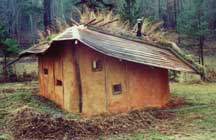
The builders, Jacques Abelman, Nik Bertulis and Aysha Massel , were pushing two extremes of tradition construction and materials in an experimental project to assemble and build a fully living structure in Seneca, South Carolina.
Rammed Earth Sculpture
“Invisible Operations”, by Karen McCoy is comprised of twenty-eight rammed earth geometric solids ranging in size from 1′ x 1′ x 1′ blocks to a 6.5′ x 2′ x 6′ wall and are situated within a grid at the South Carolina Botanical Gardens.
Rural Studio
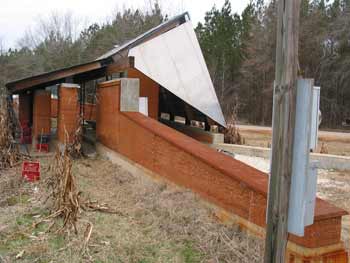
The Rural Studio has built several works of rammed-earth architecture including the Mason’s Bend Community Center (above), and the Sanders-Dudley House.
WPA Earth Buildings
It is often forgotten that when the United States was dealing with the economic depression of the 1930’s, the federal government sponsored adobe home-building project in several locations across the country. One outstanding example was at Bosque Farms, a small farming community a few miles south of Albuquerque, New Mexico. The community was established to help relocate farm families devastated by the droughts that created the “Great Dust Bowl” of northern New Mexico, west Texas and Oklahoma. The government acceptance of earth building techniques during the Great Depression years of the 1930’s was also seen in Gardendale, Alabama, where a homestead program was instituted.
Occupation
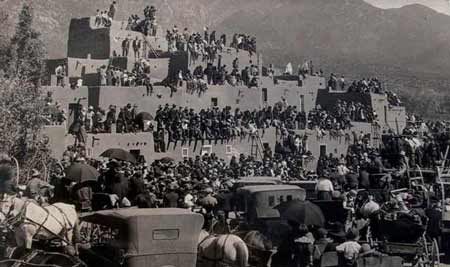
Throngs of anglo visitors overtake the Native American village of Taos Pueblo. One can only speculate the outcome of a reversed scenario.
Historic Albuquerque
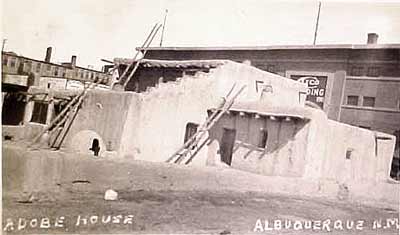
Adobe house in Albuquerque, circa 1926.
San Felipe Pueblo
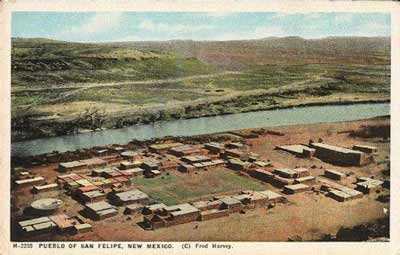
This postcard is captioned PUEBLO OF SAN FELIPE, NEW MEXICO. The back reads, The Pueblo lies on the east bank of the Rio Grande, about three miles from Bernalillo, and may be seen from the car windows en route to Albuquerque. The population is about 600. The church is one of the sights of the pueblo, having two towers and a large yard, the whole being enclosed with a high arched adobe wall. there is also the ever present Estufa or sacred meeting place where the chiefs congregate at times. The pueblo Indian while maintaining the mission churches still preserves many of the tribal customs. Circa 1915-1929
ADOBE CONFERENCE MAY 16 AND 17
The Adobe Association of the Southwest
Northern New Mexico Community College
El Rito Campus in its wonderful old adobe buildings
Friday 16th Dinner/ Reunion and Plenary Session/Keynote Presentations/Dedications
Saturday 17th Presentations/Poster Sessions/Meals Continue reading “ADOBE CONFERENCE MAY 16 AND 17”