Habitat Cabo Delgado

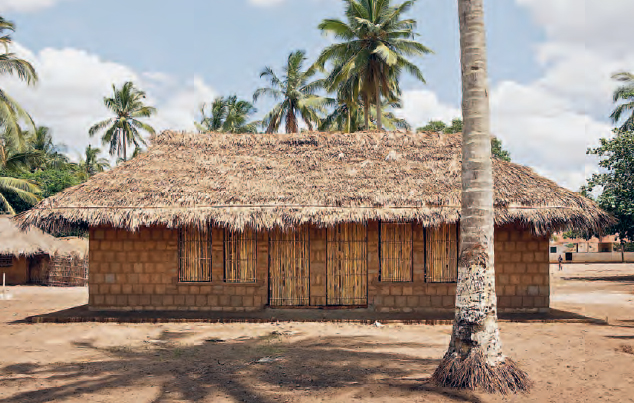
Habitat Cabo Delgado, constructed in Mozambique by Ziegert | Roswag | Seiler Architekten Ingenieure and the Aga Khan Foundation, was founded for the purpose of create more permanent housing solutions using local, natural building materials. Local construction methods were developed and improved upon in ways tailored to local craftsmens’ abilities; thus supporting the local construction culture and reinforcing village identity.
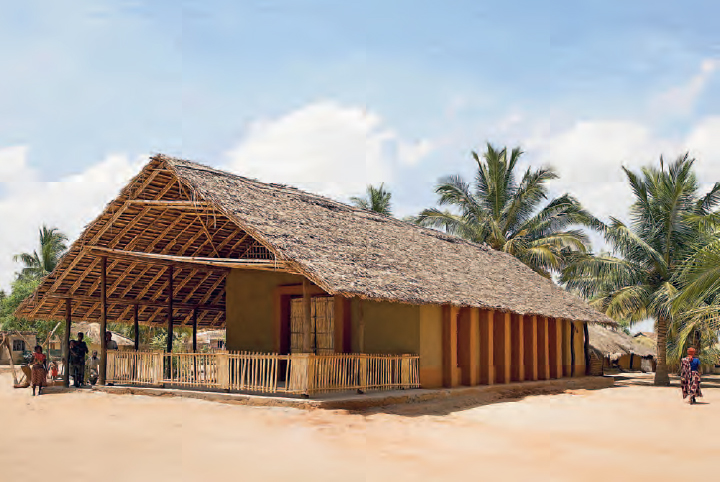
In the first phase of the project, eleven multipurpose learning centres were built to showcase the new construction methods. To facilitate the implementation and dissemination of these techniques, a total of forty local apprentices were trained in ecological building methods – skills they could later use to support themselves financially. As models of low-cost, high-quality, sustainable construction, the learning centres were designed to inspire others to imitate the new style.
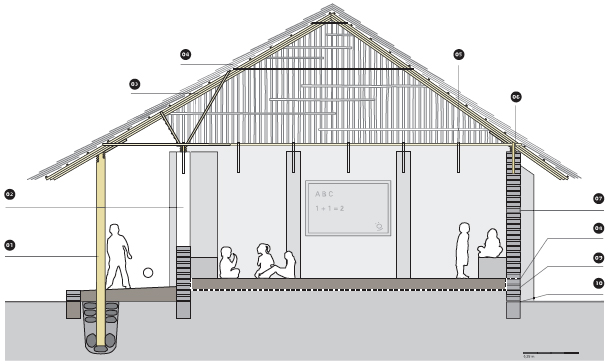
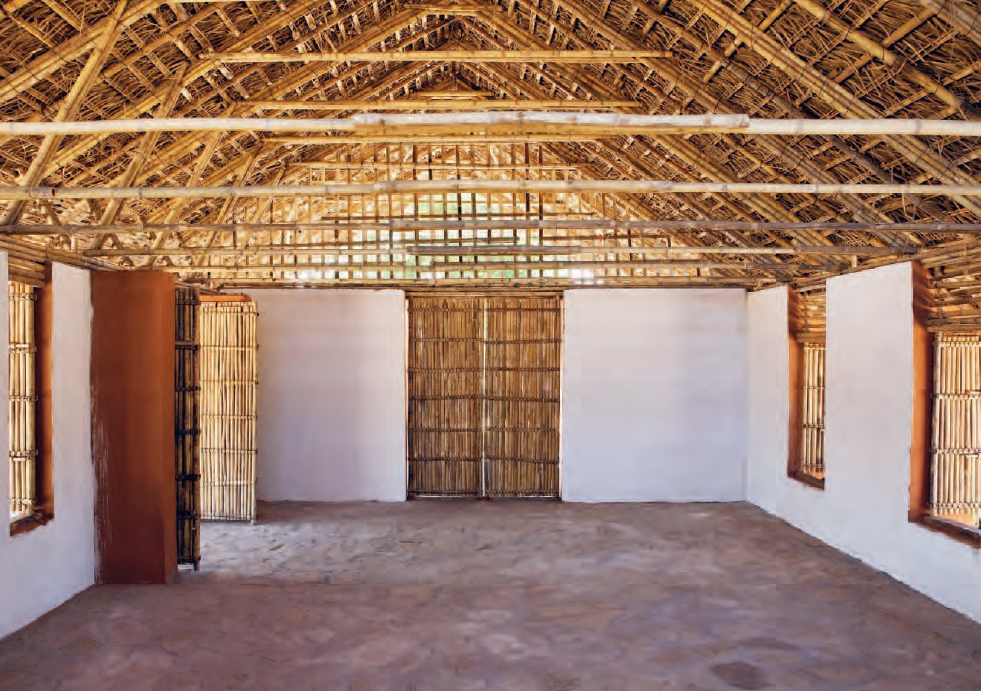
The traditional “wattle and daub” technique has been replaced with an earth-block construction method. The new buildings’ rammed-earth and earth-block foundations are stabilised with 10% cement and covered with a moisture barrier to protect them from rain and rising damp. The earth blocks used to construct the walls are stabilised through the addition of straw.

An easy-to-produce triple-layered bamboo beam has been developed for use in roof constructions; the beam is used for nearly all parts of the roof such as ring beams, purlins and triangle trusses. The prefabricated trusses have a span of 6m, enabling the construction of open-plan multipurpose buildings. The bamboo is treated with borax, a natural salt, in order to prevent damage by termites or other insects. Several different traditional palm-leaf roofing techniques are used to construct the roofs. Because locally-available resources like earth, bamboo and leaves are used as building materials, each school displays the colours of its region.
FRANÇOIS COINTERAUX (1740-1830): PIONEER OF MODERN EARTHEN ARCHITECTURE

CALL FOR PAPERS
FRANÇOIS COINTERAUX (1740-1830), PIONEER OF MODERN EARTHEN ARCHITECTURE: Theory, Teaching and Dissemination of a Vernacular Technique, International Conference, Lyons, 10-12 May 2012

Organized by the Laboratoire de Recherche Historique Rhône-Alpes (LARHRA, UMR-CNRS 5190) and the Institut National d’Histoire de l’Art

From 1785 onwards, the builder and master mason François Cointeraux actively promoted a construction technique of vernacular origin, known as pisé de terre (or ‘rammed earth’), which was at that time confined to southeast France. His cahiers or fascicules from the Ecole d’architecture rurale (School of Rural Architecture), published in Paris in 1790-91, were rapidly translated into seven languages (German, Russian, Danish, English, Finnish, Italian and Portuguese). They attracted the attention of major architects such as Henry Holland (1745-1806) in England, Thomas Jefferson (1743-1826) in America, David Gilly (1748-1808) in Germany and Nicolaï L’vov (1751-1803) in Russia, founder of a flourishing school of earthen architecture in Tiukhili near Moscow, based on Cointeraux’s school of the Colisée in Paris. Through his publications, Cointeraux generated an almost universal interest for this material, as cheap as it was abundant, and encouraged its adaptation to rural or residential architecture.

This success can largely be explained by a desire to revive rural architecture, which was in perfect harmony with both the physiocrats’ line of thought and the actions of agricultural societies. However, Cointeraux never managed to popularise its use widely and lastingly in France. His numerous publications did not achieve their expected uptake with the institutions concerned. He is nonetheless representative of a culture of invention and innovation, highly characteristic of the first industrial revolution and the birth of modern architecture. The aim of the conference is to present a synthesis of the extensive research carried out on François Cointeraux over the course of the last twenty years and to re-situate his work in the wider context of the evolution of ideas and techniques.

Organization
Laurent Baridon, Université Lyon II, LARHRA (UMR 5190), Louis Cellauro, LARHRA, Jean-Philippe Garric, INHA / AUSSER, Gilbert Richaud, LARHRA Advisory board: Hubert Guillaud, Énsa de Grenoble / CRA-Terre, Miles Lewis, Faculty of Architecture, Melbourne University, Claude Mignot, Paris-IV / Centre André Chastel, Liliane Pérez-Hilaire, Centre d’Histoire des Techniques et de l’Environnement du CNAM, Antoine Picon, Harvard School of Design, LATTS

Submission procedures
Proposals (title, abstract of maximum one page, short CV) should be sent to the organizers at the following address: cointeraux.2012@orange.fr Or: Laurent Baridon, LARHRA, Institut des Sciences de l’Homme, 14 avenue Berthelot, F-69363 Lyon Cedex 07, France

The deadline for submissions is July 31, 2011. Results of the selection will be communicated to the authors one month later. The proceedings of the conference will be published in 2013.

RESTAPIA 2012: International Conference on Rammed Earth

RESTAPIA 2012 is an international congress on rammed earth, its conservation and, in general terms, on earthen constructive techniques and its conservation. It will take place on June 21st,22nd, 23rd 2012 at Valencia. This meeting aims to incentive sharing the restoration experiences of both monumental and non monumental architectural heritage made in the Iberian Peninsula and the rest of the world in order to learn from all these interventions and derive conclusions and perspectives for the future. Thus, it aims to represent an important milestone at international level in the reflection about the conservation and restoration of rammed earth architecture and earthen architecture in general.

The program of RESTAPIA 2012 includes keynote lectures given by international experts on the topic and the presentation of papers and posters during June 21st and 22nd 2012, and an added day of technical visits on June 23rd 2012.

Saint Bartholomew’s Chapel


Photography: ©Harrison Photography

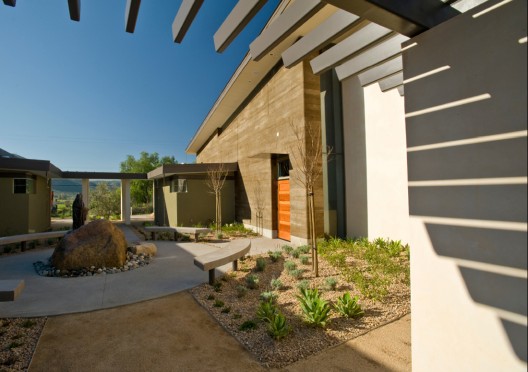
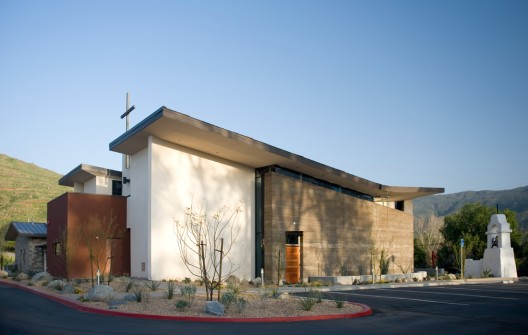
Saint Bartholomew’s Chapel, designed by Kevin deFreitas Architects, was constructed to replace a very small and intimate historic chapel that was ravaged by wildfires in 2007. From that fire, only the original adobe bell tower survived, which became the anchor element in the redesign planning.


Photography: ©Harrison Photography
The new design was conceived to reverently knit together “past” and comfortable traditions, while acknowledging and offering something relevant to current and future generations. Thus, emulating or recreating the past literally was not a project goal. Drawing from a limitless well of Native American and Catholic symbols and metaphors, design elements in plan, section, and elevation were conceived to reference and infuse meaning into the chapel, such as the; rammed earth walls, radial walls, butterfly roof, and extensive use of locally sourced materials.

[ via: archdaily.com ]

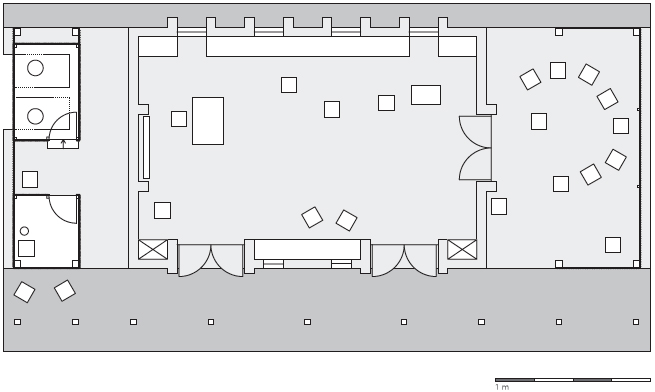
Cinema Sil Plaz


Photography: Bruno Augsburger and Laura Egger

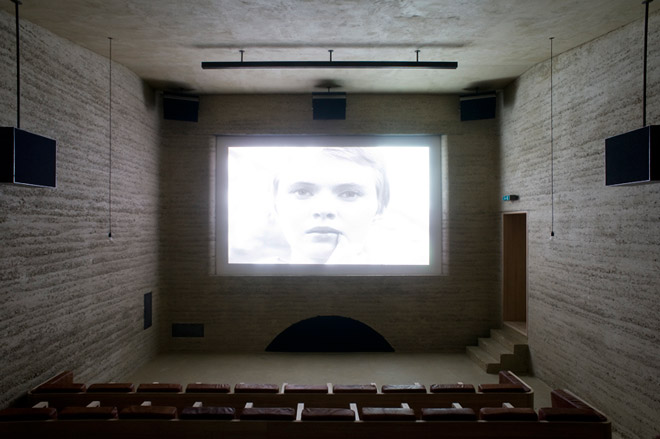
Over two decades ago, the last cinema closed in Ilanz, an Alpine town in the Swiss canton of Graubünden. To satisfy the locals’ cinephile needs, a group of people interested in film and culture formed the Filmclub Ilanz in 1989 and, after staging screenings in makeshift locations (including the town hall), they had a stroke of luck in 2004 in the shape of a 19th century former forge, which had just become vacant. After several years of screenings, they decided to revamp the space, with the help of fellow club members Capaul & Blumenthal Architects, and in collaboration with Lehm  Ton Erde create a fully fledged cinema, which opened in 2010

The ETH Zurich graduates have retained the raw character of the building, creating a cosy screening room and bar on a shoestring. Using local clay and a rammed earth construction method – a sustainable, low-tech building technique with sound-proofing benefits – the project was completed with the help of members of the Filmclub, who also conveniently included a rammed-earth specialist and a stonemason. Seating in the auditorium is padded by sheep-skin covered cushions stuffed by Filmclub members. Meanwhile, paint on the walls of the bar and stage area has been stripped back to reveal the original lime plasterwork of the building and floors are kept bare. The bar itself can be lifted by a manual forklift to make space for a dance floor when there are concerts – just one part of the Cinema Sil Plaz’s rich programme of events.

[via Wallpaper]

The Hinterland House

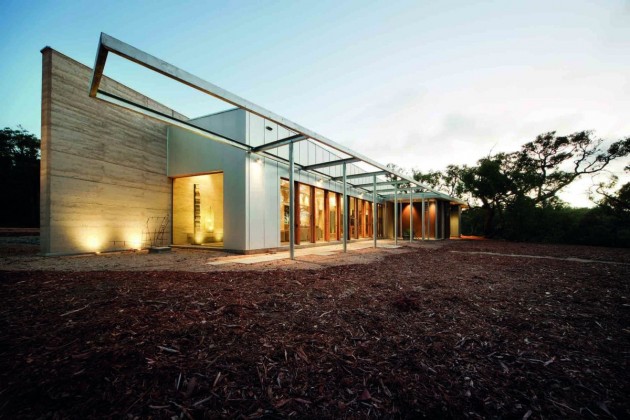
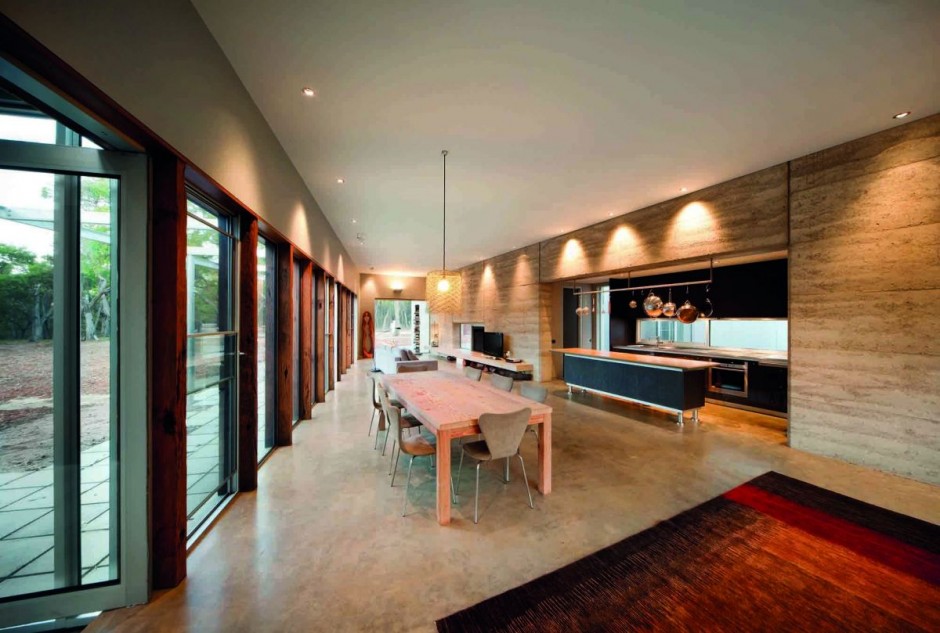
The Hinterland House by http://www.morrispartnership.com.au/ is a rammed earth house designed to be in harmony with the Australian bush. No fences, screens or garden areas were incorporated to insure as little disturbance as possible to surrounding inhabitants. The local animal and plant life can continue to roam as freely as before the structure was built.

Along with rammed earth, the material palette includes spotted gum, rough recycled timber, concrete floors, corten steel and zincalume. Building environmental features include the earthen thermal mass, double glazing, shading and cross ventilation that mitigates against the need for air conditioning. Sustainability solutions include the use of worm farm waste treatment, solar heating and hot water, and the cellar pantry drawing cooled air through an underground chamber.

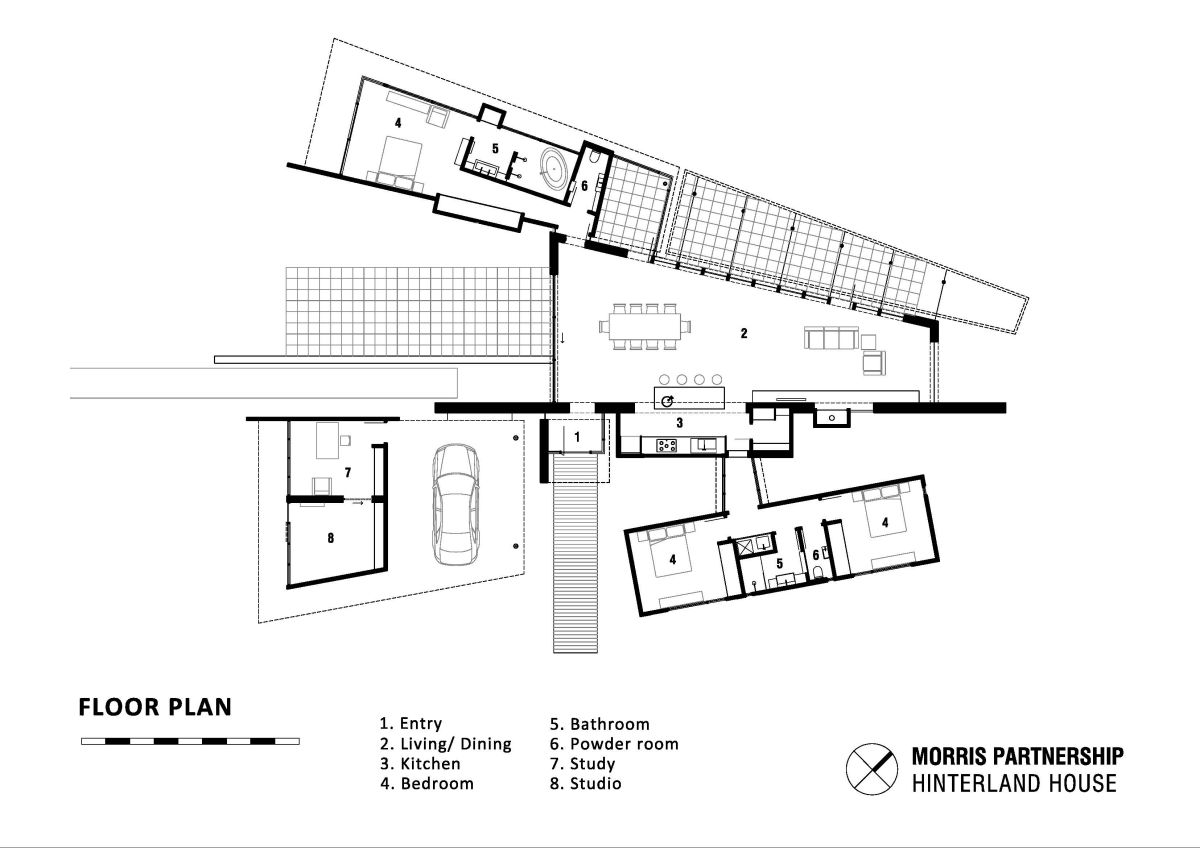
The Hinterland House program includes:

· Living/dining/kitchen core
· Clients’ separate bedroom suite
· Separate studio & study
· Separate guest accommodation

Alderney Stones

A new site-specific installation of works by Andy Goldsworthy opened on the island of Alderney, located in the Bailiwick of Guernsey in the English Channel Islands. Alderney Stones consists of an installation of 11 boulders spread across the landscape of Alderney.

Goldsworthy formed each 3-ton boulder from a mold of rammed earth and other materials sourced from the island, such as berries, seeds, old tools and discarded gloves.

Set in varying degrees of exposure to the elements, the stones will eventually erode, revealing the elements concealed inside, and ultimately return to the land from which they came.

Dwelling in Beja

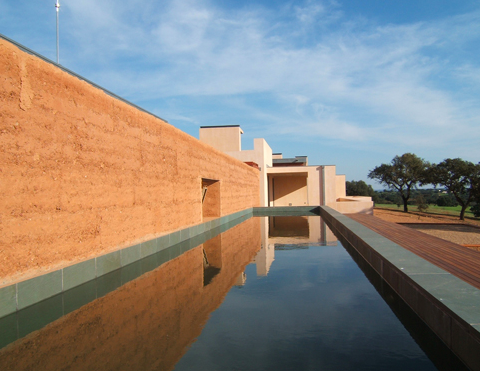
The Dwelling in Beja is a single-family dwelling built of rammed earth and a mixed structure of reinforced concrete and wood with zinc coping. Self-levelling floors of craftwork brick tiles, wood. Traditional render of aerated lime paste and whitewash with the addition of natural pigments. Betão e Taipa was responsible for the entire construction.

Building Stats
Building area 550 m2
Volume of rammed earth 260 m3
Location Beja municipality
Designed by Bartolomeu Costa Cabral, João Gomes and Mário Anselmo Crespo
Date built 2006

International Rammed Earth Workshop

On the 7th, 8th & 9th April, 2011 again is a time when we would expect you all to participate in ‘International Rammed Earth Workshop’. Austrian resident DI Hanno Burtscher has been especially invited to pass on his knowledge of rammed earth. You can read more about him, the modules and topic at www.prithwe.com There would be different approach to earth as building material, all the people associated with building material, architects and engineers, nature enthusiasts, clay&ceramic designers, interior designers, permaculture/organic farmers & all others who love nature must come forward and utilize this opportunity to know the mother earth

Other important details:
Workshop Venue: 1 Middle Road, off Napier Road, camp, Pune
Timing: 9am to 5pm
Course Fee: Rs 5999/- 140USD for all 3 days.
Breakfast & Lunch included..

Please write to us for more details. ( visa and staying facility for international & outstation candidates can be organized separately on request)

Regards,
Bharti ( prithwe@hotmail.com)
Prithwe Institute of Building Biology & Ecology
Tel.: 020-26354487 / 020-26343566
www.prithwe.com

US/China Workshop on Earth Based Materials and Sustainable Structures & Forum on Hakka Rammed Earth Buildings (Tulou)’ 2011

The West Virginia University Constructed Facilities Center, Morgantown, West Virginia, USA and Xiamen University Department of Civil Engineering, Xiamen, Fujian, China, in conjunction with the International Symposium on Innovation & Sustainability of Structures in Civil Engineering (ISISS’2011), is pleased to host the US/China Workshop on Earth Based Materials and Sustainable Structures & Forum on Hakka Rammed Earth Buildings (Tulou)’ 2011. The workshop will take place October 28 -30, 2011 at Xiamen University in Xiamen, China.

Thru the proposed workshop, the organizers would like to bring together researchers from the USA and China along with invited participants from Australia, Canada, Japan and UK to conduct a joint workshop at XMU on research potential of earth based materials and sustainable structures. The objectives of the proposed workshop will be: 1) to exchange success stories and lessons learned from the use of rammed earth as a structural material and construction technique for sustainable structures, including review of current rammed earth construction specifications and standards, 2) to address challenges and strategies for advancing the use of earth based structural materials in modern construction, 3) to establish a network of professionals to catalyze collaborative research, development and implementation including international partnerships, and 4) to develop joint R&D programs with emphasis on utilization of rammed earth material in modern construction by minimizing embodied energy. In addition, the workshop participants will have opportunity to witness the sustainability of World Heritage Hakka (ancient) village in-service and learn a few exemplary lessons potentially leading to modifications in contemporary construction techniques.

For more information on the worshop and forum events visit http://www2.cemr.wvu.edu/~rliang/ihta/forum2011.htm. More information on the International Hakka Tulou Alliance (IHTA) can be found by visiting http://www2.cemr.wvu.edu/~rliang/ihta.htm. Additional information can be obtained by contacting the Workshop Organizer: Dr. Ruifeng (Ray) Liang, rliang@mail.wvu.edu, (304) 293 9348