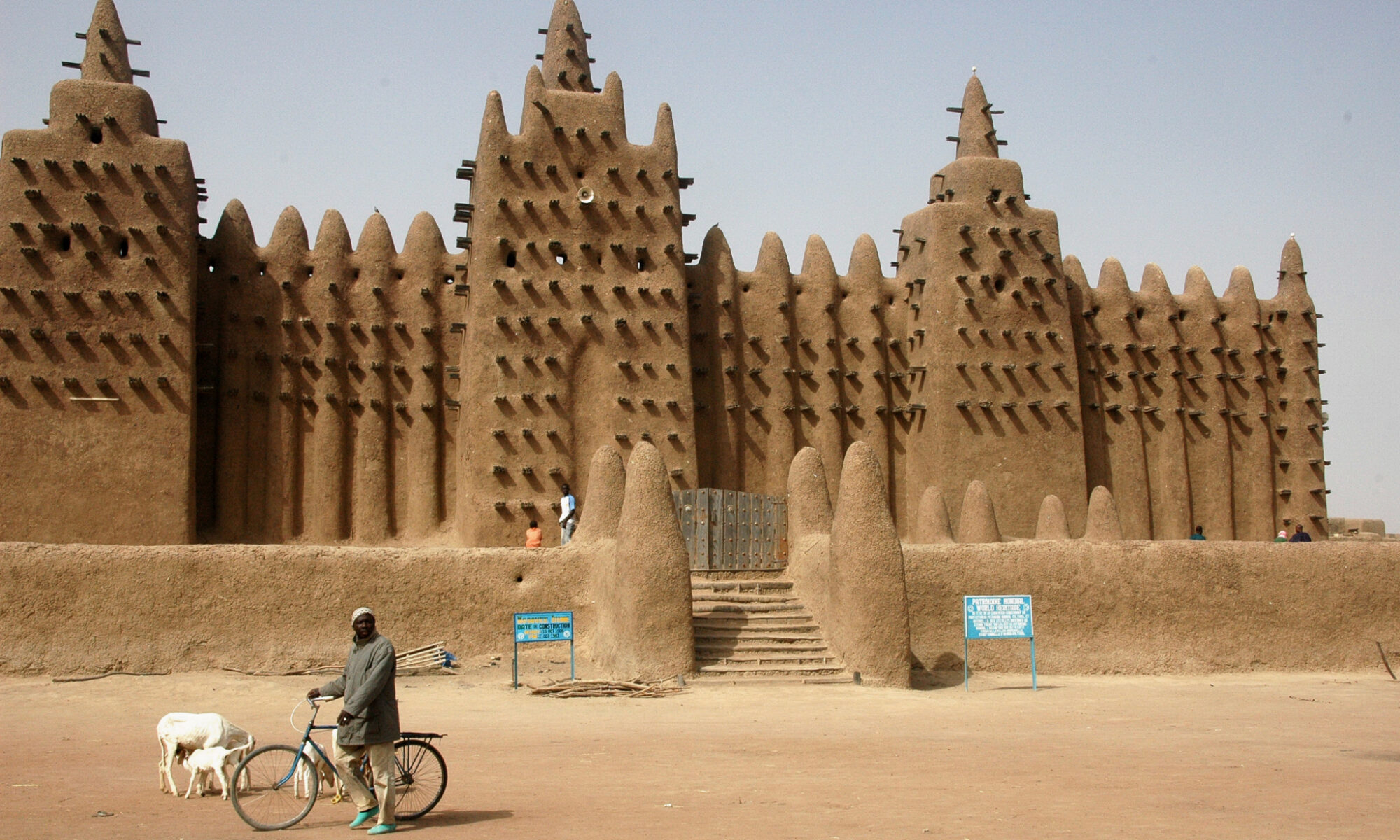
In collaboration with Ramboll UK, the Department of Civil, Environmental & Geomatic Engineering at the University College London has funding from the Engineering and Physical Sciences Research Council for an EngD studentship (4 year programme) for the following project: INNOVATIVE CONCEPTS FOR SEISMICALLY RESISTANT MUD BRICK CONSTRUCTION. Click here to download the project description.
Sandcastles Hold Key to Rammed Earth Strength
The secret of a successful sandcastle could aid the revival of an ancient eco-friendly building technique, according to research led by Durham University. Researchers, led by experts at Durham’s School of Engineering, have carried out a study into the strength of rammed earth, which is growing in popularity as a sustainable building method.
Earth Architecture on the Front Range of Colorado
Front Range Earth Architecture: Why and Why Not?, written by Michael Shernick, is a paper that looks at the history and viability of earth architecture on Colorado’s Front Range. Click here to download the paper in PDF format.
Andy Goldsworthy on Alderney Island

Photo: Jacob Ehrenberg, Copyright © 2009 National Gallery of Art, Washington D.C.
British artist, Andy Goldsworthy, is planning to produce a work using 4 to 5ft (1.2 to 1.5m) “stones” made from objects embedded in rammed earth. The stones will eventually disintegrate to reveal whatever material he decides to leave inside each one. Each stone will be made with earth containing materials and objects. These will be incorporated into each stone as it is being constructed and might be rocks, branches, bones, tools, seeds, clothes, beach debris or anything else.
The project is reminiscent of Smiljan Radic’s Casa del Carbonero. This is not Goldsworthy’s first foray into earth art. His project, Clay Wall, is a large clay plastered wall that uses human hair from his home village as a binder.
Renovations and Repairs at Church of the Holy Cross
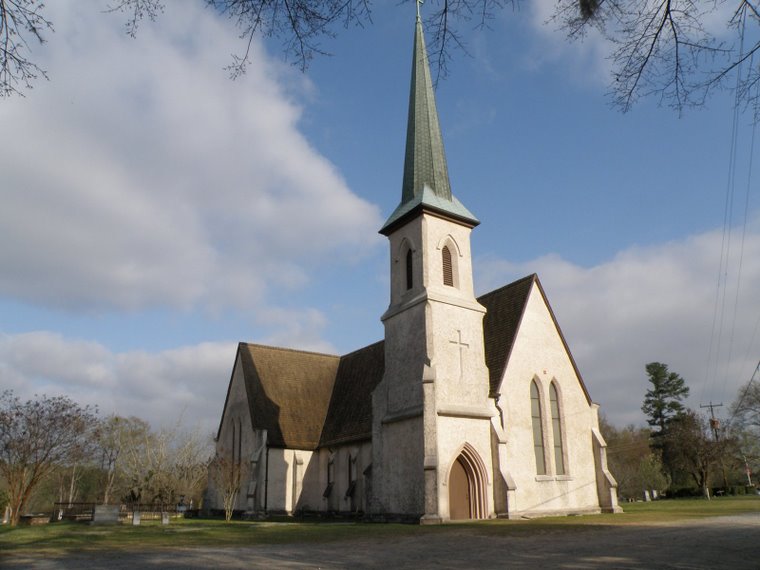
Church of the Holy Cross
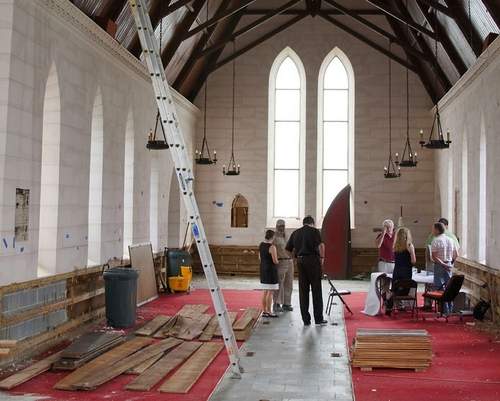
Interior
After years of waiting, the historic rammed earth Episcopal Church of the Holy Cross in Stateburg is ready to begin renovations. The church, built between 1850 and 1852, was declared a national landmark in 1978. The building is of particular historic significance because of its “unusual construction of rammed earth known as pise de terre.”
Kashgar: The End of a Mud Brick City
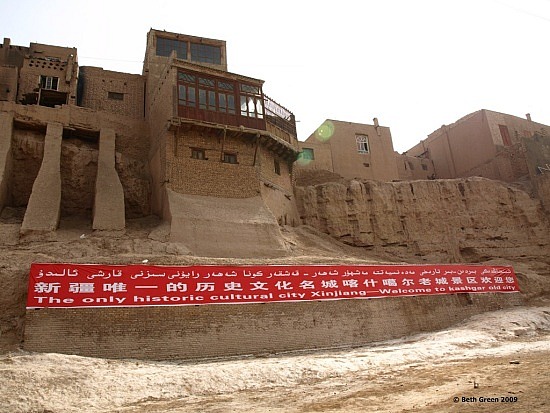
An old way of life is coming to a crashing end in north-western China with two-thirds of Kashgar’s Old City being bulldozed over the past few weeks under a government plan to “modernise” the area. Nine hundred families already have been moved from Kashgar’s Old City, “the best-preserved example of a traditional Islamic city to be found anywhere in central Asia,” as the architect and historian George Michell wrote in the 2008 book “Kashgar: Oasis City on China’s Old Silk Road.” Over the next few years, city officials say, they will demolish at least 85 percent of this warren of picturesque, if run-down homes and shops. Many of its 13,000 families, Muslims from a Turkic ethnic group called the Uighurs (pronounced WEE-gurs), will be moved.
Israel Siege on Gaza Leads to Mud Brick House
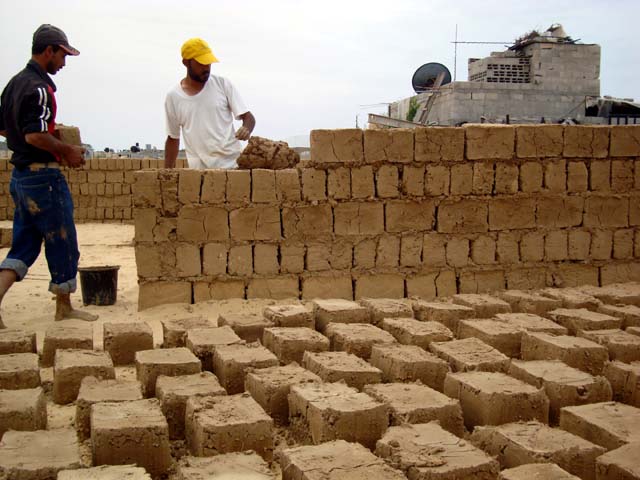
Building earthen structures like bread ovens and small animal pens is a technique many Palestinians are familiar with, but extending the method to houses isn’t a notion that has taken hold in Gaza. But Jihad el-Shaar, who lived with his wife and four daughters with extended family wanted to build a home of their own. After waiting for two years, it was apparent that the siege would make cement unavailable so he decided to build his house of mud.
The Adobe Alliance Featured in Mother Earth News
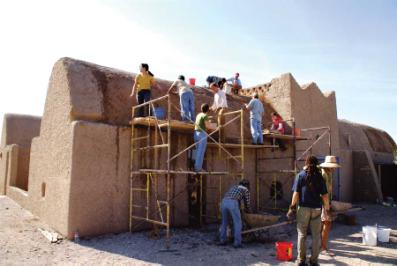
Photo by Yasmina Rossi.
“The allure of elegant earthen architecture can be life-changing. At least that was the case for urbane New Yorker Simone Swan, who in the 1970s became fascinated with the ideas and designs of renowned Egyptian architect Hassan Fathy. Then the 40-something executive head of the Houston-based Menil Foundation, Swan moved to Cairo to study with Fathy. She became his most passionate advocate, and transplanted his adobe building techniques to the Southwestern United States.”
Jahili Fort in Al Ain Abu Dhabi
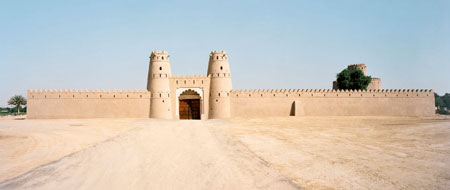
Historically, the daily life of the inhabitants of Al Ain, today the second largest city in the Emirate of Abu Dhabi, took place in the palm gardens of the oasis and the surrounding settlements and markets. To protect the oases, watchtowers and forts were erected. The Jahili Fort located in the modern-day centre of the city is the largest of Al Ain’s forts. Built in the 19th century by Sheikh Zayed the First, it can be seen from the Al Ain oasis to the west of the city. With its distinct three-tiered profile, the fort is now a national monument, pictured on the 50 Dirham note and often used as a logo or model for new architecture. The old fort was erected at the end of the 19th century.
The fort was recently restored by Roswag & Jankowski Architekten, Berlin.

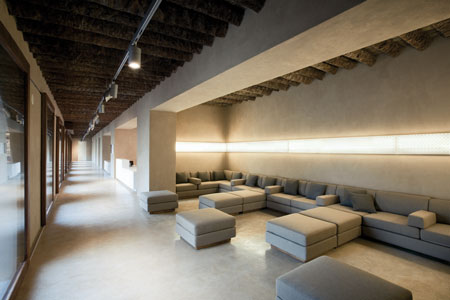
The interior surfaces remain true to the historical appearance. The ceiling consists of palm rafters and palm leaves. A local clay plaster has been used for the interior wall surfaces. In the exhibition areas a grey coloured fine clay finishing plaster made by Claytec was used to create a neutral background for the exhibition spaces. The floors likewise follow historical precedence and are made of rammed earth stabilised with a wax to cope with greater wear and tear.
All new insertions such as doors and furniture, made of corian or wood composite, are coloured white differentiating them from the surrounding building. The external render of the existing walls was examined and repaired where necessary. Previous renovation works had employed a non-traditional plaster with added gypsum for the crenelations. This plaster is too rigid and already exhibited defects; it was replaced with a clay plaster. The building was then given an overall finishing coat of clay plaster. The earth plaster is maintained at regular intervals as is traditional with this historical material. When used as an external render, clay plaster should be regarded as a weathering surface that needs ongoing maintenance, typically every two years, sometimes after sustained periods of heavy rain. Sandstorms are also a cause of erosion.
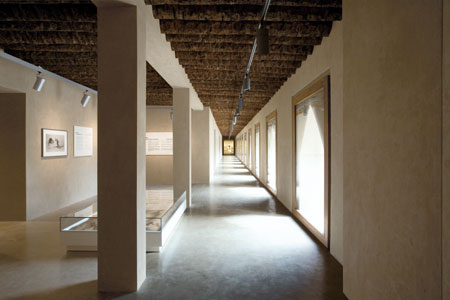
Most of the spaces will house a permanent exhibition “Mubarak bin London: Wilfried Thesiger and the Freedom of the Desert” showing photographs taken in the 1940s by the researcher and explorer Wilfried Thesiger who in the 1940s crossed the deserts of the Arabian peninsula repeatedly travelling with Bedouins and documenting what he saw with a Leica camera.
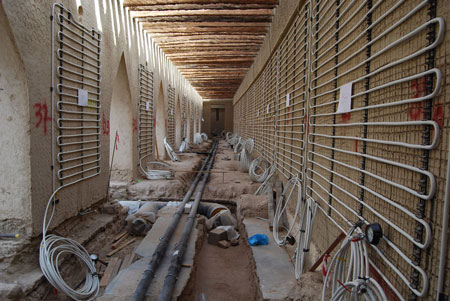
The 90 cm thick external earth walls offer excellent thermal insulation. The additional insulation on the roof improves still further the indoor room temperature and together with the solar protection windows on the façade provide effective protection against the extreme heat outdoors. The building is kept at a constant 24°C using a water-based cooling system integrated into the plaster layer of the walls. This minimizes the need for additional air cooling so that only fresh air is required. The cool indoor temperature of the walls and the reduced need for cold air makes the indoor climate more comfortable and reduces the energy consumption. An actual room temperature of 24°C equates to a felt room temperature of 22°C. The plant and technical installations for the entire fort are located below ground in the buffer zone.
The construction is made of traditionally available building materials including earth, palm products and to a lesser degree also timber. The quartered palm trunks can span a room of about 2.70 m and dictate the strongly partitioned structure of the historic buildings. The walls consist of air-dried earth blocks which can be built directly on the sandy ground without the need for foundations. A matting made of palm fronds covered with earth is laid on rafters made of split and quartered palm trunks arranged at an incline. The small amount of timber available was used for the door and window frames.
Abari Adobe Dome
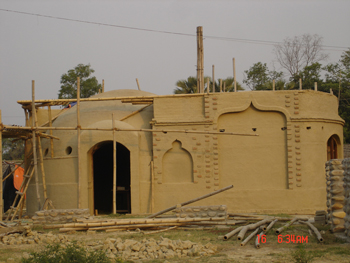
Abari, a socially and environmentally committed research,design and construction firm that examines, encourages, and celebrates the vernacular architectural tradition of Nepal. In this recent project, the dome will be covered with bamboo roof as a protection again heavy tropical rain. The adobe structure is reinforced with bamboo to make it earthquake resitant. This structure is a reception of community structure, which is also being built.