A new post on www.terracruda.com of Satrara Housing in Maritania built in 1975 by ADAUA (The African Association for the Development of Architecture and Urban planning). Italian to English translations at babelfish.
Adobe in Northern Colorado
Between 1927 and 1935, New Mexico immigrants John and Inez Rivera Romero built a four-room adobe house in Fort Collins’ Andersonville district. Romero family members continuously occupied the home until the Poudre Landmarks Foundation purchased it in 2001. Hispanic Adobe structures are rarely found as far north as Fort Collins. The Romero House signifies the necessity of combining skill, adaptability and expediency in constructing an inexpensive, yet sound, structure in a short period of time. Adobe bricks, made of sand and clay mixed with water and straw, were easily made and dried in the open air. Designated as a Fort Collins local historic landmark, the Romero House will be renovated into the Museo de las Tres Colonias and serve as an interpretative center for the contributions of the Hispanic community to northern Colorado.
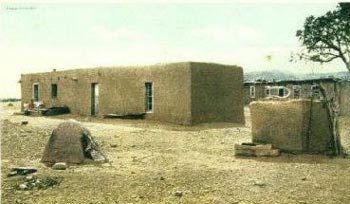
Adobe House

A typical flat-roofed New Mexican dwelling with earth plastered adobe and an earthen roof. 1906
Rammed Earth in Las Vegas
A 46,000-square-foot Desert Living Center designed by Lucchesi, Galati Architects of Las Vegas, will use earth-rammed walls that improve heating and cooling, and angled roofing that will collect rainwater for irrigation and flushing toilets.
Adobe That Survives Earthquakes
When an earthquake measuring 8.1 on the Richter Scale rocked the Andean region for over a minute in June, 2001, the southern Peruvian mountain town of Moquegua was literally shaken to pieces. But amid the rubble, three traditional adobe houses were left intact.
Earth Building in New Zealand
Graeme North looks at the history and future of earth-building in New Zealand.
Earth Architecture in Scotland
Building with Earth in Scotland by Becky Little and Tom Morton discusses techniques, history, and contains precedents of contemporary architecture.
Heikkinen-Komonen
The Kahere Eila Poultry Farming School in Koliagbe, Guinea by Finnish architects Heikkinen-Komonen utilizes wood-frame technology in combination with weight-bearing walls made from a double layer of specially developed, stabilized earth-blocks won the Aga Khan Award for Architecture 2001. More earth projects can be found in their book, Heikkinen + Komonen.
RAMMED EARTH

In Europe, Martin Rauch is regarded as one of the pioneers of modern technical and creative applications for traditional rammed earth construction. His work encompasses residential, hotel, ecclesiastical and industrial buildings, interior design and landscape design in Germany, Britain, Italy, Austria and Switzerland, including projects with Herzog & de Meuron and Schneider + Schumacher. His “Church of Reconciliation” in Berlin was the first load-bearing structure to be built with rammed earth in Germany in the last ninety years. Together with local architects Rauch constructed experimental family homes in Vorarlberg, Austria, and with Kienast Vogt & Partner, he designed a series of garden and park projects. The volume Rammed Earth: Terra Cruda by Martin Rauch and Otto Kapfinger is the definitive introduction to contemporary building with rammed earth.
Taos Fire

In the milleniua of occupation of the Taos Pueblo, this is likely not the first time that Pueblo residents sat atop their earthen structures to watch the forest burn.