Almost 100 meters of the Great Wall in Xinxing village, Zhongwei City was destroyed last month after being plundered for road building materials, according to Ningxia Daily. Ningxia Hui Autonomous Region has been called “the Great Wall Museum” because of its profusion of rammed earth sections, but it only took two nights on January 23 and 24 to wreck the Xinxing stretch.
Chinese Rural Architecture
The richly diverse vernacular architectural traditions of China are unrivaled in the world. No nation has as long an unbroken tradition and, with the dissolution of the former Soviet Union, none is as ethnically diverse. China, a nation of 56 nationalities living in disparate natural landscapes with widely varying climatic conditions, is certainly more varied in its housing patterns than is the case in single nations such as the United States or even in comparison with multi-national Europe. View a photo essay of Chinese Rural Architecture by Oliver Laude from ATLAS Magazine.
Split House
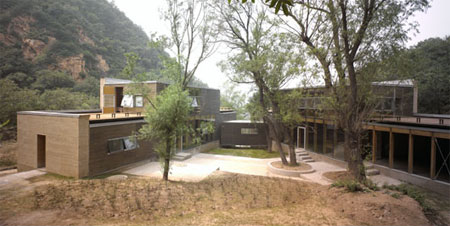
Located in the mountains of northern Beijing by the Great Wall, the Split House is designed by perhaps China’s most internationally acclaimed architect, Yung Ho Chang of Beijing’s first private architecture practice, Atelier Feichang Jianzhu. The house is split in the middle to bring in the scenery. A courtyard, or outdoor living area, is enclosed by the mountains on one side and the house, with its two split halves, on the other. The line between the natural landscape and manmade architecture is thus blurred. The angle between the two halves can be adjusted to fit the house onto various hill sites. The structure is made of laminated wood with rammed earth walls, which is well insulated with minimum environmental impact.
Chinese Hakka Architecture
Regarded by architects as the cream of Chinese traditional residential architecture, tulou, or earth buildings, first appeared about 1,200 years ago, and were mostly completed in the Ming (1368-1644) and Qing (1644-1911) dynasties. They were built and inhabited by the Hakka people – a group belonging to the Han family who can trace their ancestors back more than 1,500 years to central and north China. During the hundreds of years of migration, the Hakka people tried to maintain their own culture and way of life, keeping their own unique dialect, custom and cuisine. They built the earth complexes to guard against invasion from local bandits and to protect their children from the influence of local communities. All the families of a Hakka clan lived together in an enclosed rammed earth building.