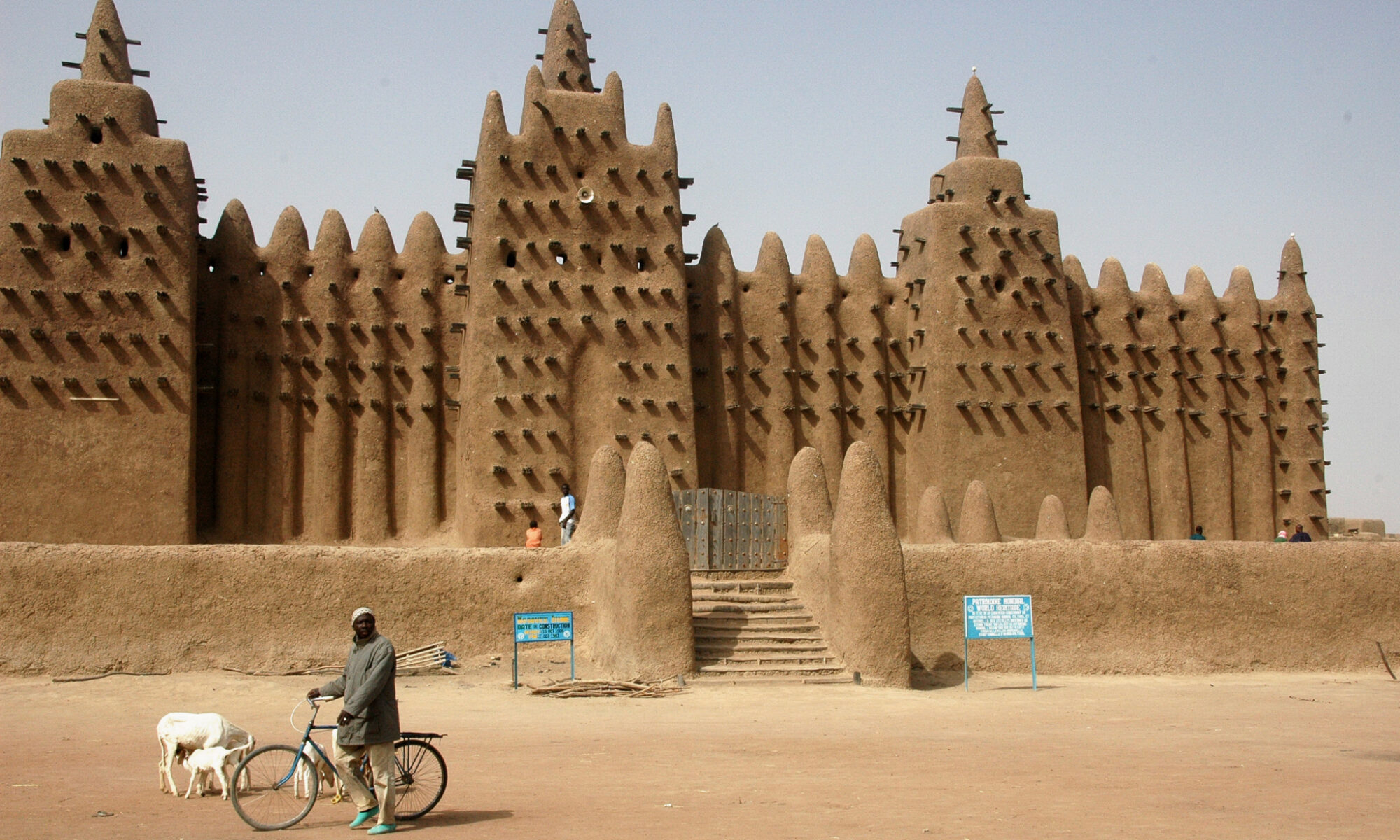
If only we could read Korean as this site seems to focus on traditional and experimental earth building techniques. You can translate the first page with babelfish but to navigate through the blog from the original page, scroll to the bottom and click the numbers. [ via ]
Rammed Earth in Fujian Province
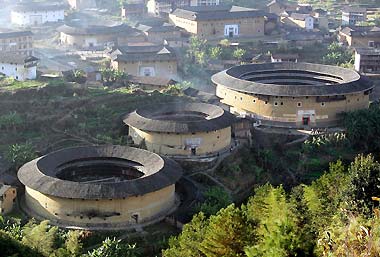
Aerial view of Earth buildings located at Chuxi Village, Xiayang town, Yongding County, in east China’s Fujian Province in this picture taken December 10, 2004. There are about 30,000 earth buildings, dating mostly from the Ming (1368-1644) and Qing (1644-1911) dynasties, in the Fujian Province, southern and eastern China.
Atelier FCJZ
Yung Ho Chang, founder of Atelier FCJZ, the first private architectural firm in China, has been part of China’s tremendous transformation. One of Chang’s most notable works is his Split House, completed in 2002. Chang’s sensibility to materials fuses the traditional with modern design by using rammed earth, an ancient method for building.
The Construction of Clan Homes in Fujian
The Construction of Clan Homes in Fujian website describes the marvelous multi-storied round dwellings of the Hakka People of China. Be sure to see the detailed drawings of these structures. [ Previously ]
Gobi Adobe
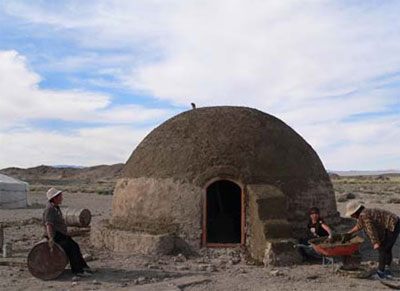
A father and son team, Basanta and Nripal Adhikary from Nepal, are reintroducing adobe in the Gobi Desert as means to provide housing in an environment where there is little timber. [ read article | construction photos ]
Great Wall of China Plundered for Road Paving
Almost 100 meters of the Great Wall in Xinxing village, Zhongwei City was destroyed last month after being plundered for road building materials, according to Ningxia Daily. Ningxia Hui Autonomous Region has been called “the Great Wall Museum” because of its profusion of rammed earth sections, but it only took two nights on January 23 and 24 to wreck the Xinxing stretch.
Living in Earthen Cities – kerpic’05 Cities Conference
The “Living in Earthen Cities – kerpic’05” congress is to be held at Istanbul Technical University , July 6-7 in Istanbul, Turkey. The focus of the congresses has evolved from quality of life in earthen architecture, environmental and health care, towards disaster prevention. The congress organizers hope that it will bring together the related disciplines of architects and engineers, on material, construction, marketing and environmental science, to create database, technology watch and strategy. The workshop will cover the entire construction activities of alker (gypsum stabilized earthen material), where all the participants can take part. Social and cultural program will offer interesting historical tour; distinguished dinner will welcome you on Bosphorus. Visit the Congress Website
Chinese Rural Architecture
The richly diverse vernacular architectural traditions of China are unrivaled in the world. No nation has as long an unbroken tradition and, with the dissolution of the former Soviet Union, none is as ethnically diverse. China, a nation of 56 nationalities living in disparate natural landscapes with widely varying climatic conditions, is certainly more varied in its housing patterns than is the case in single nations such as the United States or even in comparison with multi-national Europe. View a photo essay of Chinese Rural Architecture by Oliver Laude from ATLAS Magazine.
Chitra Vishwanath
Chitra Vishwanath is an architect in Bangalore, India that has been buillding interesting works of architecture with mud for the past 30 years.
Auroville Building Center
The Auroville Earth Institute (AEI) was founded by the Government of India in 1989. The AEI aims to research, develop, promote and transfer earth-based technologies, which are cost and energy effective. These technologies are disseminated through training courses, seminars, workshops, publications and consultancy within and outside India. The main expertise is with Compressed Stabilised Earth Blocks (CSEB), but they also promote manual rammed earth and other earth based technologies