The Mud Tub

The Mud Tub, by Tom Gerhardt, is an experimental organic interface that allows people to control a computer while playing in the mud. By sloshing, squishing, pulling, punching, etc, in a tub of mud (yes, wet dirt), users control games, simulators, and expressive tools; interacting with a computer in a new, completely organic, way. Born out of a motivation to close the gap between our bodies and the digital world, the Mud Tub frees the traditional computer interaction model of it’s rigidity, allowing humans to use their highly developed sense of touch, and creative thinking skills in a more natural way.

Could building architecture with mud coincide control 3D printers producing earth buildings while being powered by the mud itself?

Here, Matt Parker’s Lumarca and Tom Gerhardt’s Mud Tub join forces to make some cool interactions happen.

Watertower Skyscraper

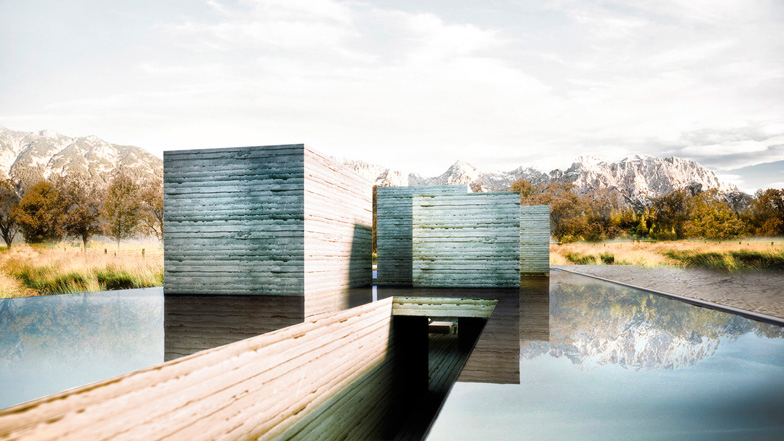
The conflict over water and land in Sudan has created political unrest for decades. However, in 2007, scientists from Boston University discovered and underground lake in the region of Darfur, Sudan. This lake is tenth biggest lake in the world (31, 000 m2) and would have great potential in resolving the conflict if managed correctly. Addressing this water issue, Polish architect Hugon Kowalski from H3AR Architect and Design recently proposed a building that allows access to underground waters through the application of water pumps. The form of the building was inspired by a water tower and also by the symbol of the African savanna—the baobab. The building houses water pumps, a treatment plant but also a hospital, a school and a food storage center. This building is meant to provoke economical development but also stimulate cultural exchange and the coexistence of the three different religions and languages in Sudan.

The building walls are constructed using compressed dry stacked clay bricks, made on site using a rough mixture of earth, cement and water. The bricks would be baked in the hot sun, thus, requiring no extra energy and limiting the environmental impact of the materials. The choice of using this technology represents the desire to introduce alternative and sustainable technologies within a context that is tied to standardized though not always optimal building practice.

Two water circulation processes would be in place. First set of extracted water is meant to heat or cool the building, and is accessible to the users. Second, set of extracted water is used for the building itself (i.e. kitchen, toilets).

More at designboom.com

MUMEMO

Mumemo is a blog about a training course carried out in Mumemo (Maputo, Mozambique) on earth construction by two Portuguese architects, Miguel Mendes and Teresa Beirao, during May and August 2006. The project was created for the inhabitants of a new village, created as a resettlement for the victims of the massive floods in the year 2000. The course gave students a wide and solid knowledge about earthen construction and three main techniques (rammed earth, adobe, compressed earth blocs) as well as provided them with the ability to direct similar courses in other communities. During the course, a small 50m2 house was built.

EarthCo Megablock™

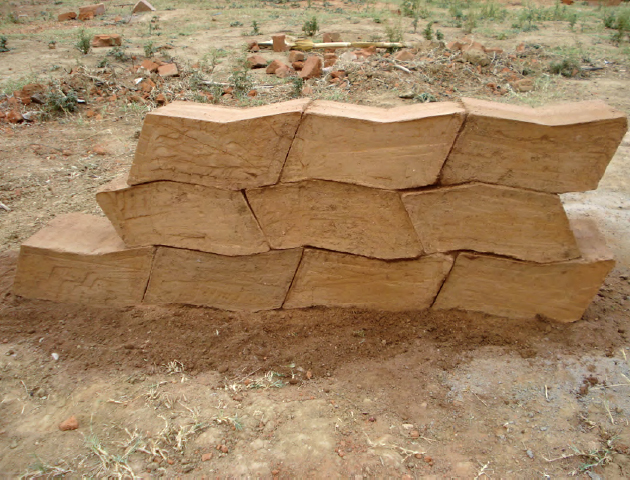
The EarthCo Megablock™ is a construction delivery system that combines onsite manufacturing with a simple and efficient mechanical placement. The system converts local soils into giant modular building blocks—a small block can measure 18” wide by 12” tall is over 14 feet long and weighs more than 1 ton.


Example of an compressed and extruded Megablock™

Earthquake Resistant Housing

Specialist earth builder, President of the Earth Building Association of Australia, and guest researcher in the Faculty of Engineering and Information Technology, Peter Hickson, has combined one the world’s most ancient building techniques, “cob” construction, with modern engineering methods to develop a model house as part of an effort to createlow cost earthquake resistant housing for millions of people around the world. Hickson’s house introduces many new technologies, but what makes his system unique structurally is the addition of internalbamboo reinforcing and the use of structural diaphragms. Read more about Hickson’s research.

Earthquake Proofing Traditional Peruvian Houses

Since 1970, Peru has been hit by five powerful and deadly earthquakes. The latest struck Peru’s coast exactly two years ago with a magnitude of 8.0 on the Richter scale. It fiercely shook the capital Lima, but its devastating epicentre was about 200km (124 miles) to the south, near the town of Pisco, a small fishing port built largely of adobe – mud bricks which Peruvians have used for thousands of years. For Peruvian engineer Marcial Blondet, it was the devastating quake in 1970 that first motivated him to develop earthquake-resistant buildings, particularly for those who could least afford them. Mr Blondet and his team found a solution in an industrial plastic mesh used by mining companies to hold back earth on slopes. It is strong, cheap and easy to use. Securely enveloping a normal mud-brick home in the mesh can prevent the walls from collapsing in an earthquake. The building wobbles but it does not fall down.

Modern Rammed Chalk


Credit: The White balance

Dan Brill Architects has designed a £50,000 extension to an Edwardian home on the outskirts of Winchester using rammed chalk. The chalk, which makes up the soil of the site was considered as it is a traditional technique in the region and because of the large amount of excavation required to accommodate the addition.


Credit: The White balance

The clients, who wanted something contemporary and innovative, appreciated rammed earth and more so the pristine appearance of the stark, white chalk walls. The material has been used in modern construction in the Pines Calyx project. It was also used in the construction of eight experimental cottages at the Department of Industrial Science and Research at Amesbury between 1919 and 1921. Construction is slated for later this year.

Oaxaca School of Plastic Arts by Mauricio Rocha

The Oaxaca School of Plastic Arts was designed by Taller de Arquitectura—Mauricio Rocha at the request of artist Francisco Toledo, in collaboration with the Benito Juárez University. An important premise incorporated into the project was the presence on the plot of land of a Mixtec ball game, used on weekends by players.

Several campus construction project occurring at the same time made available a tremendous amount of earth, inspiring Rocha to construct several of the buildings within complex out of rammed earth. This enhanced the quality of the exterior courtyards and created a comfortable micro-climate within the building optimal for Oaxaca. Other buildings are made of stone and create a series of inhabitable terraces.

Exterior courtyards suggest a floor layout in the shape of a chessboard, where the alternation between mass and space in the walkways creates a variety of views and paths.

Read more about The Oaxaca School of Plastic Arts.