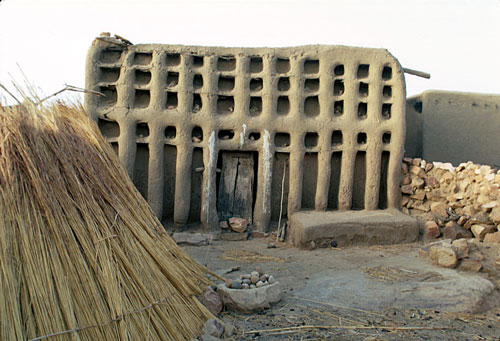
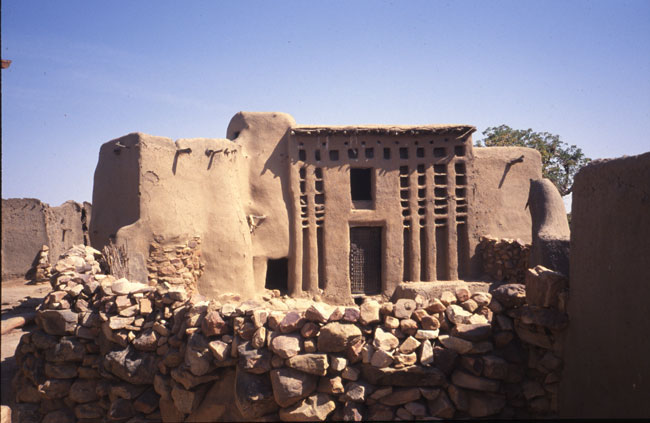
In each village in Dogon Country, Mali exists a large family dwelling, called a Ginna, that is reserved for the spiritual leader of the community. The building has a raised living area reached by a ladder carved from a tree trunk. The windowless facade is decorated with 80 niches, representing the original ancestors and their descendants. The two doors are often carved with rows of male and female figures which, like the niches, symbolize earlier generations. Inside this building, some altars and a small shrine form the focus of the clan cult. In most Dogon villages, the head of a clan lives in the gina until his death.
A curious relationship between mud brick architecture,clay and the automobile exists in two very important earthen architecture building cultures: among the Ndebele people of South Africa, whose vividly painted mud brick houses have been transposed to the automobile, and in northern New Mexico where the descendants of the Indigenous Pueblo people and Spanish colonists created a unique style of mud brick architecture from which emerged the invention of the lowrider.
Ndebele
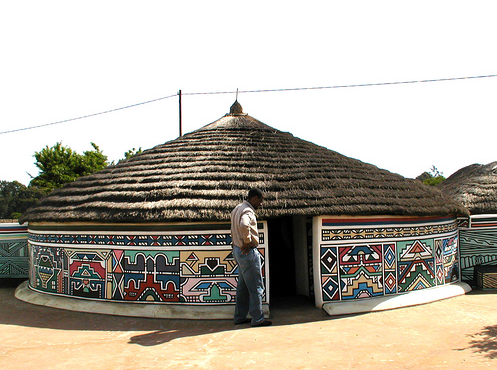
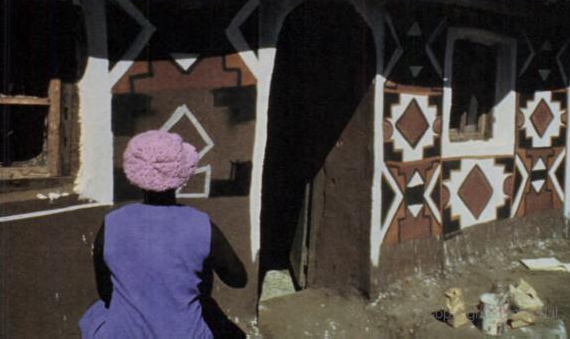
The Ndebele people of South Africa are famous for the the colorful patterns applied to the exterior of their houses, which are made of a mixture of dung, mud, and clay. Their distinctive house-painting style, originally based on a similar but less colourful style originally developed by the Northern Sotho or Pedi, flowered and achieved its creative pinnacle within the almost slave-like conditions which the Ndebele endured on the white-owned farms of the south-eastern Transvaal during the late 19th century and the first half of the 20th century.
The almost exclusively female creators of these arts have for decades been borrowing elements from the social and cultural repertoires both of their neighbours and of modern industrial society. Peter Rich writes, “The strength of Ndebele spatial models and aesthetic grammar allowed them to invest images reinterpreted from other cultures, with their own symbolic meaning. They had an affinity with the stylised art deco that was prevalent in cities such as Pretoria in the 1940s and ’50s. The changing trends in Western society, notably the American car culture of the ’50s, fashion and infatuation with images of power/electricity/jet aeroplanes, were other catalysts. ‘We see what we want to see and make it our own’, proclaims a Ndebele matriarch.”
Application of paint to earthen wall
Because of the striking designs adorning the houses, tourists drove great distances to see the Ndebele, often from as far away as Johanasburg, which was 100 miles away. According to Elizabeth Ann Schneider, the Ndebele women noticed the license plates on the cars and although they could not read them, they liked the shapes of the letters and numbers and began to paint them on their earthen walls. They mirrored the shapes of these forms to create symmetrical patterns on the front of their houses. Wavy designs known as “tire tracks” are still sometimes applied to walls and also appear on floors.
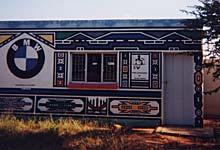
Modern “BMW” Ndebele House
‘Mural decoration is the prerogative of the woman; it denotes her unique and intimate relationship with the indlu (home) and her passive response to being exploited socially and politically,’ wrote Margaret Courtney-Clarke in Ndebele, but with the pressures of a modern era, the Ndebele women became increasingly dependent upon the automobile to find work in cities that were a good distance from their villages. This cultural shift led to the application of Ndebele motifs, which until then used the car as inspiration, to the car itself.
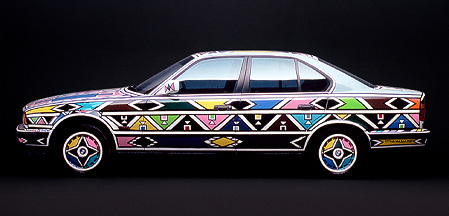
Many Ndebele women became well known for their craft and the most celebrated of these artists is Esther Nikwambi Mahlangu. Born in Middleburg in 1936, she was invited in 1989 to exhibit at the Pompidou Art Museum in Paris. In 1991, she was invited to paint a prototype of the new BMW 525i model. Esther’s car, eleventh in the Art Car Collection, was the first to be decorated by a woman artist and as a black woman artist from a little-known South African community to be included in a prestigious international artistic line-up of artists including Frank Stella, Roy Lichtenstein, Andy Warhol and David Hockney made this fact all the more exceptional.
Esther Mahlangu’s Ndebele BMW
In 2008 Mahlangu was invited to paint another car—this time the new Fiat 500.
Mahlangu next to her Fiat 500
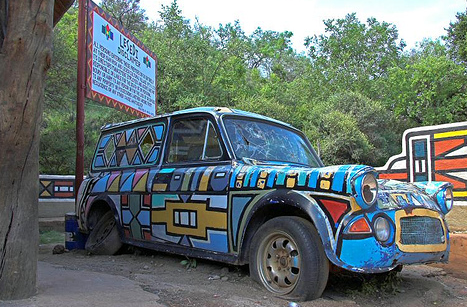
Today, calling attention to the automobile’s long relationship with the the architecture of the Ndebele, an old car, painted in this evolving tradition, joins a sign announcing the entrance to the famous mud brick village of Lesedi.
Mud brick was the principal building material Northern New Mexico from the founding of the first European colony in 1598 until the mid 20th century, and hand formed mud had been used in to construct multi-story dwellings for thousands of years prior. Industrialization, mining and the lure of jobs in cities transformed what was largely agrarian society in New Mexico into a society increasingly dependent upon the automobile to travel the great distances from the isolated villages to cities and the mines in central Colorado.
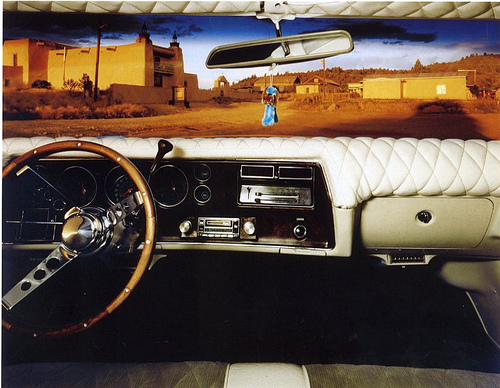
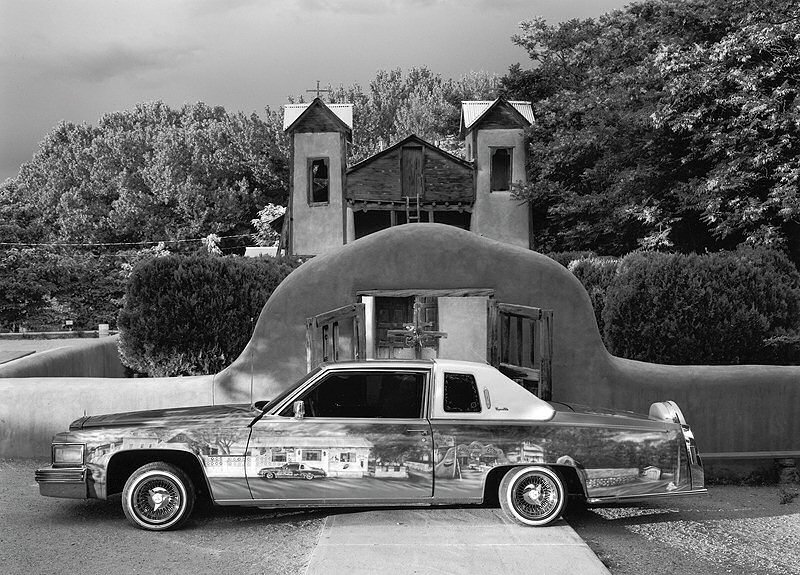
From the desire to bring with them a piece of home from a landscape in which the people were deeply rooted, emerged the lowrider—a chapel on wheels that evoked the essence of the ancient baroque mud brick churches that were at the center of village life.
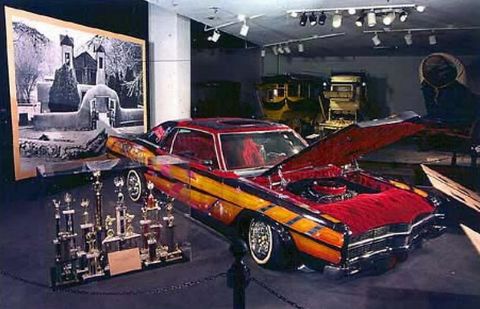
Dave’s Dream as displayed in the Smithsonian Museum’s former Road Transportation hall, with photomural of the El Santuario de Chimayo, and an assembly of trophies won by this lowrider automobile. Photo by Jeff Tinsley, Negative #: 95-3340
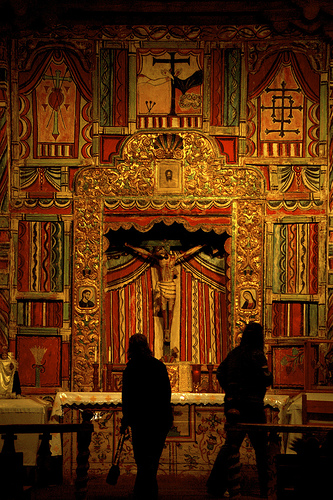
The altar of El Santuario de Chimayo whose color scheme and ornamentation could be seen as influential to “Dave’s Dream”
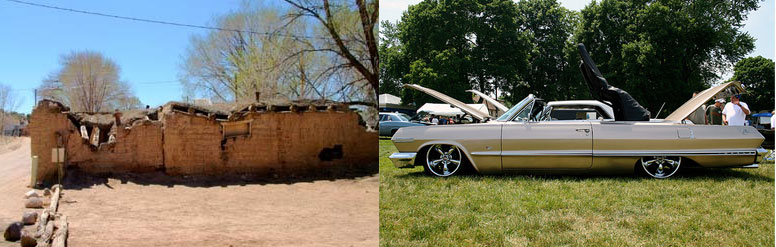
The long lines of automobiles produced in the 40’s, 50’s, 60’s and 70’s were reminicent of the longcorrieras—adobe houses that were composed of several branches of a single family constructed through a series continuous additions as the family grew. The interiors and/or exteriors of the car were often lavishly ornamented, reminiscent of the baroque ornamentation found in the mud brick interiors.
Ruin of a corriera house in San Idelfono, New Mexico and a 1963 Impela.
Low-rider Cadillac named “Chimayo,” Chimayo, New Mexico, 1997 by Craig Varjabedian
Today, the mud brick village of Chimayo, New Mexico is considered the spiritual center of the lowrider world and nearby Española, New Mexico is considered the lowrider capital of the world. Today lowrider culture has become a global phenomena, but the ornate vehicles and over-zealous use of hydraulics that tilts the automobiles into torqued positions still recall the leaning ancient mud brick structures of northern New Mexico.
And while lowriding has become a serious artform and mud brick architecture has roots in the sacred, the combination of adobe architecture and the automobile has also been poked fun at in popular culture as evidenced by the adobe car, featured in a Saturday Night Live “fake commercial“, a transcript of which appears below:
Spokesman: These days, everyone’s talking about the Hyundai, and the Yugo. Both nice cars, if you’ve got $3,000 or $4,000 to throw around. But, for those of us whose name doesn’t happen to be Rockefeller, finally there’s some good news – a car with a sticker price of $179. That’s right, $179. The name of the car?
Adobe. The sassy new Mexican import that’s made out of clay. German engineering and Mexican know-how helped create the first car to break the $200 barrier. At this price, you might not expect more than reliable transportation – but, brother, you get it! Extra features: like the custom contour seats, or the beverage-gripping dash. And the money you save isn’t exactly small change!
Jingle:
“Hey, hey, we’re Adobe!
The little car that’s made out of clay!
We’re gonna save you some money
that you can spend in some other way!
Hey, hey, we’re Adobe!
Hey, hey, we’re Adobe!
Adobe!”
Spokesman: Adobe. You can buy a cheaper car. But I wouldn’t recommend it!
Announcer: Not approved for street use in some states. No warranty either expressed or implied. All sales final.
Interestingly, most major automobile manufacturers actually employ clay to visualize their designs before they go into production. This art of designing cars in clay has existed since the 1920’s, just as the Industrial Revolution was beginning to influence the culture of the remote villages of Northern New Mexico and still today, most of the futuristic prototypes found at car shows are clay models crafted with multiple axis computer controlled mills that carve the car from clay based on designs created using 3D modeling software.
High Speed CNC Machine
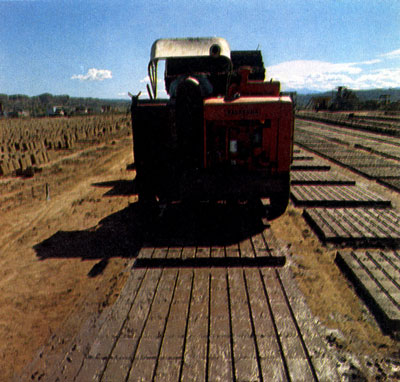
And as sophisticated machinery is being developed to shape the automobiles of the future out of clay, cumbersome vehicles exist that move across flat terrains, which consume mud and excrete large quantities of mud brick to fuel a growing demand for adobe houses in New Mexico and beyond. Such machinery can be found at The Adobe Factory in Alcalde, New Mexico and can produce 20,000 mud bricks per day.
Save the Heritage of Hassan Fathy is an International Association based in Geneva (Switzerland), founded in February 2008 to safeguard the heritage of the Egyptian architect, Hassan Fathy.
His works constitute a patrimony of outstanding value which belongs to the cultural world heritage. The Association’s objectives are the following:
– Raising the awareness of the public opinion about the importance of the work of the Egyptian architect
– Providing a platform of exchanges between the concerned Institutions (public and private) and Universities
– Promoting protection and conservation projects to safeguard this outstanding heritage
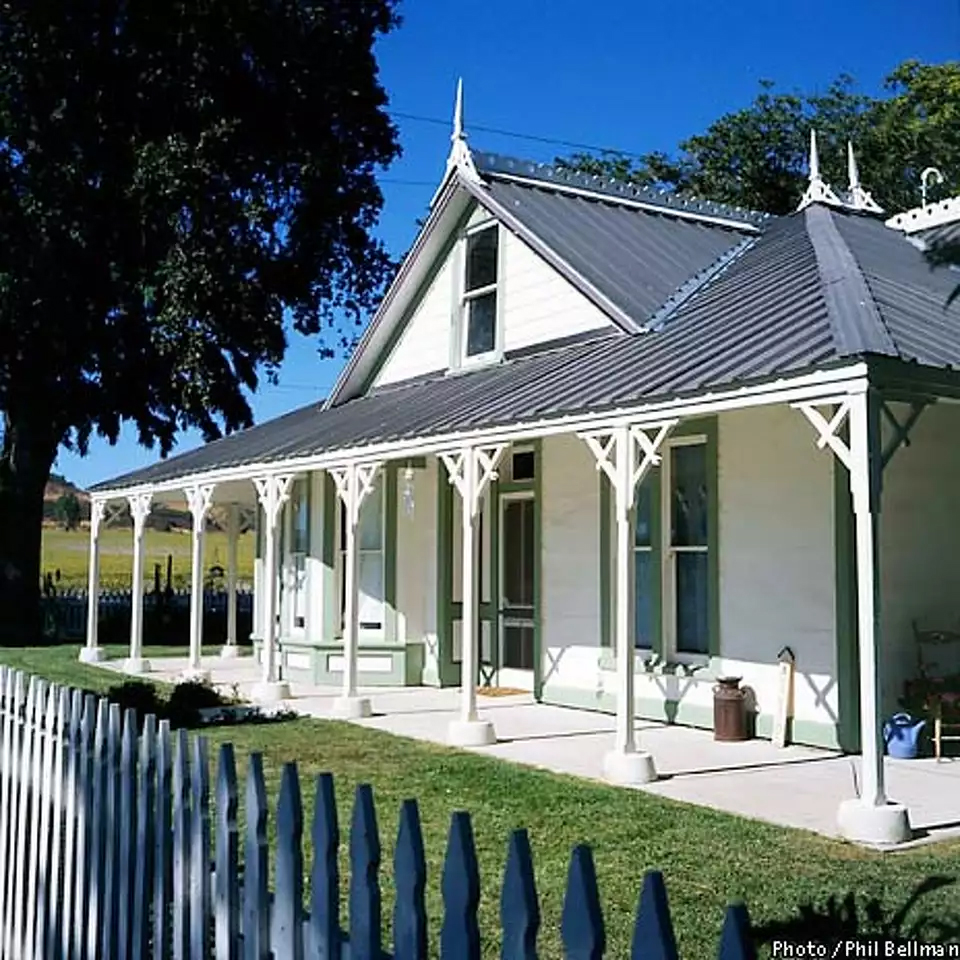
The San Antonio Valley, in southern Monterey County an hour south of Salinas and due east of Hearst Castle, is a trove of some of California’s rarest buildings—rammed earth and adobe buildings with interesting histories. Read more at the San Francisco Gate.
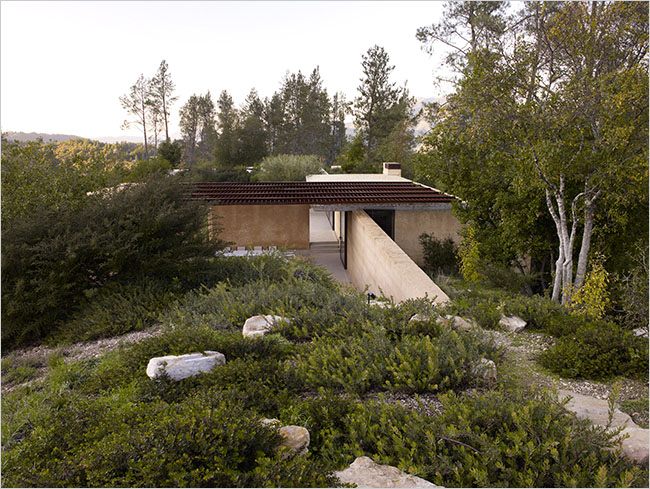
THE first clue that a visitor to Tatwina and Richard Lee’s hilltop property is headed somewhere unusual is the approach, as it’s known in landscape design parlance. The nearly half-mile of dusty road winds dramatically up an intermediary ridge of the Diamond Mountains above Napa Valley. Each turn raises the expectation that the house will soon appear, as houses normally do, but even when the gravel parking area at the top is finally reached, there’s no sign of a house or a garden, just a simple path of crushed stone edged with mounds of green-gray Sonoma sage and California lilac. This, it turns out, leads over a rise to a low, rammed-earth house hidden on the other side.
The house — really a line of four one-story buildings made of earth, concrete and steel and designed by Steven Harris Architects— sits in the depression between two knolls on a narrow, rocky peninsula, with steep, pine-covered hills swooping down on three sides to vineyards famous for their cabernet sauvignon.
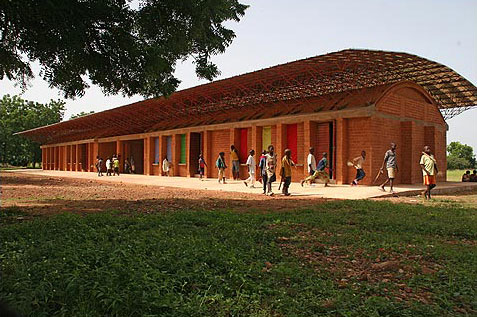
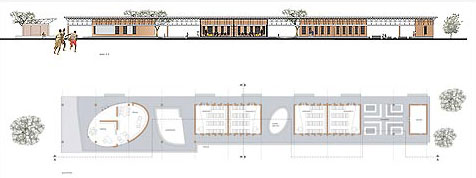
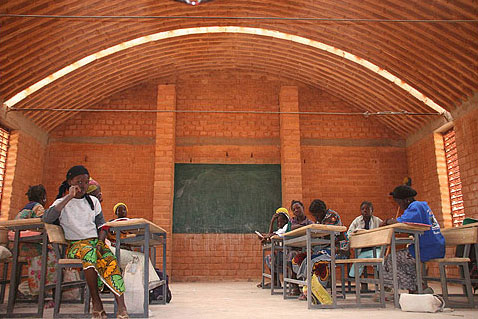
Following the success of his design for a Primary School in Burkina Faso, which prompted growing numbers of students attending the school, architect Diébédo Francis Kéré has completed an extension to the school using many of the same techniques and materials, but with an innovative new compressed earth vault protected by an airy vaulted metal canopy. In addition to classrooms, the extension also houses a kitchen and library.
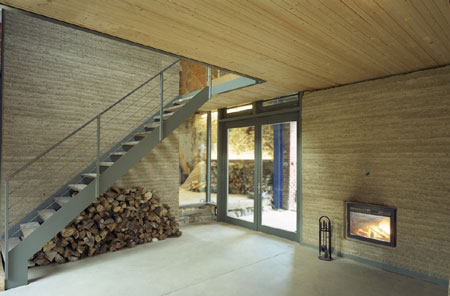
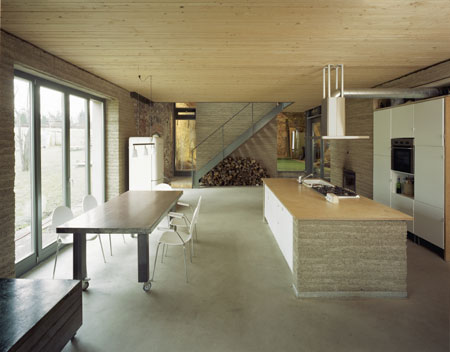
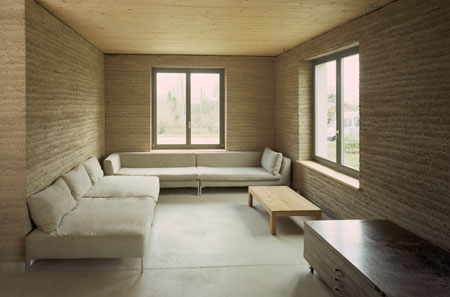
Berlin based architect Eike Roswag’s Haus Ihlow is a renovation and addition to a historic stone barn using rammed earth built in the country side near Berlin. It is the first load bearing housing project in Germany since the 1950s. The construction is based on the “Lehmbauregeln”, but build with surprisingly thin walls (30cm) and large openings for windows.
The house has passive solar heating with a 60 m2 hot water collector and can store 4,000 liters of water supplemented by a wood fire place, connected to a floor and wall heating system. The owners use rain water for toilets and do wastewater treatment before draining the water on their own ground. Roswag’s firm, werk_A has many other projects in rammed earth.




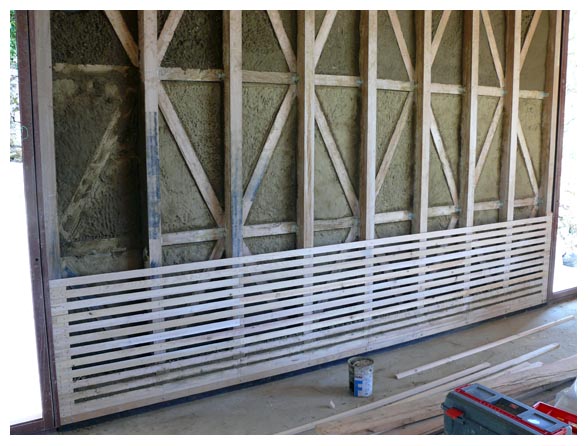
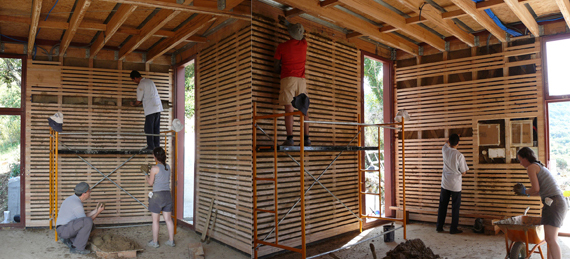
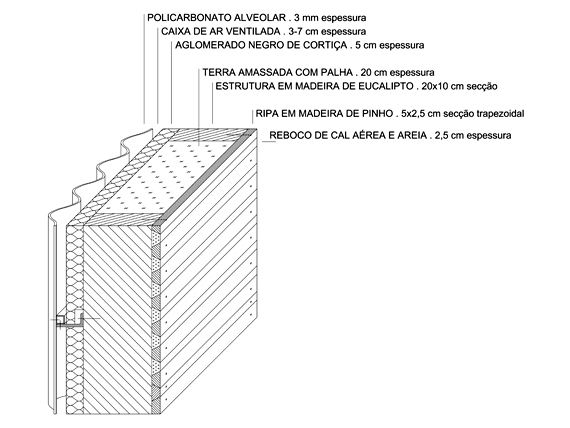 Casa em Arruda Dos Vinhos construction website.