The oldest house in Palo Alto, California is a 160-year-old building constructed of a unique hybrid system that combines techniques found in rammed-earth and cob, traditionally known as encajonado. Known as the Juana Briones House, this historic work of earthen architecture is now slated to be demolished. After nine years of legal battles, the city of Palo Alto has agreed to issue a demolition.
Rammed Earth & Modular Contained Earth
Alternative Construction: Rammed Earth & Modular Contained Earth is a 3-hour interactive online course examines the systems and materials associated with alternative construction, including scenarios on the uses of rammed earth and modular contained earth. It discusses their histories, environmental impacts, and construction methods. This is part of a series of courses concerning Alternative Construction: Contemporary Natural Building Methods.
Abari

Abari is a not-for-profit organization that examines, encourages, and celebrates the vernacular architectural tradition of Nepal. Much of that tradition includes the use of mud brick as seen traditionally in Eastern Kathmandu and in their recent Gobi Adobe project.
Red Hill Residence
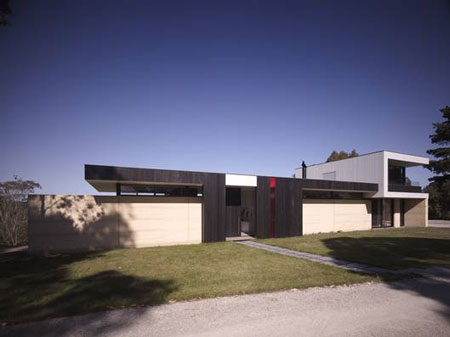
The Red Hill Residence designed by CHRISTOPHERCHRIS PTY LTD ARCHITECTURE was constructed in Mornington Peninsula, Australia. More images of the project can be found at Arkinetia where they write, the house is “constructed primarily from locally sourced rammed earth and ship lapped cedar panelling, the house is sited across the ridge of the property. The elemental form of the building is enhanced by the contrasting and intersecting selection of material, textures and colours, threaded together by the linear rammed earth wall.”
Springs Preserve
The $250 million, 180-acre Springs Preserve in Las Vegas, Nevada will feature museum, walking trails and a 46,000-square-foot desert-living center, built using the latest green-building techniques. Designed by Lucchesi, Galati Architects, it will have earth-rammed walls, and an angled roof that collects rainwater for irrigation and flushing toilets.
Handmade School
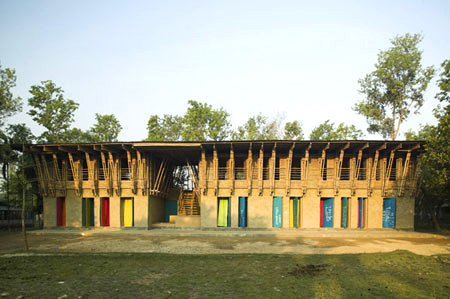
Architects Anna Heringer and Eike Roswag from Linz and Berlin have realized a beautiful school that is a recipient of The Architectural Review Awards for Emerging Architecture.
Refining the local technique of using very wet loam to build walls, the school has a brick foundation, a damp proof course, and walls made of a mixture of loam and straw, the latter acting as a form of reinforcement. The loam and straw are combined by getting cows and water buffalo to tread them in. The ‘Wellerbau’ technique employed here involves building a 700mm high wall layer, leaving it to dry for two days, and trimming off with a spade. A further drying period is followed by the addition of the next layer.
For more information, visit: METI Handmade School.
Qurna Residents are Displaced Again
Bulldozers have moved in to demolish houses in the Egyptian village of Qurna (Gourna) which sits on top of dozens of pharaonic tombs in Luxor. The Egyptian government is determined to move the 3,200 families of the village to an alternative settlement it has built a few kilometres away. In 1945 the Egyptian government displaced the entire city to a New Gourna designed by the architect Hassan Fathy. “All of the architect’s best intentions, however, were no match for the avariciousness of the Gournis themselves, who took every opportunity possible to sabotage their new village in order to stay where they were and to continue their own crude but lucrative version of amateur archaeology.” Today New Gourna is almost abandoned and all what remains today of New Gourna is the mosque, market and a couple of houses. Perhaps history will repeat itself and the residents of Qurna will resist forced displacement. However if destruction of the village continues, an important history will be lost. [ images of New Gourna | Qurna ]

Maisons en Terre | Rammed Earth Housing
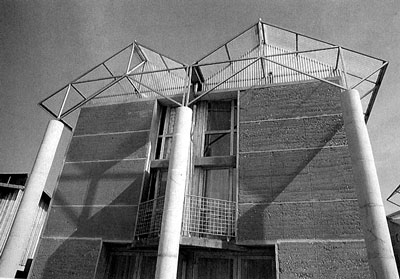
Completed in 1981, Maisons en Terre by architects Francoise Jourda and Gilles Perraudin was one of many projects for earth housing built in the earth village of the Isle of Abeau.
Adobe USA 2007
The 4th Adobe Conference of the Adobe Association of the Southwest: AdobeUSA 2007 will take place May 18, 19, 20 and 22, 2007 in El Rito, New Mexico on the campus of co-sponsor Northern New Mexico Community College in Cutting Hall Auditorium. It adjoins the two-story South Dorm and Cafeteria forming a stately adobe complex.
Information on the Association and the previous conferences can be found at: http://www.adobeasw.com/
Call for Papers Schedule:
December 15, 2006: Abstracts due. One page, 8-1/2 x11, maximum
January 5, 2007: Notification of acceptance
February 23, 2007: Full paper due. (7-page maximum including graphics)
Presenters will have 20 minutes for presentation and 10 minutes to answer questions. Time limits will be carefully monitored. The host institution can handle 2×2 slides in Carousels, digital presentation files, DVD, VHS and overheads.
Submit abstracts to:
Quentin Wilson, Speakers Committee
PO Box 426, El Rito, NM 87530
505-581-4130 fax
or qwilson@mail.nnmc.edu as an attachment in .txt, .doc (msword) or .pdf format or email body or printed on paper.
Final papers for publication consideration must be in .pdf or .doc formats. Conference Languages: English and Spanish
Topics of special interest are:
Affordable adobe construction
Thermal properties of earthen materials
Physical properties of earthen materials including seismic considerations
Historical buildings of note
Historical builders, developers, architects or designers worldwide
New projects: architecture, adobe art and design
Adobe education
Manufacture and supply of adobe and related construction materials
Wirraminna Environmental Education Centre
More than 10 years of hard work paid off yesterday as Wirraminna Environmental Education Centre’s new rammed-earth interpretive building officially opened at Burrumbuttock.