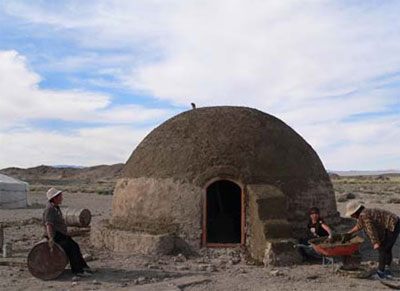
A father and son team, Basanta and Nripal Adhikary from Nepal, are reintroducing adobe in the Gobi Desert as means to provide housing in an environment where there is little timber. [ read article | construction photos ]
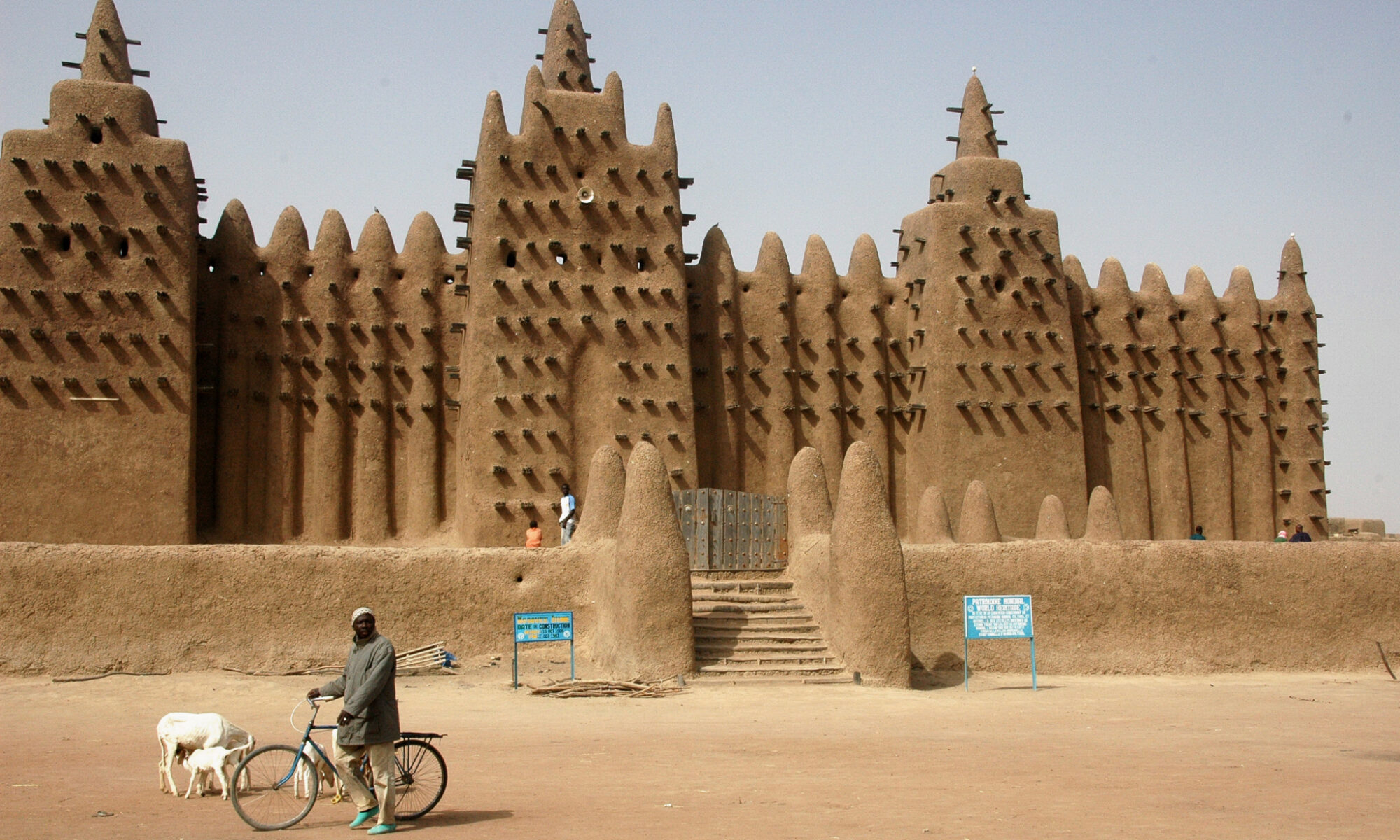
Architecture, Art, Design, and Culture using of mud, clay, soil, dirt & dust.
A father and son team, Basanta and Nripal Adhikary from Nepal, are reintroducing adobe in the Gobi Desert as means to provide housing in an environment where there is little timber. [ read article | construction photos ]
The Center for Irish Earthen Architecture was founded in response to the number of enquiries sent to the Plymouth centre of earthen architecture, regarding information, training and the techniques of cob, rammed earth,
adobe and wattle and daub. Along with the development and implementation of training courses for both the individual and academic institutions, the centre wishes to establish a monitoring system to deliver competence in earthen architecture to the wider audience.
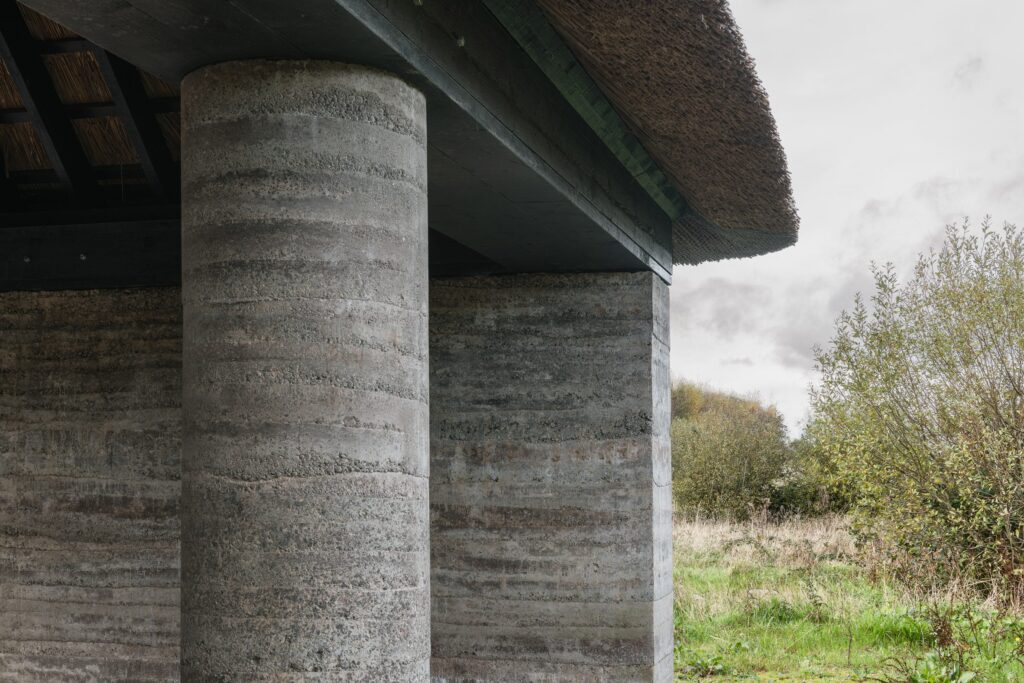
(Link/center is defunct now, but see this paper about earthen architecture in Ireland)
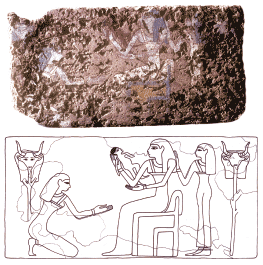
In 2002, University of Pennsylvania Museum archaeologists discovered a 3700-year-old “magical” birth brick inside the palatial residence of a Middle Kingdom mayor’s house just outside Abydos, in southern Egypt. The colorfully decorated mud birth brick, the first ever found, is one of a pair that would have been used to support a woman’s feet while squatting during actual childbirth.
Chitra Vishwanath is an architect in Bangalore, India that has been buillding interesting works of architecture with mud for the past 30 years.
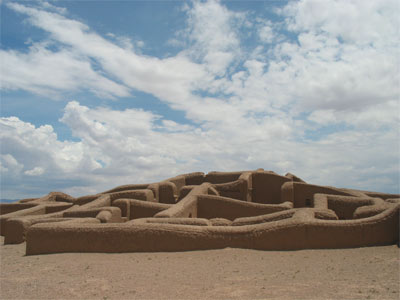
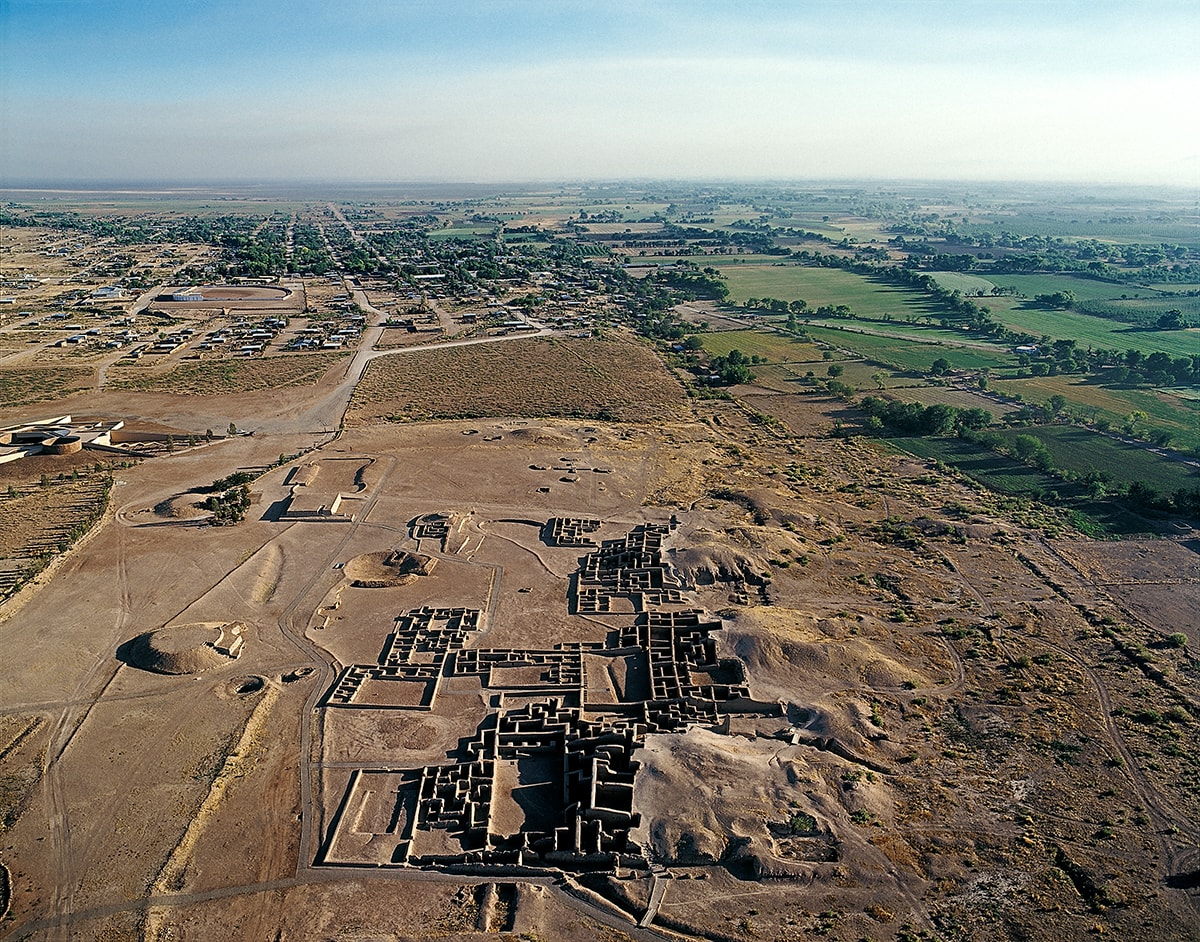
The Paquime ruins, located near Nuevo Casas Grandes in the state of Chihuahua, Mexico, is a archeological, sculptural and architectural wonder. Paquime emerged from shadowy origins early in the thirteenth century. It became the largest and most culturally complex settlement in northern Mexico and the southwestern United States. Much like the Hohokam to the north and west, the Paquime people began building rectangular walled surface structures next to their pithouse lodges late in the first millennium.
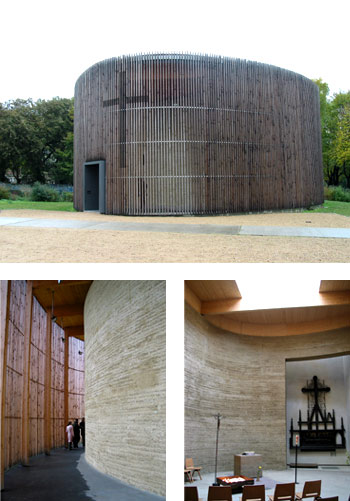
The Chapel of Reconciliation is both Germany’s first public rammed earth building in over 150 years as well as the first rammed earth German church. The building was built on the site of the former Church of Reconciliation, which was built in 1894 and was later destroyed, as it was surrounded by the wall dividing east and west Germany.
The rammed earth walls in the new church are made using clay mixed with the ground up remains of the former church. The building was designed by architects Rudolf Reiterman and Peter Sassenrath and constructed with help from Austrian rammed earth expert Martin Rauch.
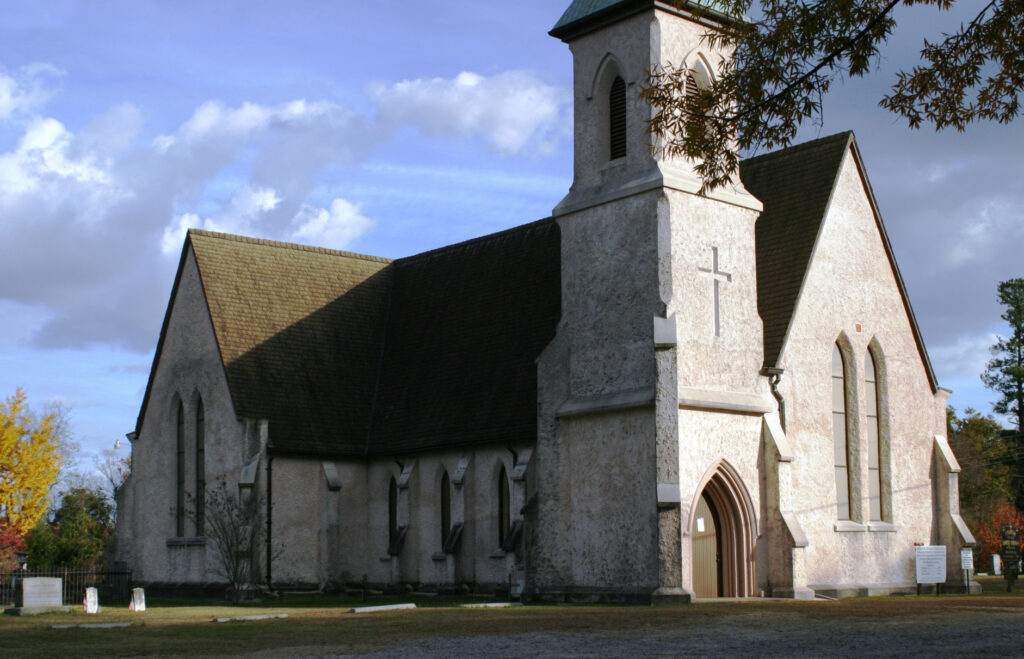
Leaders of the Church of the Holy Cross off S.C. 261 in Stateburg, a 150-year-old national landmark, sued both Orkin Exterminating Co. Inc. and Terminex Service Co. Inc. as well as an architect and contractor involved in the restoration of the church. The church, built between 1850 and 1852, was declared a national landmark in 1978. The building is of particular historic significance because of its unusual construction of rammed earth known as pise de terre.
More information available here: Holy Cross Church Restored
In the essay “The Renaissance of Rammed Earth” which was published in AMC Aspects magazine, January 2001, it is discussed that “Antonio Gaudi and Frank Lloyd Wright appreciated rammed earth. Gaudi showed great interest for the popular architecture. In 1884 he used rammed earth (called “tapial” in Spain) for the construction of the pavilions at the entrance to the farm of Eusebio Guell. Frank Lloyd Wright suggests rammed earth for the construction of buildings in his project for Broadacre City.”
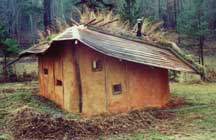
The builders, Jacques Abelman, Nik Bertulis and Aysha Massel , were pushing two extremes of tradition construction and materials in an experimental project to assemble and build a fully living structure in Seneca, South Carolina.
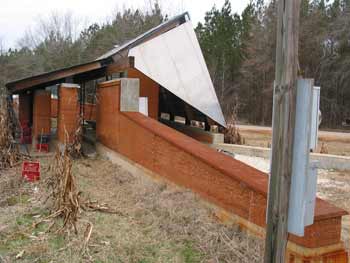
The Rural Studio has built several works of rammed-earth architecture including the Mason’s Bend Community Center (above), and the Sanders-Dudley House.