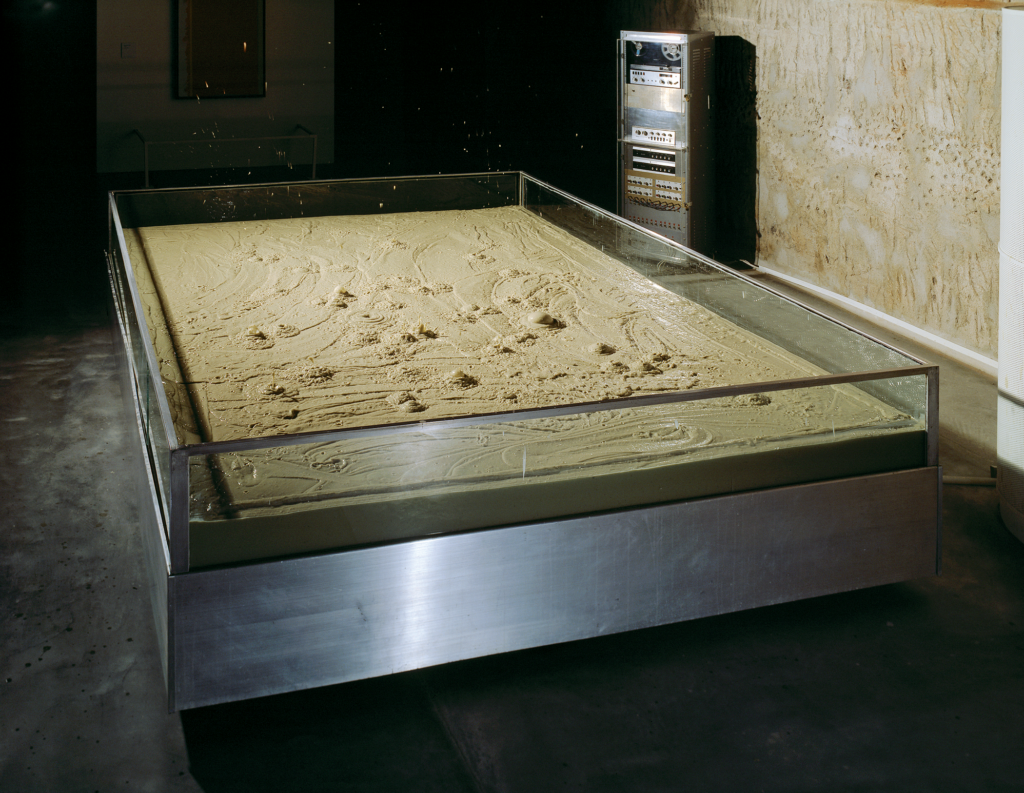
Mud Muse, a kinetic artwork created between 1968 and 1971 by American artist Robert Rauschenberg, in collaboration with engineers from Teledyne( through the Art & Technology program at the Los Angeles County Museum of Art), is a large aluminum-and-glass vat that contains an enormous amount of mud, weighing thousands of pounds. Although considered mud by standard terminology, its more appropriate content appellation is bentonite, an absorbent, swelling clay composed of montmorillonite, from weathered volcanic ash.
The mixture is stirred to a distinctive viscosity in the vat, over the course of several hours or days. The primary allure of the art piece is the bubbles produced with the aid of pulsing air valves that are located beneath the surface of the mud. This is connected to an adjacent prerecorded soundtrack that emits sound from a 1960s reel-to-reel. The sound pushes air through the valves, resulting in a physical manifestation of sound emission. Rauschenberg imagined different audio stimuli, including traffic noises, police sirens, and, most ambitiously, real-time sounds made by visitors that would be picked up by a hanging microphone. In the end, he decided that Mud Muse, when officially displayed for the public, would “play itself,” essentially a recursive loop of the audio made by the bubbles.
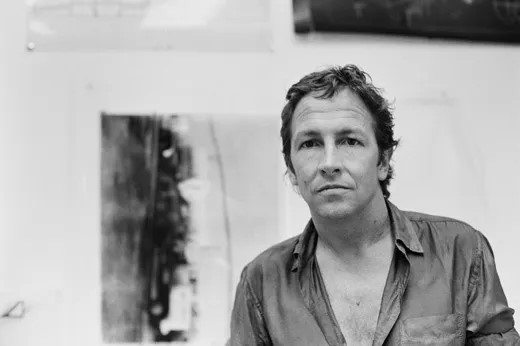
Rauschenberg (1925-2008), born in Port Arthur, TX, is considered a pioneer in the art scene due to his early adaptations of technology in his work, such as radios, electric lights, and clocks, as well as his more renowned printmaking works. His endeavors into kinetic art began in 1960, after meeting Swiss artist Jean Tinguely. Together, they created several kinetic works alongside engineer Billy Klüver, such as Oracle (1962–65), a sonic sculptural environment, and Soundings (1968), an immersive, voice-activated sound and light installation. This era, which was marked by technological innovation and space exploration, ultimately played a pivotal role in Rauschenberg’s creation of Mud Muse.
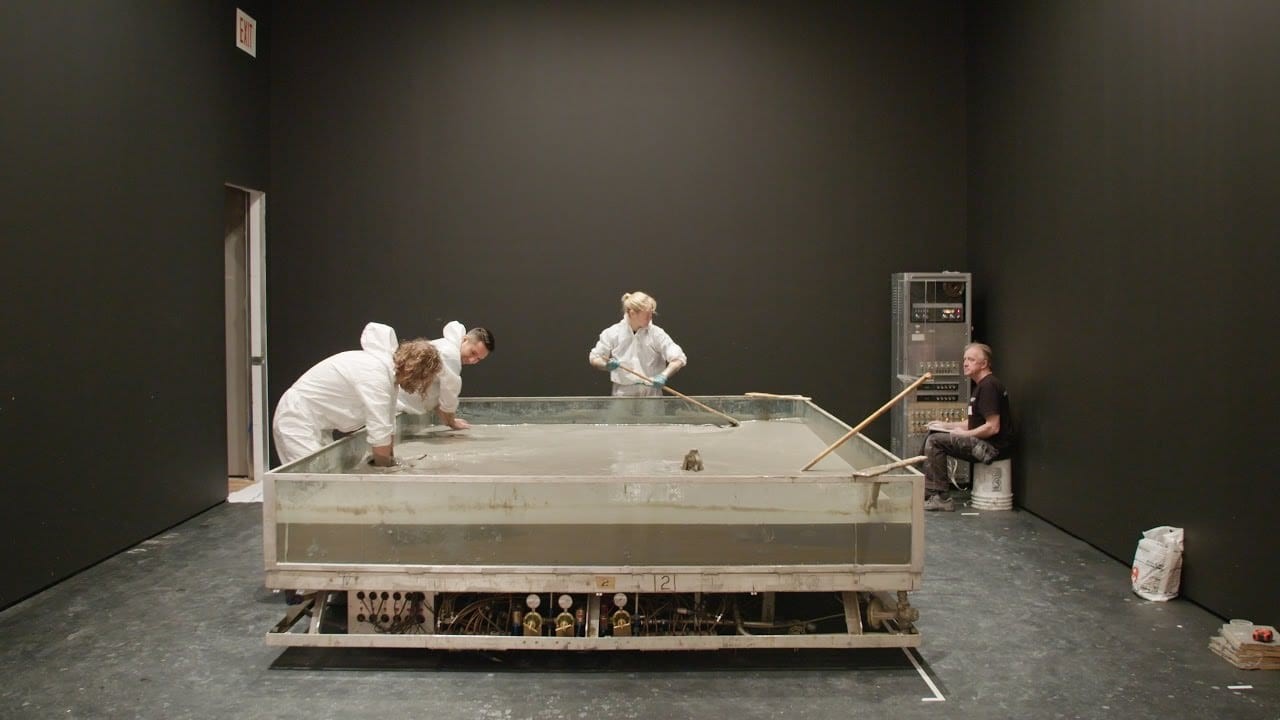
In modern days, Mud Muse acts as a tradition passed down through the years. The current installer, Gunnar Marklund, notes that “The audio equipment and its cabinet are quite old and require maintenance and repair on occasion. And there are sixty-four valves in the bottom of the pool, and they do get clogged; I have to check them every time and clean them as needed.” Occasionally, during installation, he experiments with different music to activate the bubbling (in New York recently, ABBA). Overall, the knowledge he has gained over 19 years, he passes on to future generations.
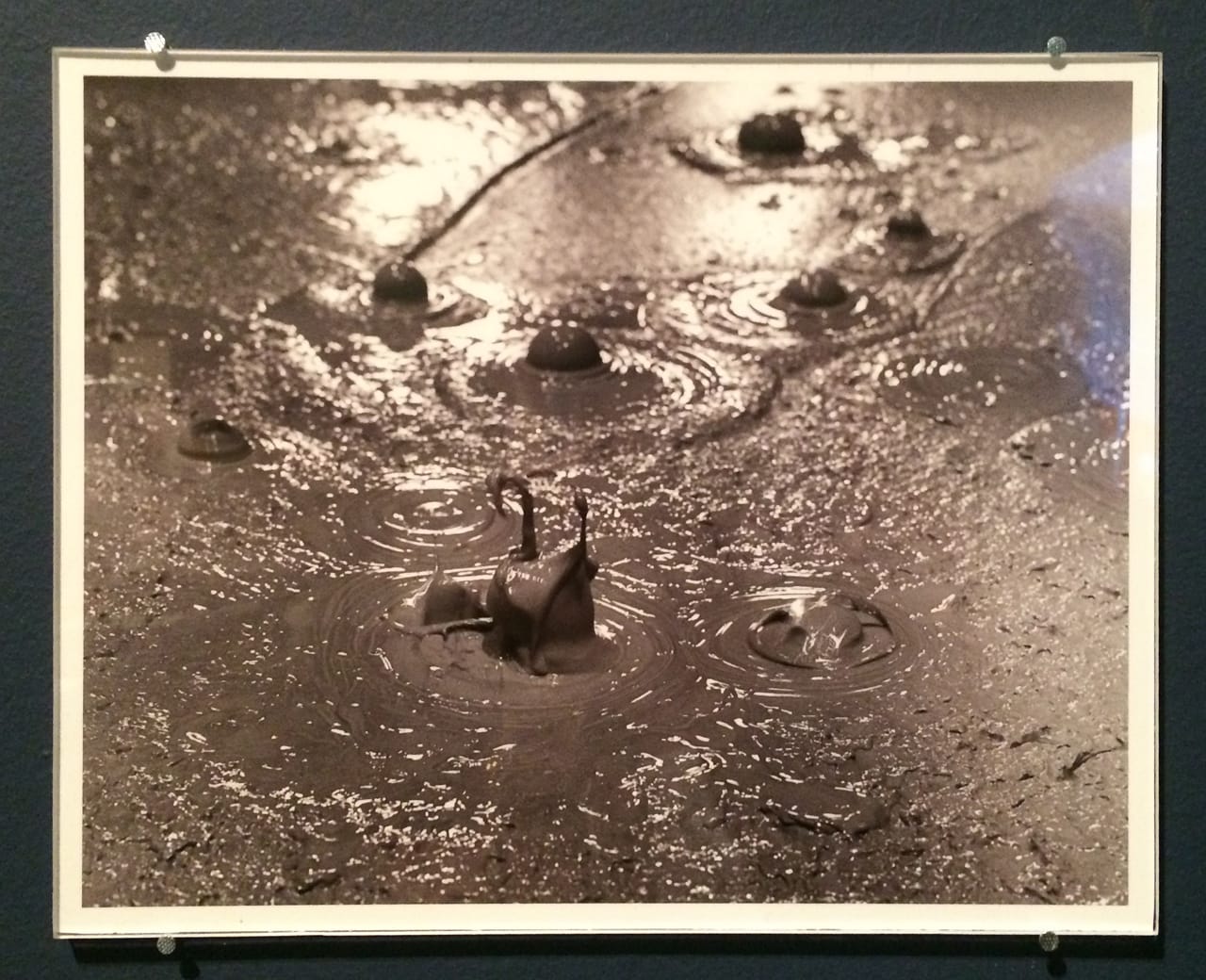
In recapitulation, Mud Muse acts not only as a visual experience, but one that activates hearing, smell, and touch, allowing the public to have a holistic and interactive participation with the piece. It collides two opposing worlds of ancient material and modern technology, creating a piece of art that has withstood the tests of time and continues to bewilder audiences.
Sources:
Artchive. “Oracle – Robert Rauschenberg (1965).” Accessed March 9, 2026.
https://www.artchive.com/artwork/oracle-robert-rauschenberg-1965/
Daniel Langlois Foundation for Art, Science, and Technology. “Collection of Documents Published by E.A.T.” Accessed March 9, 2026.
https://www.fondation-langlois.org/html/e/page.php?NumPage=394
Elephant Magazine. “Rauschenberg’s Mud Muse Taught Me to Find Cohesion Even Amidst Chaos.” January 28, 2021.
https://elephant.art/rauschenberg-mud-muse-taught-me-to-find-cohesion-even-amidst-chaos-28012021/
Rauschenberg Foundation. “Soundings.” Accessed March 9, 2026.
https://www.rauschenbergfoundation.org/art/artwork/soundings
Teledyne Technologies. “EverywhereYouLook!” Accessed March 9, 2026.
https://www.teledyne.com/en-us
Tinguely Museum. “Museum Tinguely.” Accessed March 9, 2026.
https://www.tinguely.ch/en.html
Wallach, Amei. “Recalling Robert Rauschenberg.” Smithsonian Magazine, May 18, 2008.
https://www.smithsonianmag.com/arts-culture/recalling-robert-rauschenberg-49830834/
YouTube. Video. Accessed March 9, 2026.
https://www.youtube.com/watch?v=7r88iDgTd-M
YouTube. Video. Accessed March 9, 2026.
https://www.youtube.com/watch?v=Tvt-VSgPd4c