An official in Housing and Urban Development Ministry said in Tehran on Wednesday the earthquake which devastated the ancient city of Bam last December is estimated to costs rls 15,000 billion ($1.9 billion), IRNA repored.
Bam Photo Exhibition
The Ministry of Culture and Islamic Guidance’s Publicity Department expresses its sympathy towards its compatriots, and especially the survivors of Bam’s disastrous earthquake by holding an international exhibition and competition of photography centered on Bam’s tragic event, under the title “The Wrecked Roof of Bam”, using the expression influential and comprehensive medium of photography. Photographers all over the world who have succeeded in catching glimpses of various scenes of this nation-wide calamity are here by invited to contribute to this exhibition by sending their photographic works. The Dead line of this exhibition is February 5, 2004. The entry rules and application is attached to this mail. For more information contact saremi@photoagency-ir.com We are looking forward to receive your works!
Ali Reza Karimi Saremi,
Directing Manger of Exhibition
tel +9821868117
Experts Size Up Daunting Task to Rebuild Bam
Iranian officials have said they plan to restore the ancient city, near the center of the modern city of Bam. “You cannot rebuild it in concrete,” said Dinu Bumbaru, secretary general of the International Council on Monuments and Sites who came from Canada to inspect the damage. “This is not public works. This is heritage.”
Earthquake Proof Houses Hard to Sell
Iran-born architect Nader Khalili has a technique for building earthquake-proof houses, but he is struggling to sell it to governments even though he teaches it for free and it could save countless lives.
Nader Khalili Proposes Mud and Barbed Wire
Most experts are suggesting that if Bam is to be rebuilt, the mud-brick construction that made the Iranian city unique should be replaced by more modern methods. But Nader Khalili disagrees. ‘I can rebuild city with mud and barbed wire,’ says architect
Superadobe Iran
Iranian-born architect, Nader Khalili, now working in California’s seismic zone urged his fellow Iranians to try his “superadobe” building technique, using sandbags and barbed wire, in rebuilding the 2,000 year old quake-flattened city of Bam.
Earthquake Destroys World Treasure
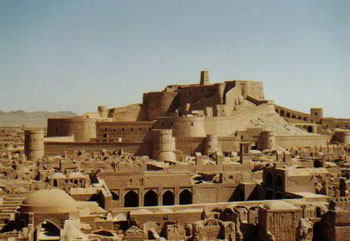
A devastating earthquake virtually leveled the historic heart of Bam which was one of the wonders of Iran’s cultural heritage, boasting a 2000-year-old citadel that was the largest mud-brick structure in the world. Built entirely of mud bricks, clay, straw and the trunks of palm trees, the city’s old quarter dates from pre-Islamic times, although most of the monuments were from Iran’s modern heyday under the Safavid rulers of the 16th and 17th centuries. 20,000 feared dead in the collapse of buildings in the city.
Photos of Bam pre-2003 earthquake:
Photos 1 | Photos 2 | Photos 3
Photo of Bam post-2003 earthquake:

Nader Khalili
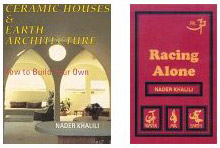
Iranian born Nader Khalili, California architect/author is the world renowned Earth Architecture teacher and innovator, and author. He has been a licensed architect in the State of California since 1970, and has practiced both in the U.S. and abroad. Click here to visit Khalili’s website: Cal-Earth, The California Institute for Earth Art and Architecture.
His books, Ceramic Houses and Earth Architecture: How to Build Your Own and Racing Alone document his life of searching for a method to fire mud houses and turn them to stone by firing and glazing an entire building after it is constructed from clay-earth on site.
Yazd 2003
The Ninth Conference on the Research and Protection of Unbaked Mud Monuments opened at Dowlatabad Garden and was attended by a number of world experts. Speaking at the inaugural ceremony, Head of Yazd province Cultural Heritage Department Seyed Mohammad Beheshti reiterated the importance of the unbaked mud monuments and the inherent complexities of the material.
Drying Mud Bricks
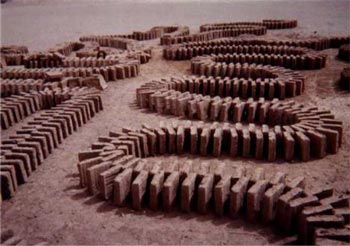
Sun dried mud bricks, called “Khesht” in Iran, are laid on their side to promote even drying. The patterns created in a landscape of mudbricks can also be considered as an aesthetic part of the process of building with earth. These bricks are being prepared for the restoration of the Naren Rampart in Yzad, Iran. Image by Dr. Hossein Massoud, 2001