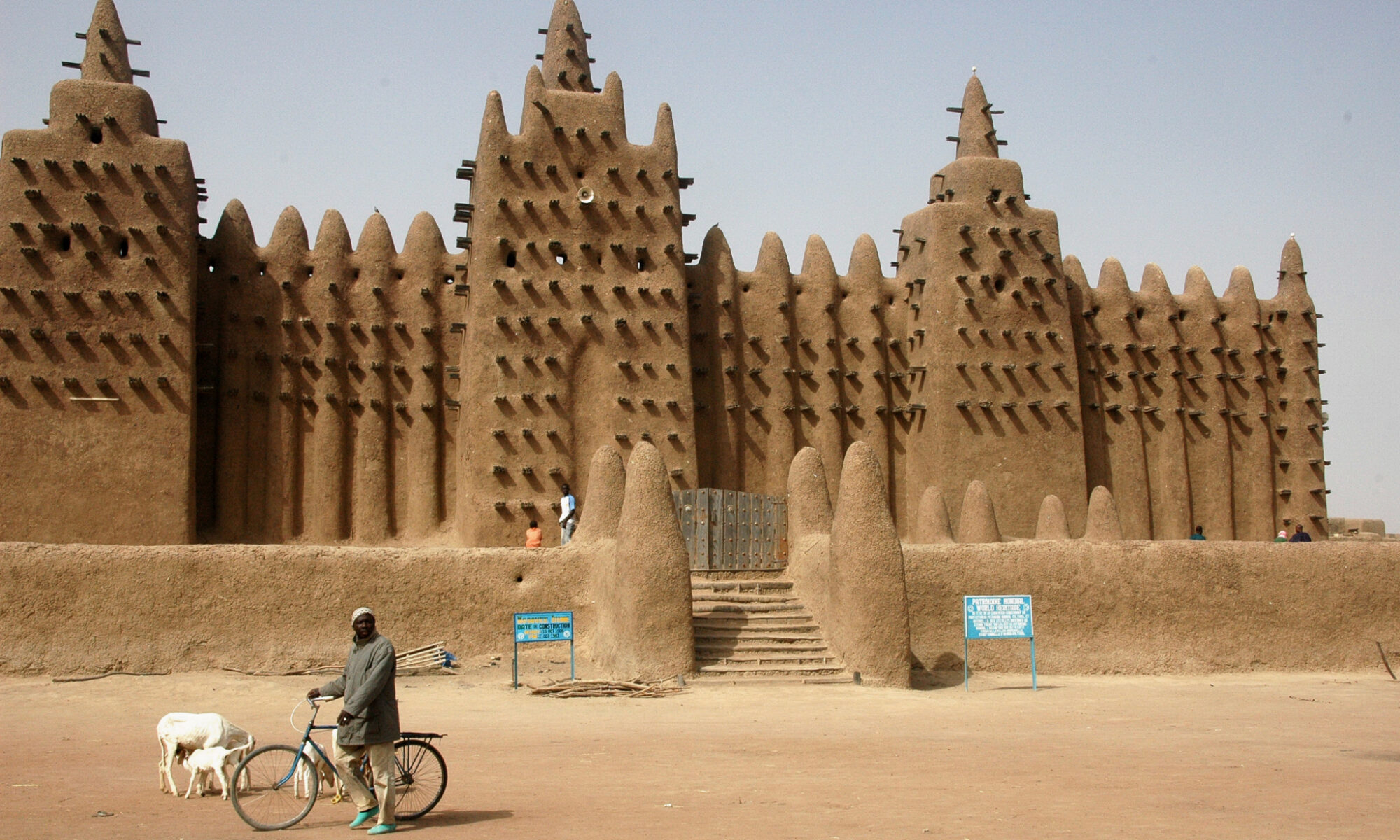
Most experts are suggesting that if Bam is to be rebuilt, the mud-brick construction that made the Iranian city unique should be replaced by more modern methods. But Nader Khalili disagrees. ‘I can rebuild city with mud and barbed wire,’ says architect
Superadobe Iran
Iranian-born architect, Nader Khalili, now working in California’s seismic zone urged his fellow Iranians to try his “superadobe” building technique, using sandbags and barbed wire, in rebuilding the 2,000 year old quake-flattened city of Bam.
Earthquake Destroys World Treasure
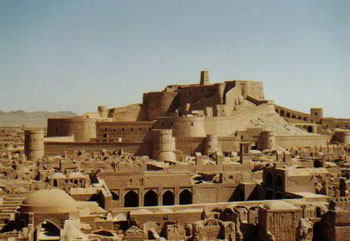
A devastating earthquake virtually leveled the historic heart of Bam which was one of the wonders of Iran’s cultural heritage, boasting a 2000-year-old citadel that was the largest mud-brick structure in the world. Built entirely of mud bricks, clay, straw and the trunks of palm trees, the city’s old quarter dates from pre-Islamic times, although most of the monuments were from Iran’s modern heyday under the Safavid rulers of the 16th and 17th centuries. 20,000 feared dead in the collapse of buildings in the city.
Photos of Bam pre-2003 earthquake:
Photos 1 | Photos 2 | Photos 3
Photo of Bam post-2003 earthquake:

Nader Khalili
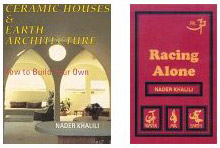
Iranian born Nader Khalili, California architect/author is the world renowned Earth Architecture teacher and innovator, and author. He has been a licensed architect in the State of California since 1970, and has practiced both in the U.S. and abroad. Click here to visit Khalili’s website: Cal-Earth, The California Institute for Earth Art and Architecture.
His books, Ceramic Houses and Earth Architecture: How to Build Your Own and Racing Alone document his life of searching for a method to fire mud houses and turn them to stone by firing and glazing an entire building after it is constructed from clay-earth on site.
The Architecture of Mud
The Architecture of Mud, a film by Caterina Borelli and Pamela Jerome, is shot in the Hadhramaut region in the south east of Yemen which well known for its mudbrick architecture. Throughout the centuries, the population has developed very sophisticated building techniques and created a unique architectural environment.
Yazd 2003
The Ninth Conference on the Research and Protection of Unbaked Mud Monuments opened at Dowlatabad Garden and was attended by a number of world experts. Speaking at the inaugural ceremony, Head of Yazd province Cultural Heritage Department Seyed Mohammad Beheshti reiterated the importance of the unbaked mud monuments and the inherent complexities of the material.
House of Earth and Light
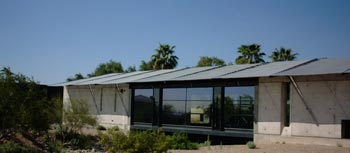
The House of Earth and Light, a private residence designed by Iraq-born, Phoenix Architect Marwan Al-Sayed uses a 3-layer fabric roof to bring tension and lightness to the thick poured gypsum walls. Computer renderings of the building show the proposed quality of the architecture. More information can be found here in an article by the Industrial Fabrics Association International (.pdf format).
Drying Mud Bricks
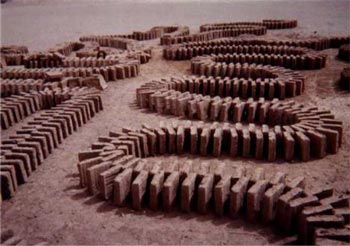
Sun dried mud bricks, called “Khesht” in Iran, are laid on their side to promote even drying. The patterns created in a landscape of mudbricks can also be considered as an aesthetic part of the process of building with earth. These bricks are being prepared for the restoration of the Naren Rampart in Yzad, Iran. Image by Dr. Hossein Massoud, 2001
Ziggurat at Ur
One of the most intriguing monuments still standing in Iraq is the Ziggurat at Ur. A ziggurat is a colossal stepped platform; and it is thought that ziggurats supported temples at their tops. These ziggurats were built during the third millennium B.C. Archaeologists don’t know for certain what the purpose of these ziggurats was; however, it is speculated that they had some connection with religion. There are several ziggurats visible throughout Iraq, the most famous of which is the ziggurat at Ur in the south of Iraq. The core of the ziggurat at Ur was constructed using mud bricks which were then covered with baked bricks. The mud bricks were made out of mud and reed; the reed was pressed into moulds that had been left to dry in the sun. Each brick measured around 25 x 16 x 7 centimeters and weighed around 4.5 kilograms.
Ctesiphon Arch
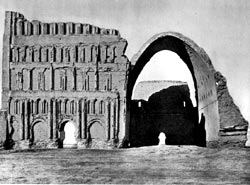
The Ctesiphon arch is considered as one of the many architectural wonders of Mesopotamia. This arch was built in 400 A.D. by the Parthian Persians to be the largest single-span vault of un-reinforced brickwork in the world. The arch has a span of seventy-five feet and is about 110 feet high.It stands in the ancient city of Ctesiphon. Ctesiphon is a historically significant city that lies on the east bank of the Tigris River just south of Baghdad. The Ctesiphon arch is a pointed ovoid peculiar to Mesopotamian architecture; it was built using unfired, thin mud bricks which were laid on a slant.