Les Maisons Murondins is a series of conceptual earthen refugee housing projects proposed by eminent architect Le Corbusier in collaboration with his partner Pierre Jeanneret during the mid-20th century.[1] In the wake of Germany’s invasion of France and Belgium in May of 1940, France was partitioned into three zones: a military zone in the north occupied by Nazi forces, an Italian colony in the East, and the collaborationist Vichy government in the South.[2] This process saw millions displaced as a result of the German invasion, and forced many refugees into abject conditions bereft of housing or sufficient infrastructure.

Respondent to the devastation of the Second World War, Corbusier and Jeanneret began working on a proposal for refugee housing known as Murondins— a combination of the French words for wall (mur) and logs (rondins). Murondins prioritized earth and wood materials and construction techniques, owing to their accessibility and exceptional performance. Earth and logs did not require advanced industrial infrastructure in order to manufacture and assemble, meaning residents were equipped to construct Murondins themselves.[3] Furthermore, walls could either be constructed out of rammed earth, or blocks of earth combined with lime depending on the circumstances. In essence, Murondins sought to use whatever materials were readily accessible, and designed to be built quickly, without special expertise.

This idea did not only operate materially through the use of earth and wood construction, but also formally through the use of long, rectangular walls, and an offset gabled roof— forms that ensured stability, and that those without technical knowledge or experience in construction could produce them. The internal structure of Murondins was proposed to be entirely constructed out of earth, arranged in L-shaped formations to ensure structural stability.
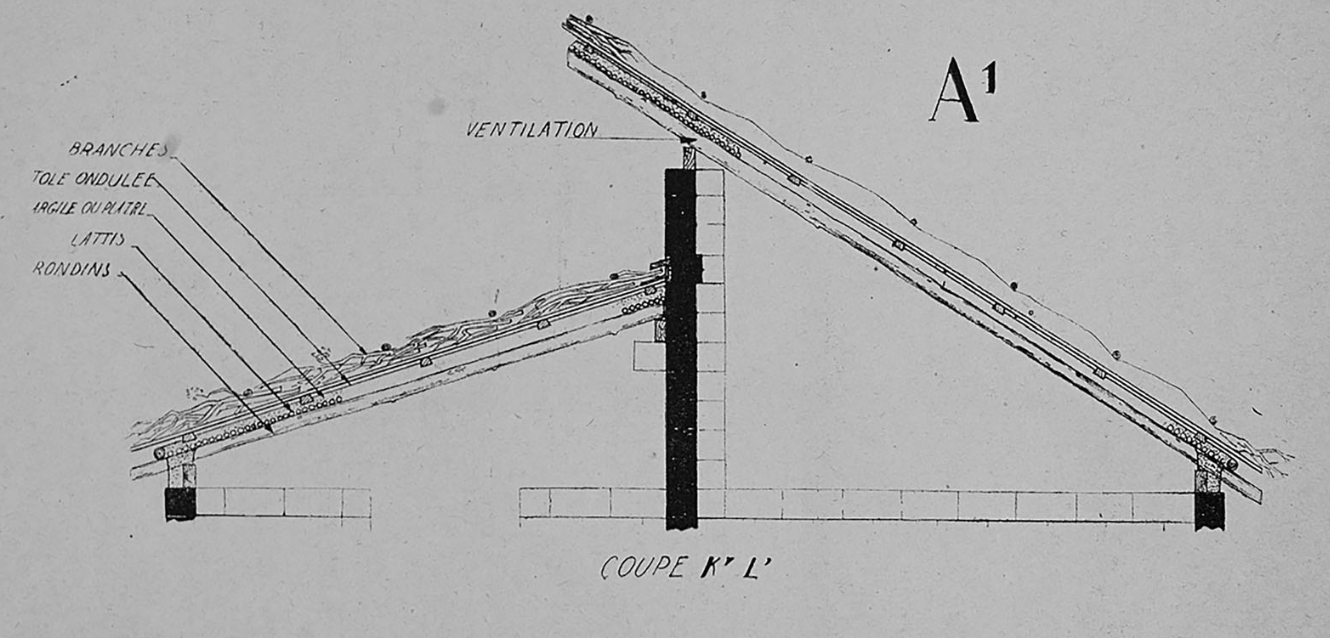
As for the roofs, they were to be made out of logs and waterproofed using sod, plaster, and tar paper. For purposes of ventilation, roofs were also offset, with one side of the gable taller than the other, to accommodate for daylighting and passive ventilation.[4] With this Murondin system, a range of buildings accommodating whatever programs were necessary for life could be constructed for refugees, by refugees using natural and readily available materials. Although this proposal never made it to fruition, Le Corbusier and Pierre Jenneret’s Murondins continues to serve as an instrumental historical proposal for accessible, communal earthen construction.
Sources:
[1] McLeod, Mary, “To Make Something out of Nothing: Le Corbusier’s Proposal for Refugee Housing” in The Journal of Architecture, 421–47, 2018.
[2] Hart, B.L, “Battle of France,” in Encyclopedia Britannica, 2026. https://www.britannica.com/event/Battle-of-France-World-War-II.
[3] McLeod, Mary, “To Make Something out of Nothing: Le Corbusier’s Proposal for Refugee Housing” in The Journal of Architecture, 421–47, 2018.
[4] Mary McLeod, On the Maisons Murondins, 2024. https://www.youtube.com/watch?v=Wt94ZA8TkVw.