The Master
The European Master in Earthen Architecture and Construction (TERRA) is a unique programme dedicated to advancing knowledge and professional practice in earthen architecture and construction. Its first edition will take place in the 2026/2027 academic year as a funded Erasmus Mundus Joint Master.
TERRA is a one-year, full-time programme (60 ECTS) awarding a double Master’s degree, jointly delivered by the University of Minho (Portugal), the Technical University of Valencia (Spain), the Graduate School of Civil, Environmental and Urban Engineering from the National School of Public Works (France), and the University of Florence (Italy). The programme is held on a rotating basis among partners. Students complete their coursework at one university and develop their dissertation at another. The language of instruction and examination is English. The curriculum is structured around five core areas:
- Earthen Architecture and Building Culture
- Earthen Materials
- Functional Design and Sustainability
- Structural Analysis and Design
- Conservation of Earthen Buildings
Through an excellence-driven academic and research environment, students will develop a comprehensive and interdisciplinary skill set to address the complex challenges of earthen architecture and construction. Graduates will be equipped to stand out in a construction sector increasingly focused on sustainable solutions and in a rehabilitation market that demands specialised technical expertise.
Objectives
The TERRA is a highly specialised Master programme designed to educate a new generation of professionals capable of leading the transition towards sustainable construction practices. Graduates will be prepared to develop innovative earthen construction solutions, analyse the structural and environmental performance of earthen buildings, and implement conservation strategies for the rehabilitation of earthen architectural heritage.
The programme fosters a truly integrated approach between Architecture and Civil Engineering, grounded in a robust scientific foundation and aligned with the current global challenges in the construction sector. In addition to professional practice, graduates will be well prepared to pursue advanced research or doctoral studies in the field of Earthen Architecture and Construction.
Partners
The TERRA consortium brings together four leading higher education institutions of excellence, jointly awarding a double Master’s degree to its students.

University of Minho Guimarães, Portugal (Coordinator)

Technical University of Valencia Valencia, Spain

Graduate School of Civil, Environmental and Urban Engineering Lyon, France

University of Florence Florence, Italy
The TERRA Master’s programme is supported by a broad network of Associated Partners worldwide (up to 39 until now), including higher education institutions, research and development institutes, industry partners, associations and non-governmental organizations. The Associated Partners play a relevant role in Master’s activities by:
- Delivering lectures and seminars
- Co-supervising dissertations and hosting students during the dissertation period
- Contributing to the development of course materials
- Supporting graduates’ employability prospects
The TERRA Master integrates the expertise of four leading European Higher Education Institutions in areas related to Earthen Architecture and Construction: the University of Minho (Portugal), the Technical University of Valencia (Spain), the Graduate School of Civil, Environmental and Urban Engineering at the National School of Public Works (France), and the University of Florence (Italy). Together, these partners deliver a high-level education programme founded on academic excellence and strong interdisciplinary collaboration.
Students engage with specialists from the complementary fields of Architecture and Civil Engineering through six coursework units (1st semester), hosted by two partner universities per edition on a rotating basis. The Master’s dissertation is completed during the 2nd semester and may be hosted at any of the four partner institutions. Students are required to complete their coursework and dissertation at different locations.
The mobility track is based on students’ preferences while ensuring an adequate balance among partner institutions and observing specific eligibility criteria. The curriculum remains identical across all mobility tracks, ensuring academic consistency and equivalence of learning outcomes
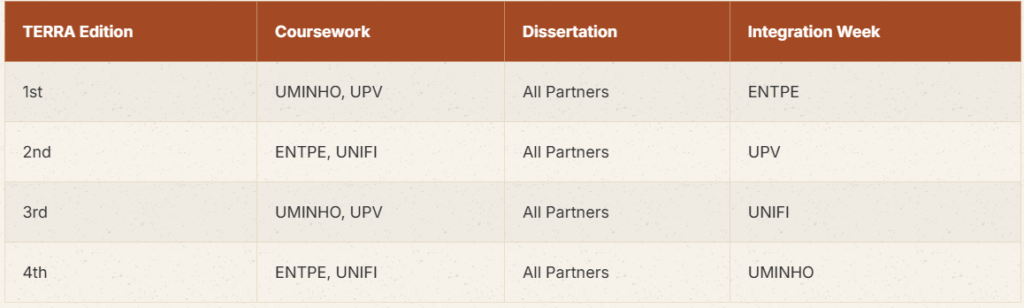
The programme also includes an Integration Week where all students will meet together at a partner institution not hosting coursework in that edition. Furthermore, a TERRA workshop series will be launched following the first edition to promote networking and collaboration among students, alumni, lecturers, researchers and professionals in the field.
The TERRA mobility scheme follows a two-edition cycle, with the full rotation (including the Integration Week), achieved after four editions, enabling students to visit up to three partner institutions during their studies. The table below summarises the full mobility cycle, including coursework, dissertation, Integration Week and TERRA Workshop.
TERRA is a one-year, full-time programme. The study plan comprises seven course units:
- five sequential units and one project-based learning unit delivered during the 1st semester (September to February), each worth 5 ECTS (i.e. 45 hours of lectures and 95 hours of independent student work)
- one dissertation conducted during the 2nd semester (March to July), worth 30 ECTS (i.e. 15 hours of supervision and 825 hours of independent research work).
The curriculum is identical for all students, regardless of their mobility track. Attendance in all seven course units is mandatory, requiring students’ physical presence in the classroom.
Unit 1 (5 ECTS): Earthen Architecture and Building Culture
Unit 2 (5 ECTS): Earthen Materials
Unit 3 (5 ECTS): Functional Design and Sustainability
Unit 4 (5 ECTS): Structural Analysis and Design
Unit 5 (5 ECTS): Conservation of Earthen Buildings
Unit 6 (5 ECTS): Integrated Project on Earthen Construction
Unit 7 (30 ECTS): Dissertation
Professional Perspectives
TERRA graduates will emerge as highly skilled professionals equipped to address the growing global demand for sustainable, resilient and culturally grounded construction solutions. The programme offers a comprehensive and interdisciplinary education, combining engineering, architecture, materials science, conservation and sustainability. This broad foundation enables graduates to work across the full spectrum of the construction sector, from designing new earthen buildings to conserving architectural heritage and developing sustainable materials and technologies.
For Application details, check the website.