Woodless Construction

woodless.jpg

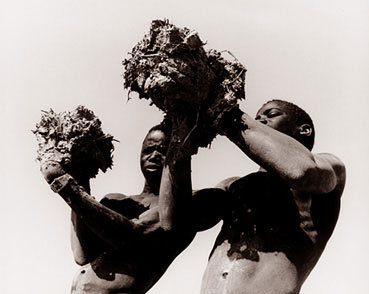
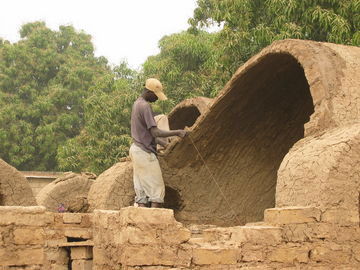
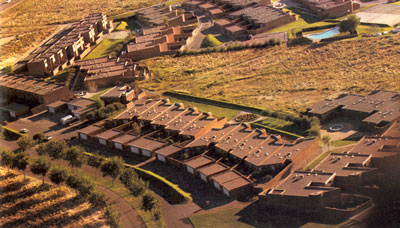
Woodless construction is an approach to building in the sahel that uses traditional building techniques to build houses entirely out of mud, including the roof. Such houses save on scarce wood, encourage local industry by using local skills and materials, and provide good internal comfort, staying warm in cold season, and cool in hot season.

[ via | photos ]

Abari

abari.png

Abari is a not-for-profit organization that examines, encourages, and celebrates the vernacular architectural tradition of Nepal. Much of that tradition includes the use of mud brick as seen traditionally in Eastern Kathmandu and in their recent Gobi Adobe project.

Handmade School

SCHOOL1.jpg

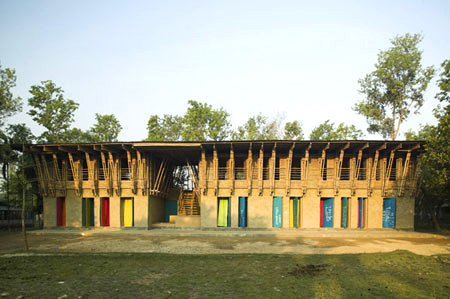
Architects Anna Heringer and Eike Roswag from Linz and Berlin have realized a beautiful school that is a recipient of The Architectural Review Awards for Emerging Architecture.

Refining the local technique of using very wet loam to build walls, the school has a brick foundation, a damp proof course, and walls made of a mixture of loam and straw, the latter acting as a form of reinforcement. The loam and straw are combined by getting cows and water buffalo to tread them in. The ‘Wellerbau’ technique employed here involves building a 700mm high wall layer, leaving it to dry for two days, and trimming off with a spade. A further drying period is followed by the addition of the next layer.

For more information, visit: METI Handmade School.

[ The Architectural Review | Handmade School Web Site ]

Qurna Residents are Displaced Again

Bulldozers have moved in to demolish houses in the Egyptian village of Qurna (Gourna) which sits on top of dozens of pharaonic tombs in Luxor. The Egyptian government is determined to move the 3,200 families of the village to an alternative settlement it has built a few kilometres away. In 1945 the Egyptian government displaced the entire city to a New Gourna designed by the architect Hassan Fathy. “All of the architect’s best intentions, however, were no match for the avariciousness of the Gournis themselves, who took every opportunity possible to sabotage their new village in order to stay where they were and to continue their own crude but lucrative version of amateur archaeology.” Today New Gourna is almost abandoned and all what remains today of New Gourna is the mosque, market and a couple of houses. Perhaps history will repeat itself and the residents of Qurna will resist forced displacement. However if destruction of the village continues, an important history will be lost. [ images of New Gourna | Qurna ]

Adobe USA 2007

The 4th Adobe Conference of the Adobe Association of the Southwest: AdobeUSA 2007 will take place May 18, 19, 20 and 22, 2007 in El Rito, New Mexico on the campus of co-sponsor Northern New Mexico Community College in Cutting Hall Auditorium. It adjoins the two-story South Dorm and Cafeteria forming a stately adobe complex.

Information on the Association and the previous conferences can be found at: http://www.adobeasw.com/

Call for Papers Schedule:

December 15, 2006: Abstracts due. One page, 8-1/2 x11, maximum
January 5, 2007: Notification of acceptance
February 23, 2007: Full paper due. (7-page maximum including graphics)

Presenters will have 20 minutes for presentation and 10 minutes to answer questions. Time limits will be carefully monitored. The host institution can handle 2×2 slides in Carousels, digital presentation files, DVD, VHS and overheads.

Submit abstracts to:
Quentin Wilson, Speakers Committee
PO Box 426, El Rito, NM 87530
505-581-4130 fax
or qwilson@mail.nnmc.edu as an attachment in .txt, .doc (msword) or .pdf format or email body or printed on paper.

Final papers for publication consideration must be in .pdf or .doc formats. Conference Languages: English and Spanish

Topics of special interest are:

Affordable adobe construction
Thermal properties of earthen materials
Physical properties of earthen materials including seismic considerations
Historical buildings of note
Historical builders, developers, architects or designers worldwide
New projects: architecture, adobe art and design
Adobe education
Manufacture and supply of adobe and related construction materials
Tel Dan

tel-dan.jpg

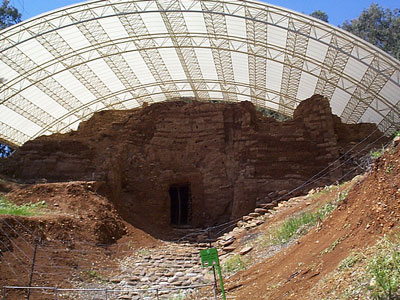
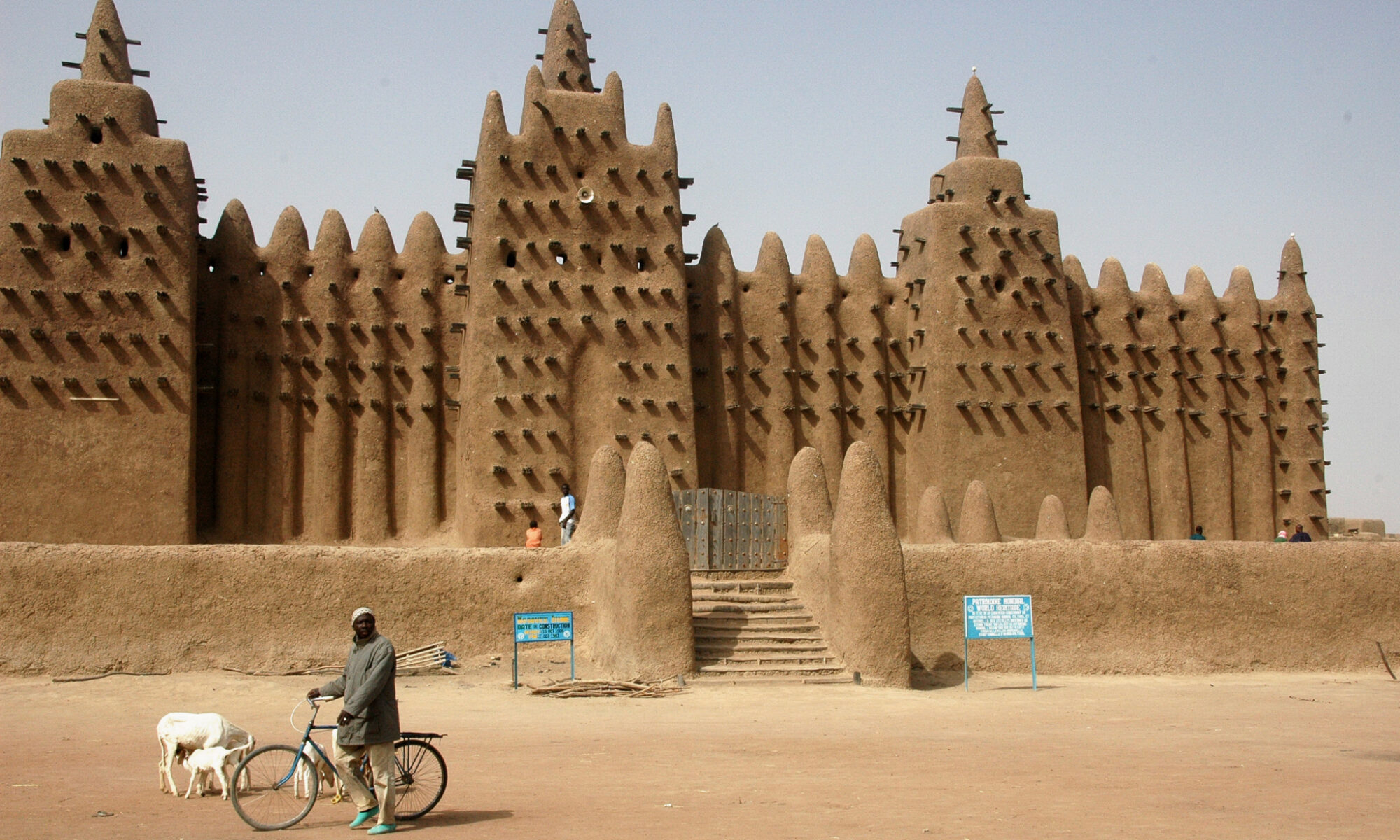
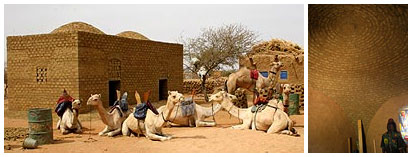
Tel Dan, one of the more important sites in the Golan Heights near the Israel-Lebanon border, is better known for the world’s oldest intact arched gateway, a 4,000-year-old, mud-brick structure now protected under a modern shelter, but the site is under possible threat from a possible errant Hezbollah missile.

Quake Safe

quake-safe.jpg

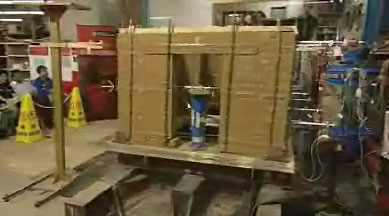
Quake Safe is a frame made from string, bamboo and wire, which can be either retrofitted into an existing adobe (mud brick) house or incorporated into a new house as it’s being built, in order to give it a much higher level of structural protection against earthquakes. The invention was created by Faculty of Engineering Ph.D Student at the University of Technology in Sydney, Dominic Dowling.

The frame is designed to be affordable to people who live in adobe houses, particularly the poorer rural communities of Central America.

[ interview | video ]

Association La Voute Nubienne

AVN.jpg

Population growth in Sub-Saharan Africa, together with increasing desertification and regression of forested areas, means that the use of timber in traditional building techniques is no longer feasible and the alternative of using corrugated iron is expensive and thermally and acoustically problematic. The Association La Voute Nubienne’s primary objective is to persuade people to use the Nubian Vault technique as a valid alternative to traditional building methods in rural areas of Burkina Faso and neighboring countries of the Sahel. Using a simplified and codified adaptation of the classic Nubian vault technique which Hassan Fathy brought back into the public eye in the 1940’s. Thus far, some 200 vaults have been built in Burkina Faso, including a church and a mosque, and some two-story buildings, and over 40 builders have ben trained in the technique.