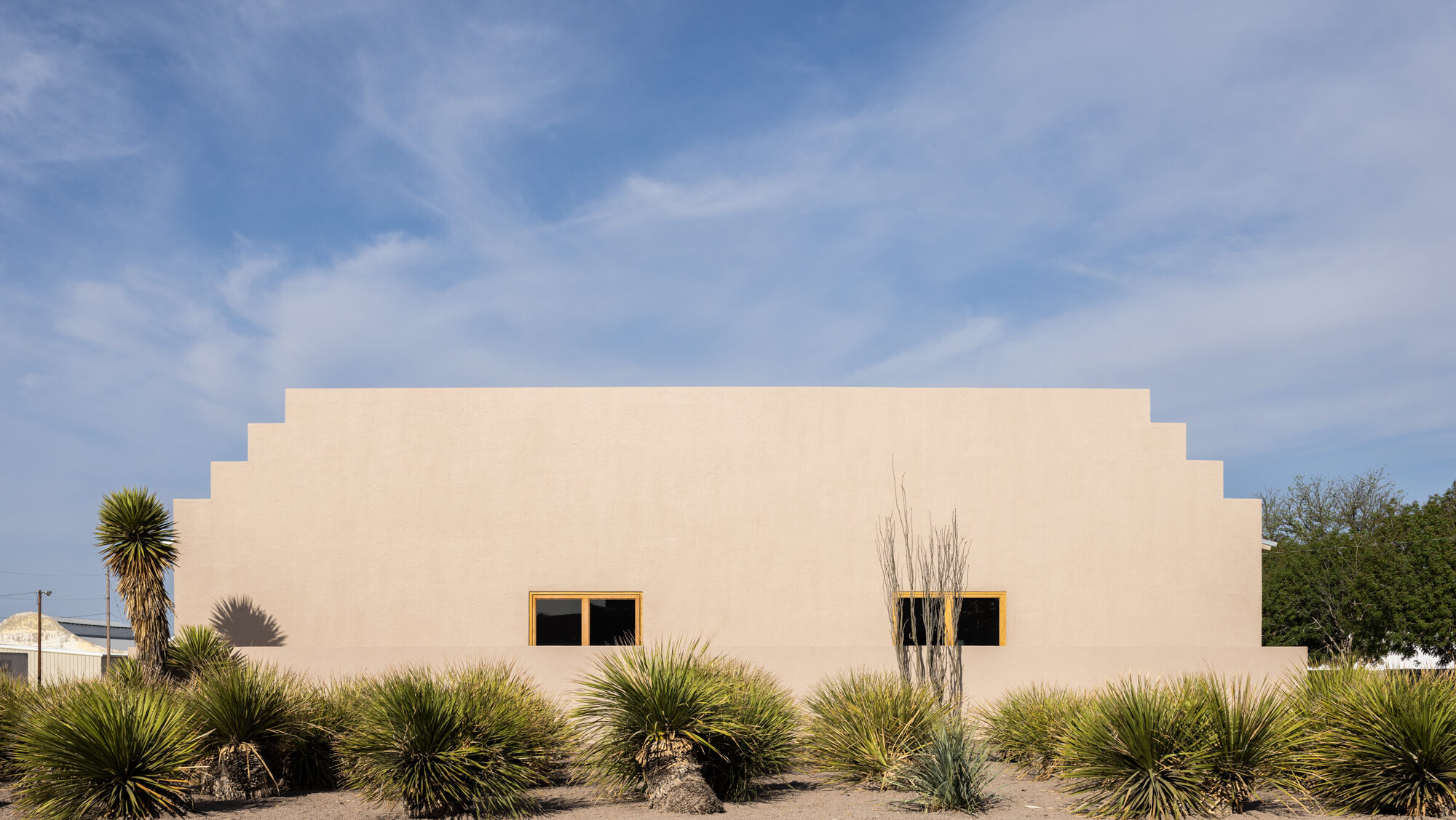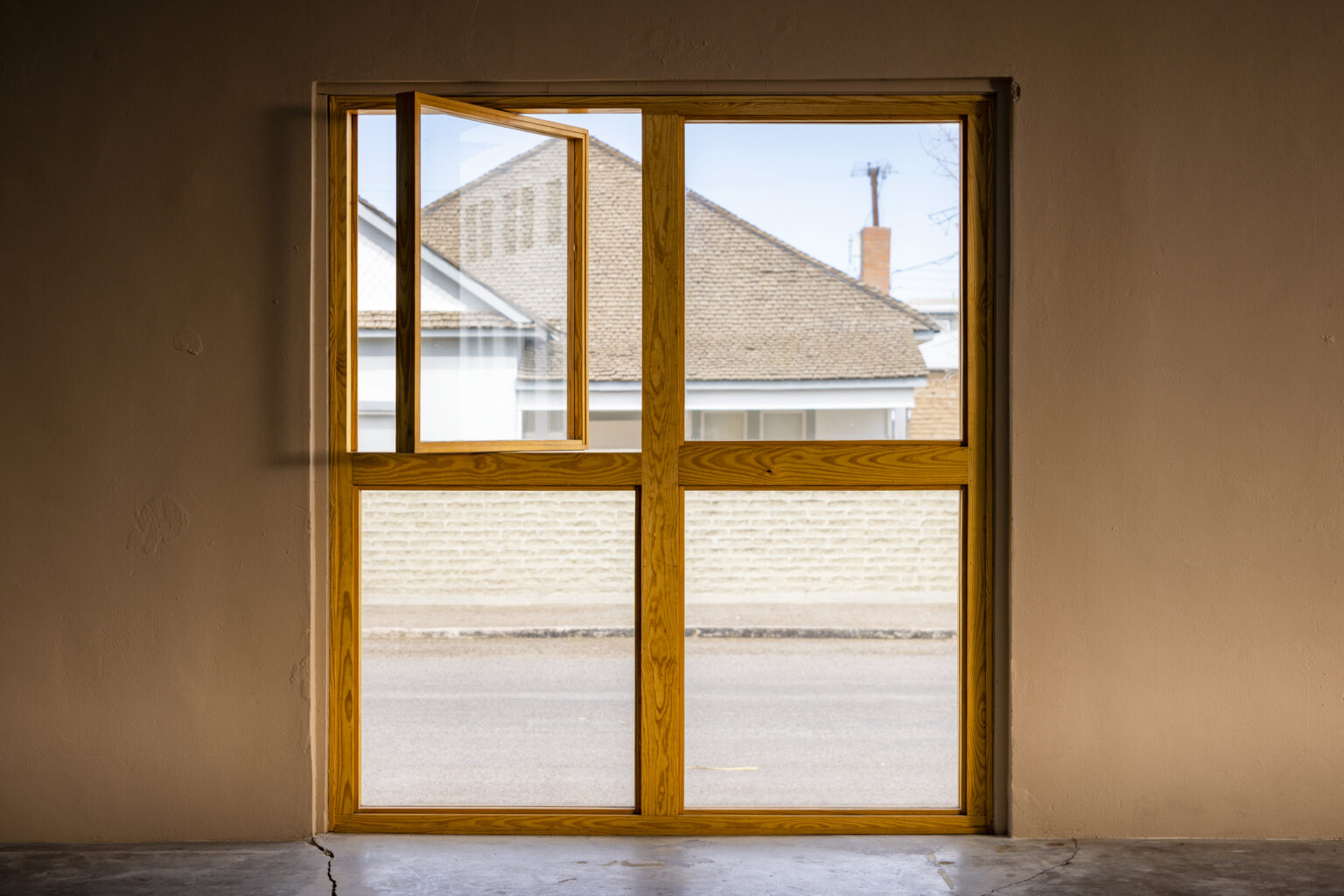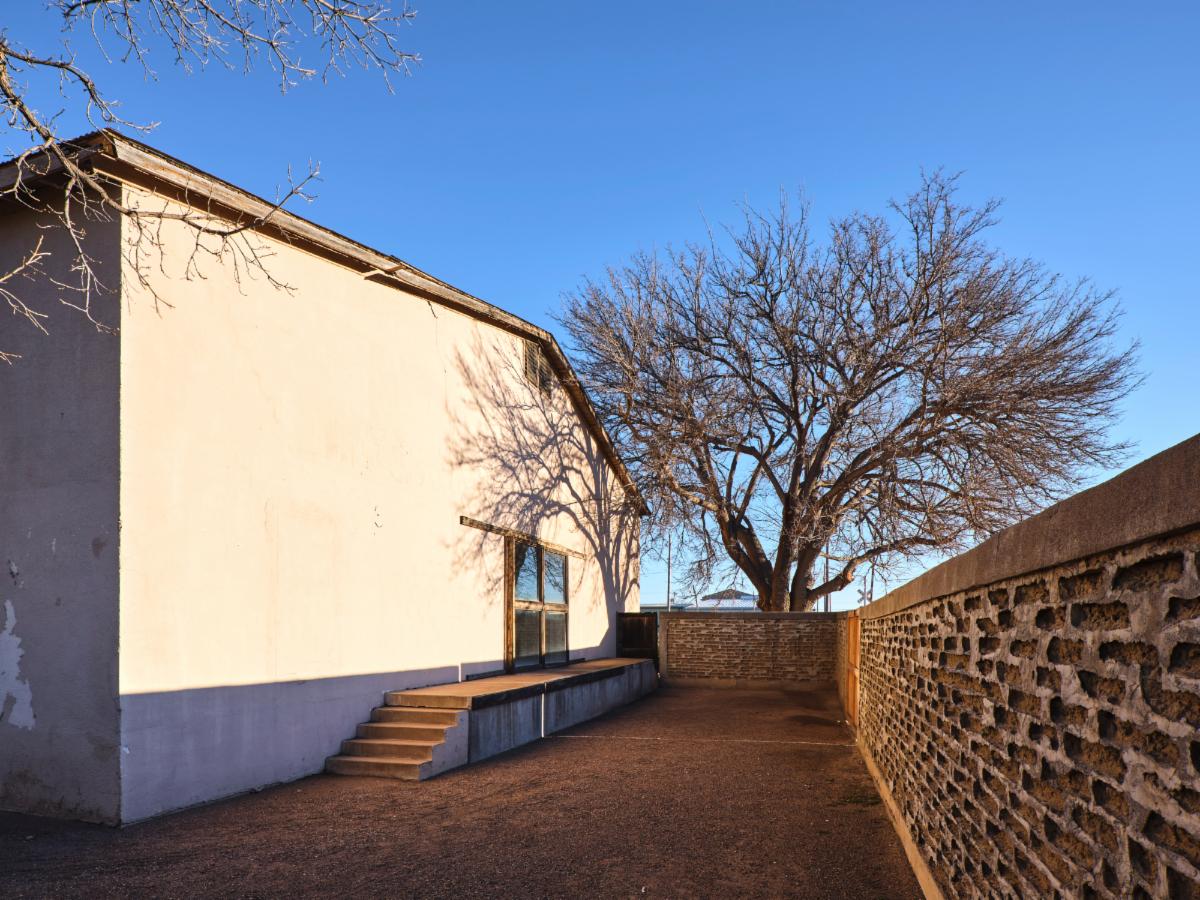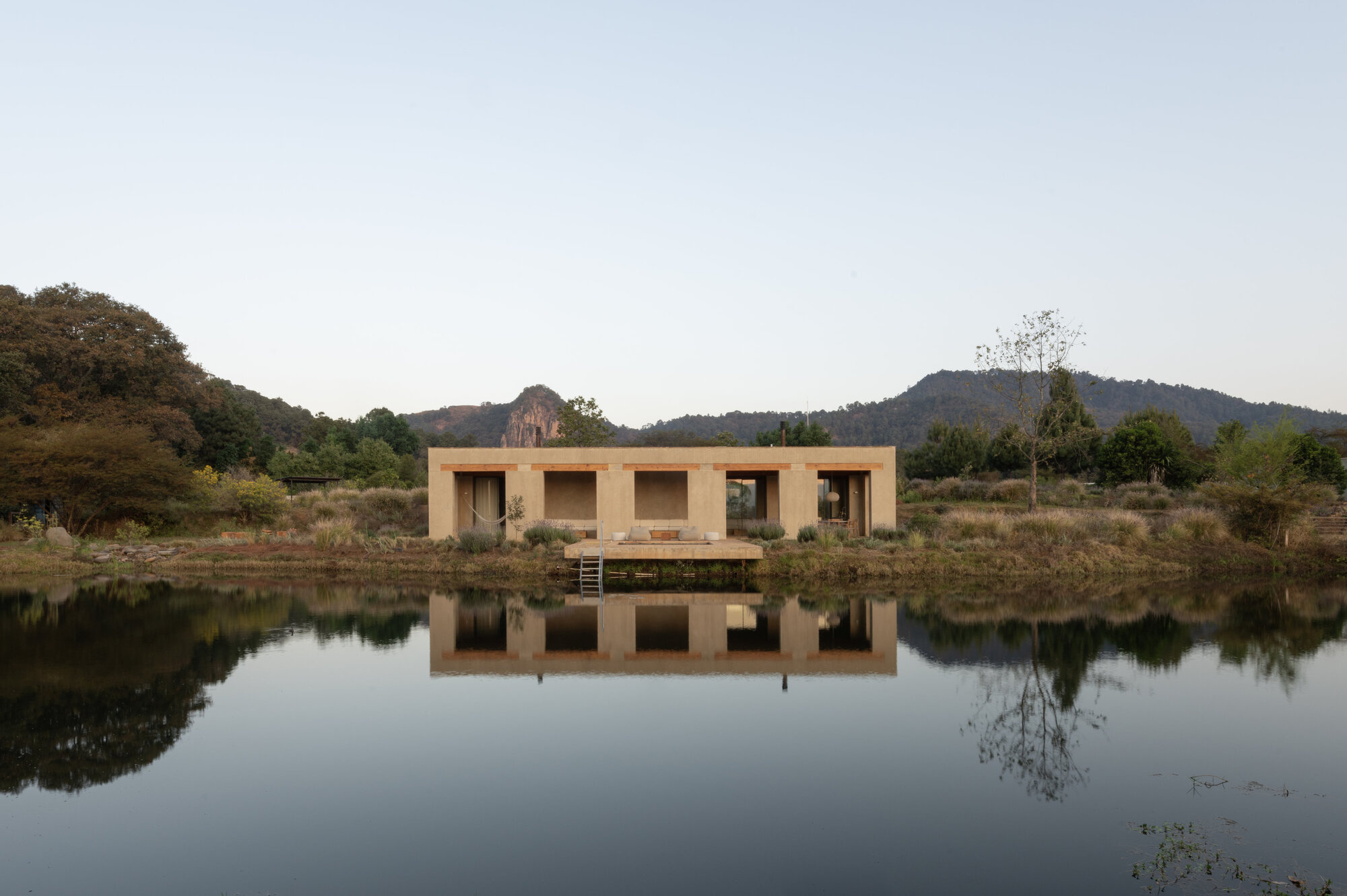
DUST: Tucson Mountain Retreat

Photographed by Jeff Goldberg / Esto

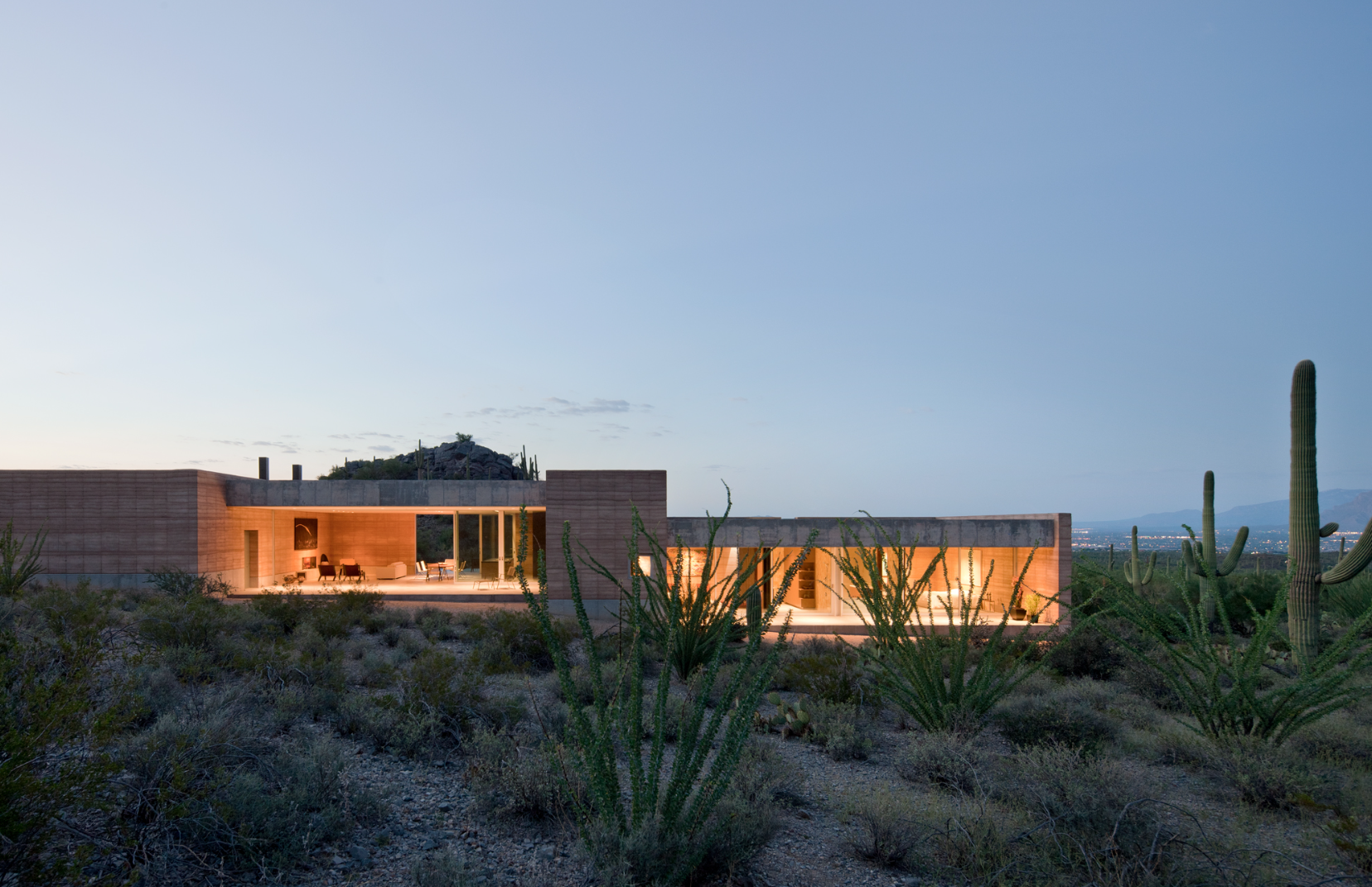
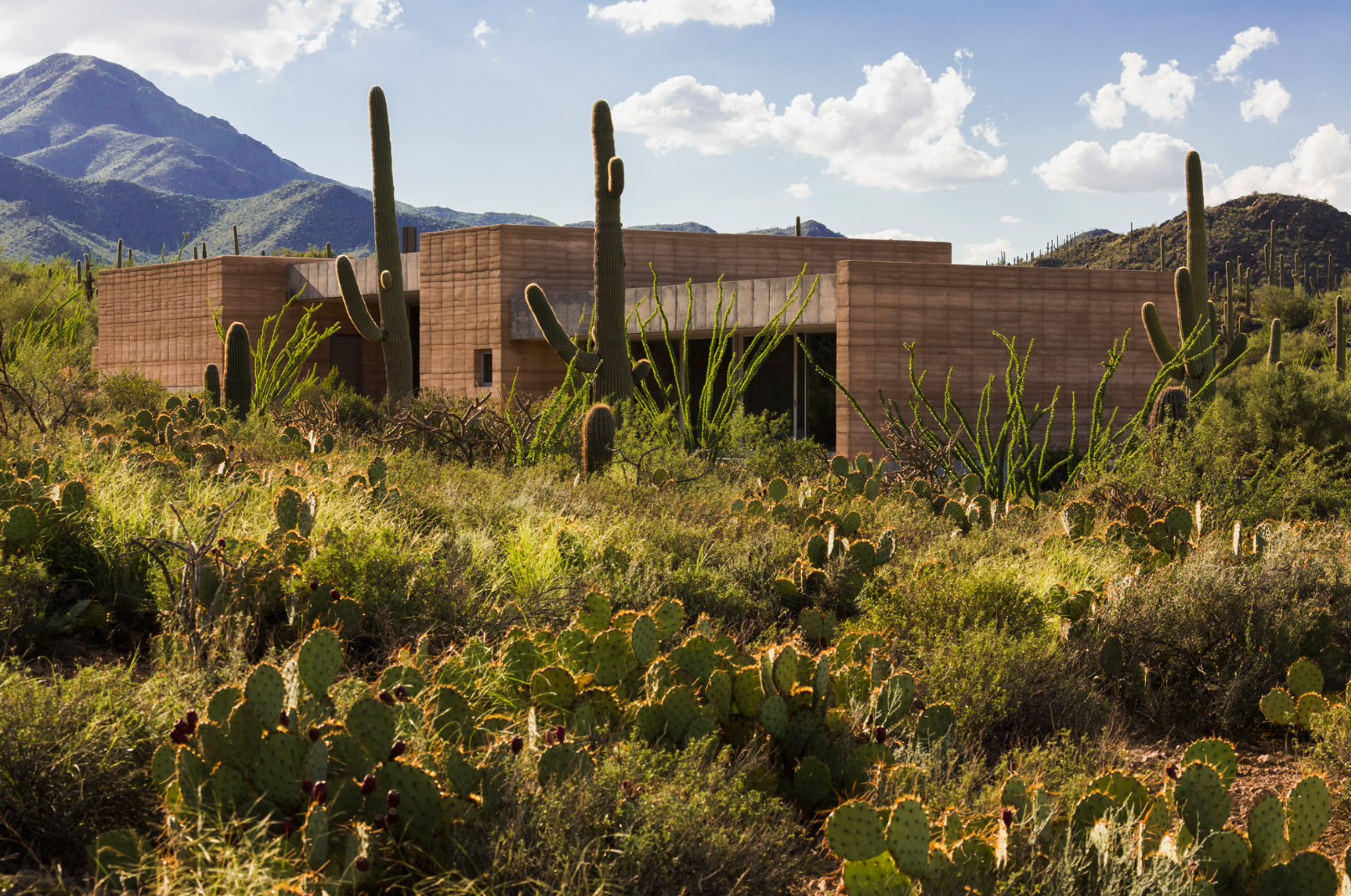
The project was designed by DUST (Design, Undertaking, Space, Territory), led by architects Cade Hayes and Jesús Robles. Completed in 2012 in the Tucson Mountains, Arizona, the approximately 2,300-square-foot residence reflects the studio’s commitment to material authenticity and desert-responsive architecture.
Photographed by Jeff Goldberg / Esto

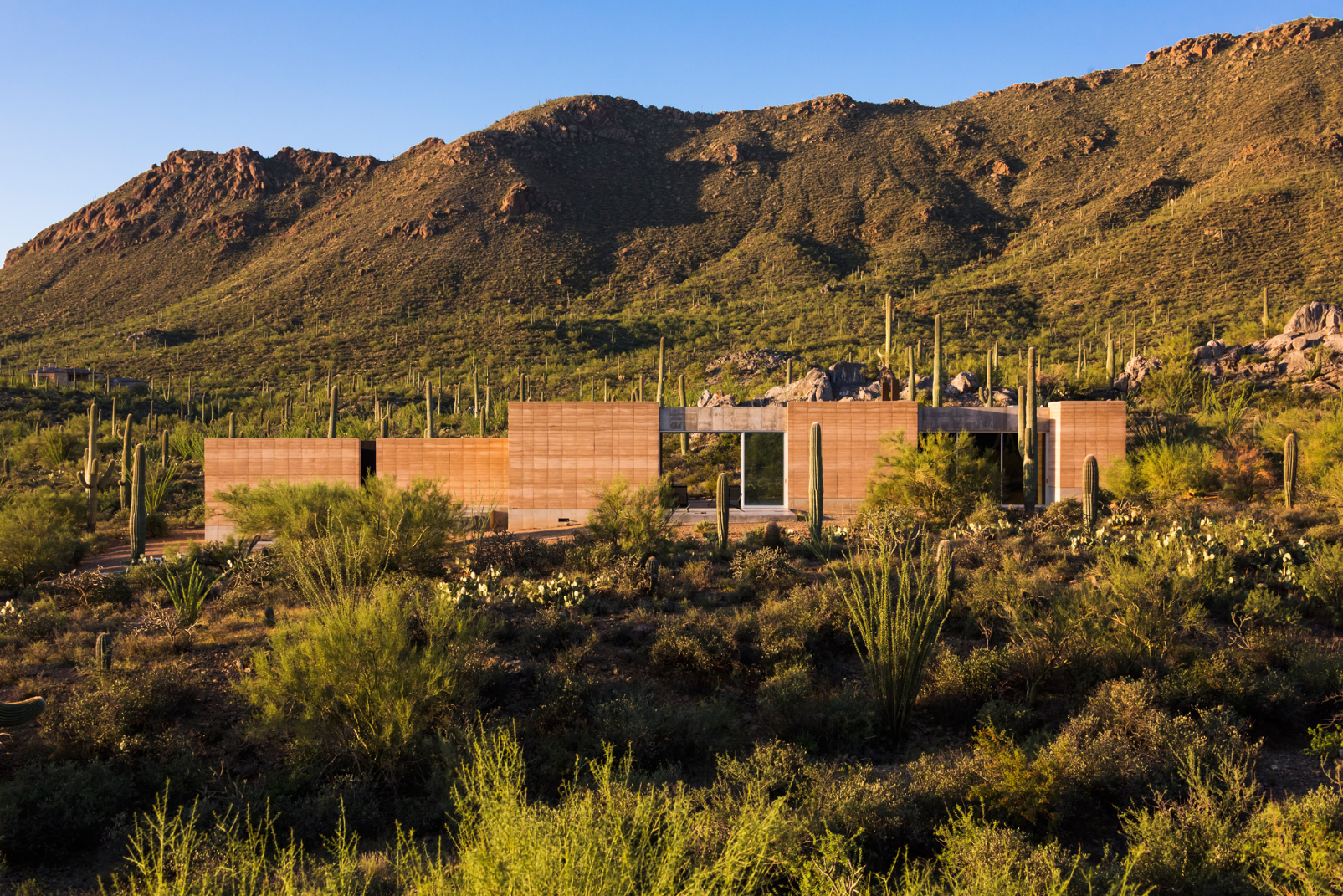
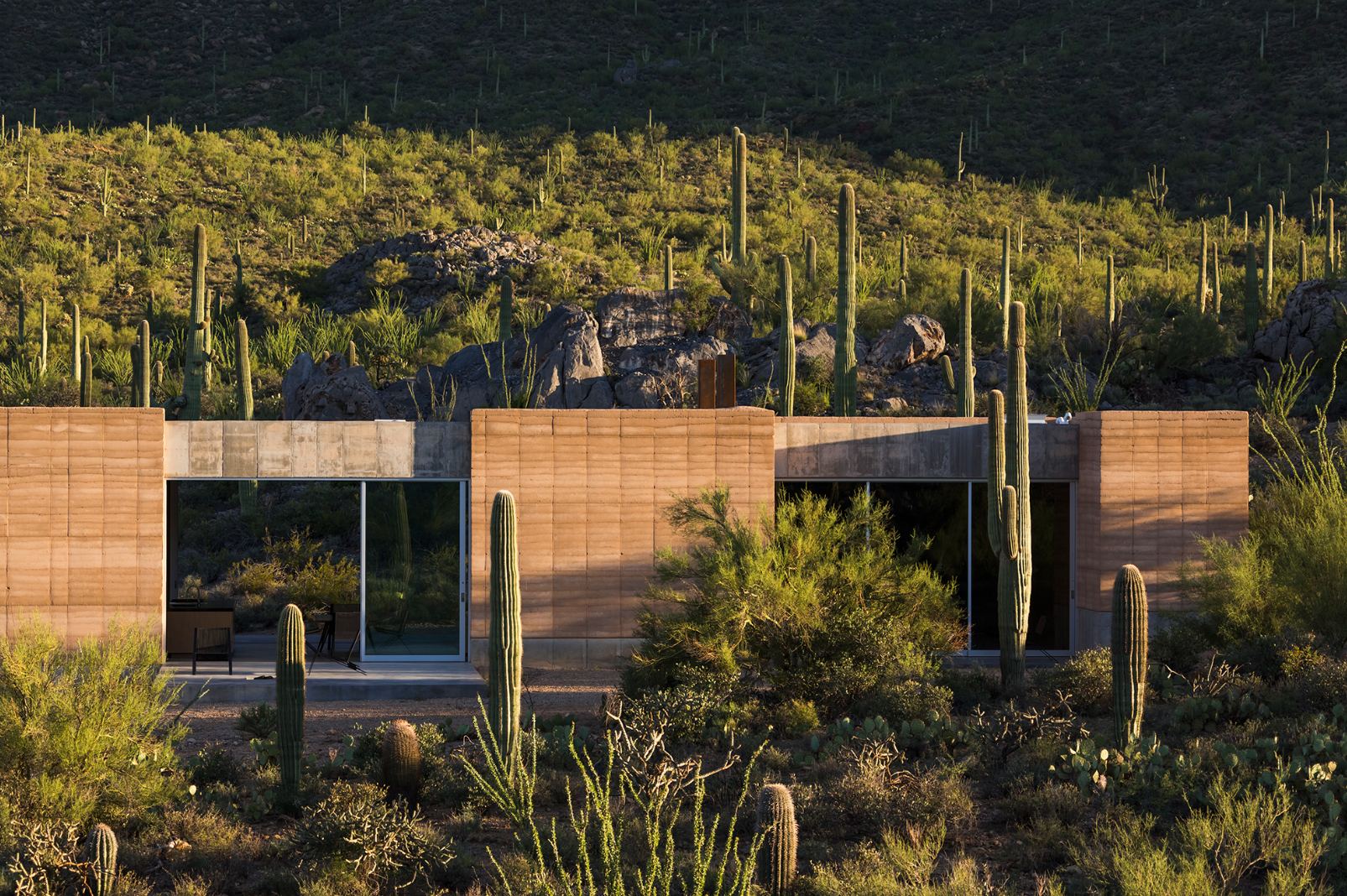
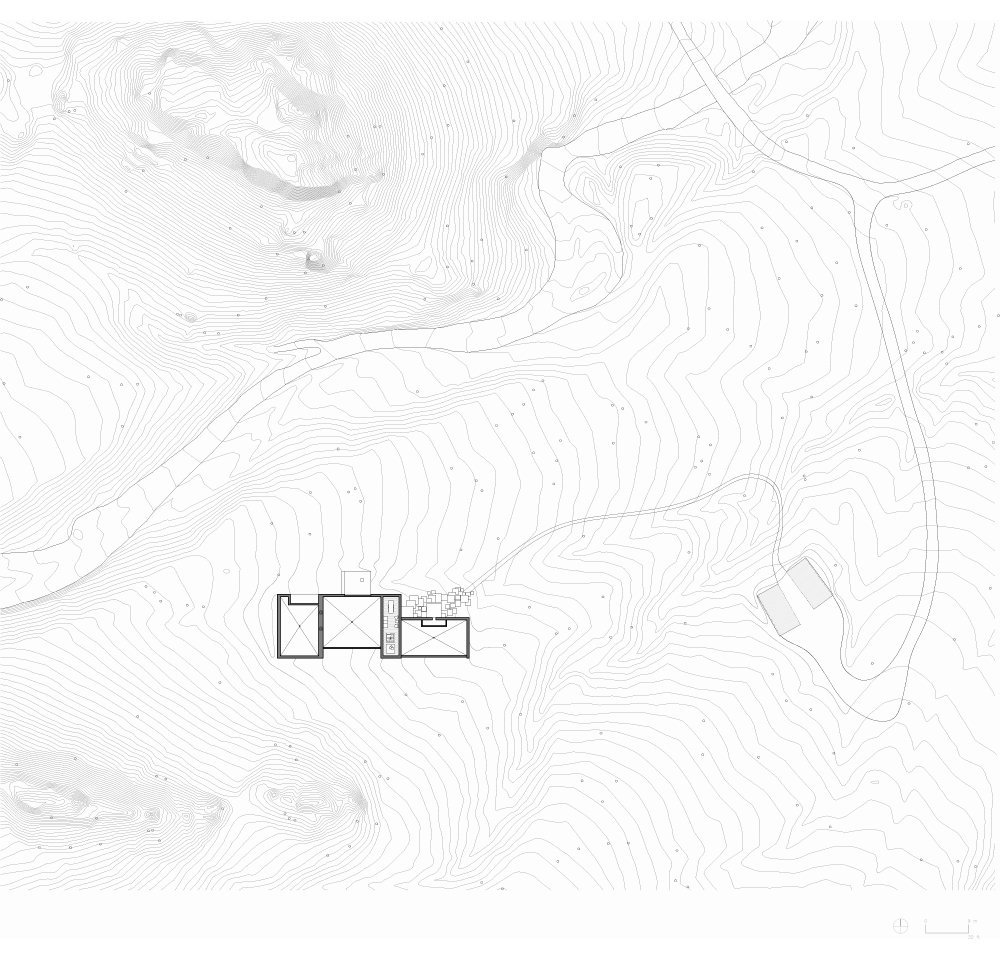
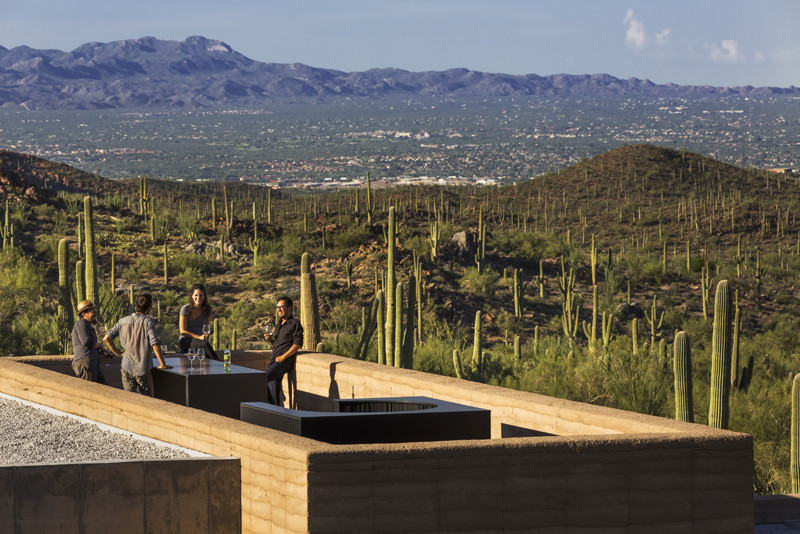
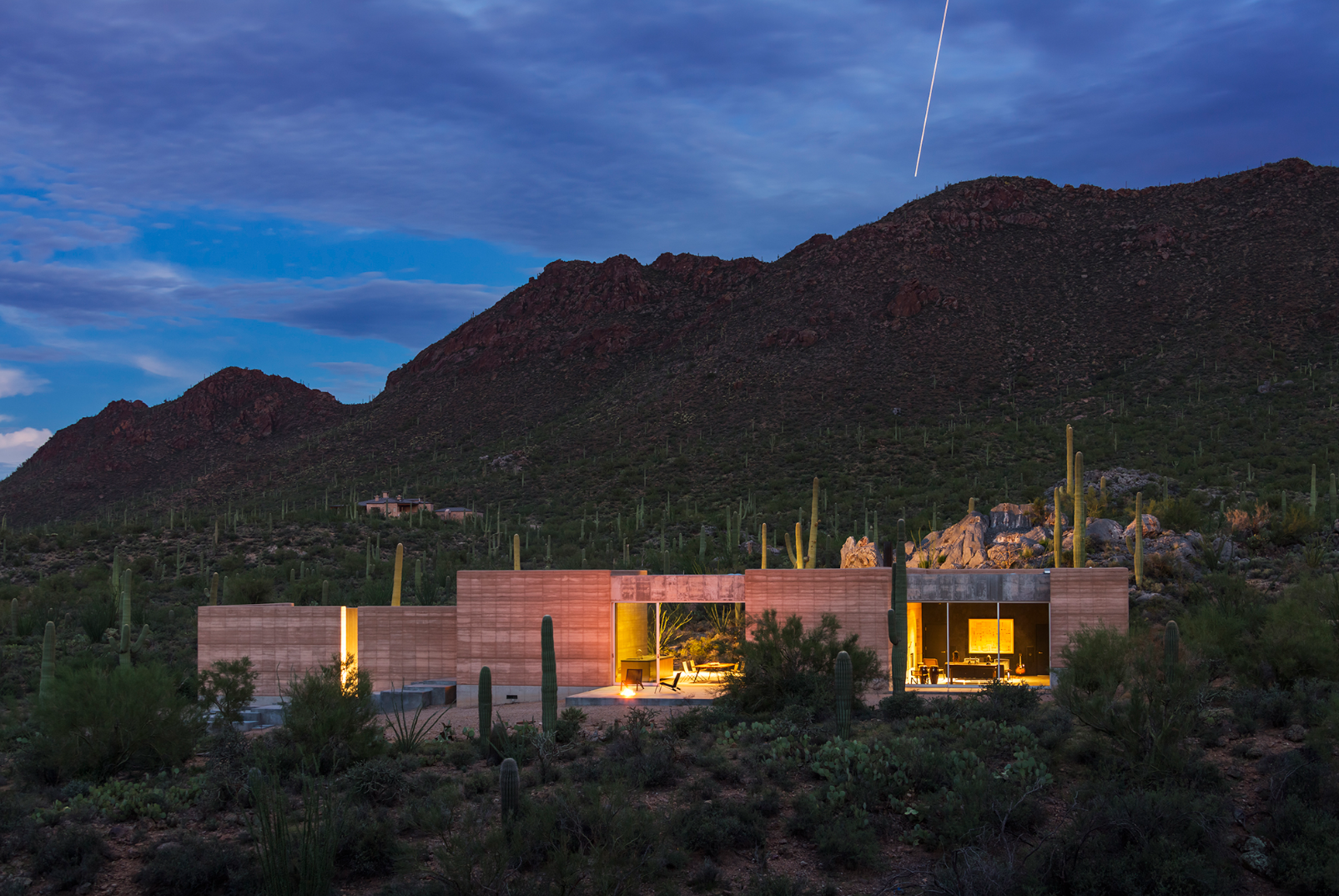
The Tucson Mountain Retreat is located along more than 900 feet of shared boundary with Saguaro National Park, embedded within the rugged and ecologically sensitive Sonoran Desert. Surrounded by dense stands of towering saguaro cacti, the site conveys a profound sense of stillness and geological permanence. The architecture responds not as an object placed upon the land, but as a form shaped by its climate, light, and topography.
Photographed by Jeff Goldberg / Esto
Site Plan | DUST

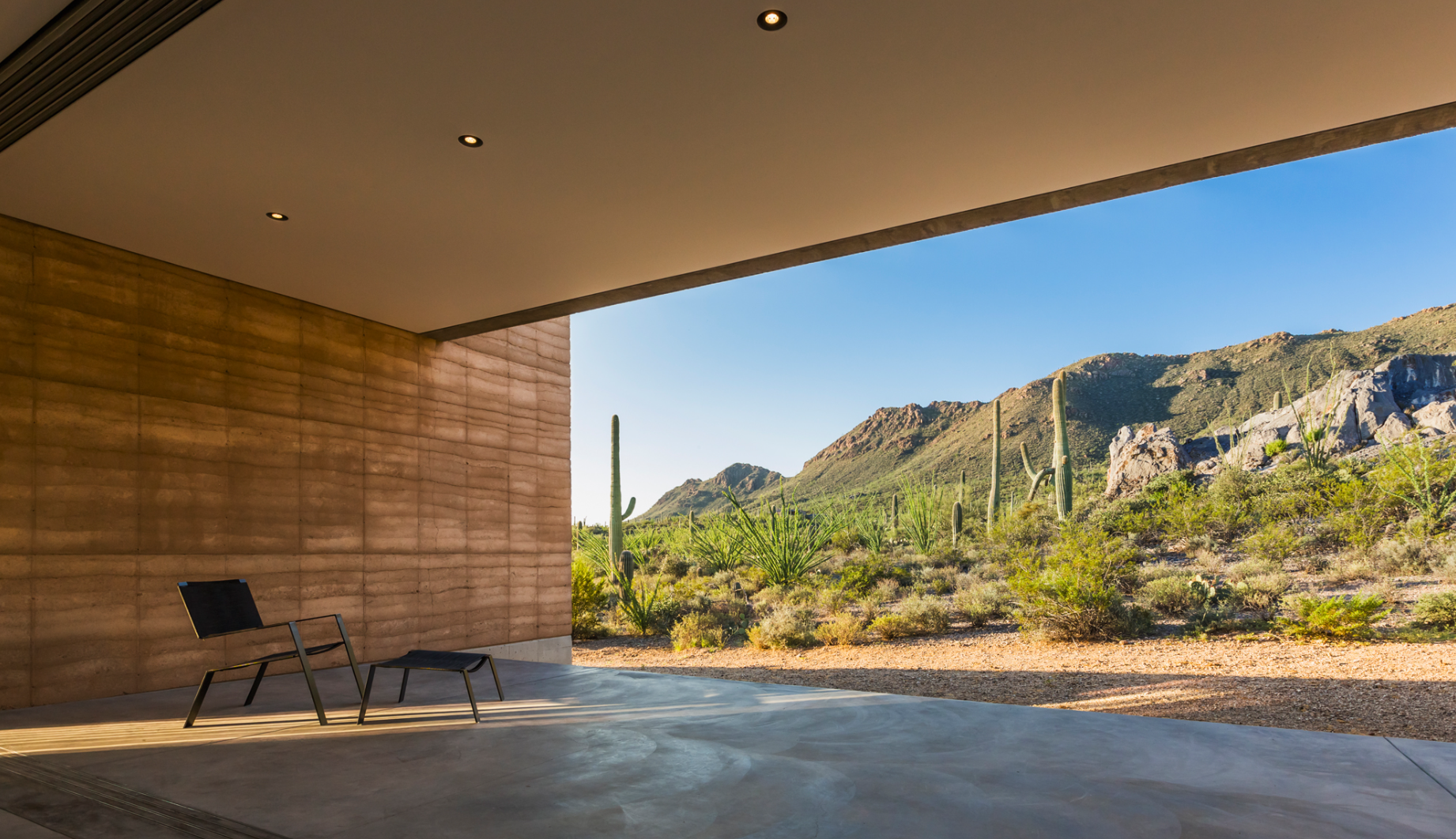
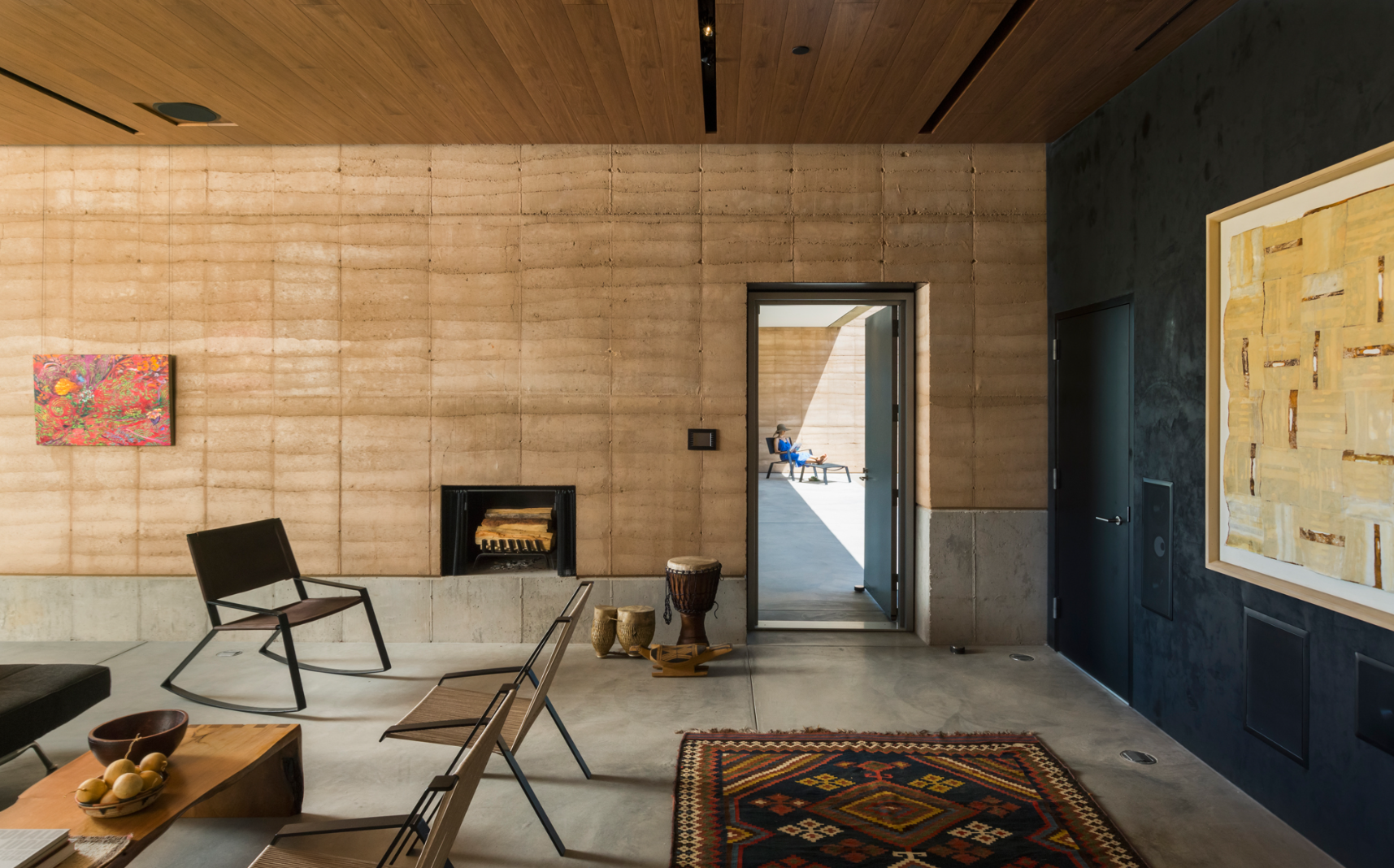
Conceived as an experiential rammed earth residence, the project approaches the desert landscape with restraint and reciprocity. The muted tones and layered texture of rammed earth define a restrained program that opens generously toward the horizon. Circulation sequences deliberately extend outdoors, folding landscape into daily life. Shifting desert light, filtered views, and seasonal changes become active participants in the spatial experience.
Photographed by Jeff Goldberg / Esto

The clients—a physician from San Diego and his wife—sought both reconnection to the desert landscape and a space that supports music as an integral part of daily life. The program includes living spaces, bedrooms, and a dedicated music studio. A clear separation strategy organizes these functions to enhance site integration while ensuring acoustic isolation between the studio and private areas.
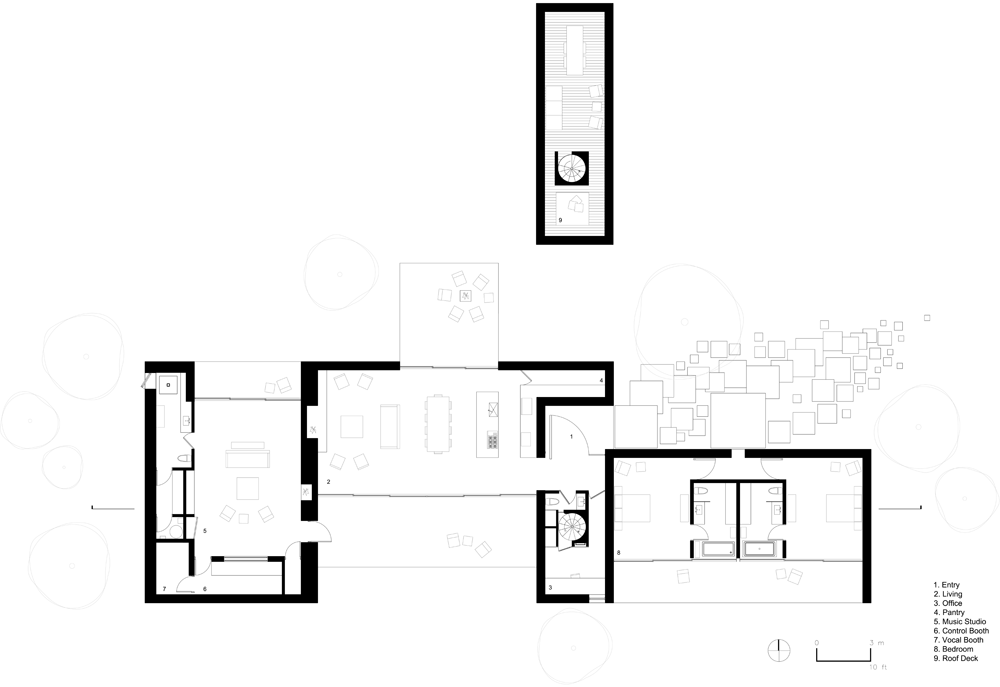
1&2F Plan | DUST
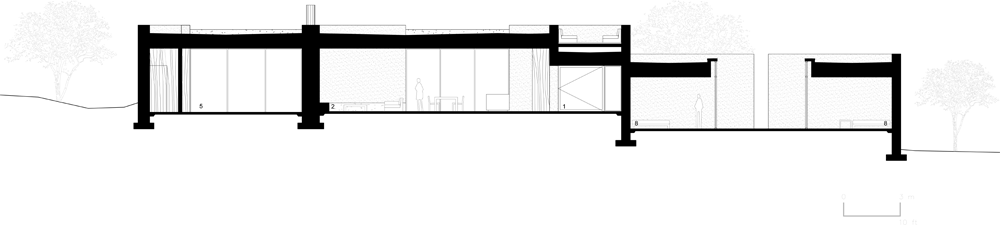
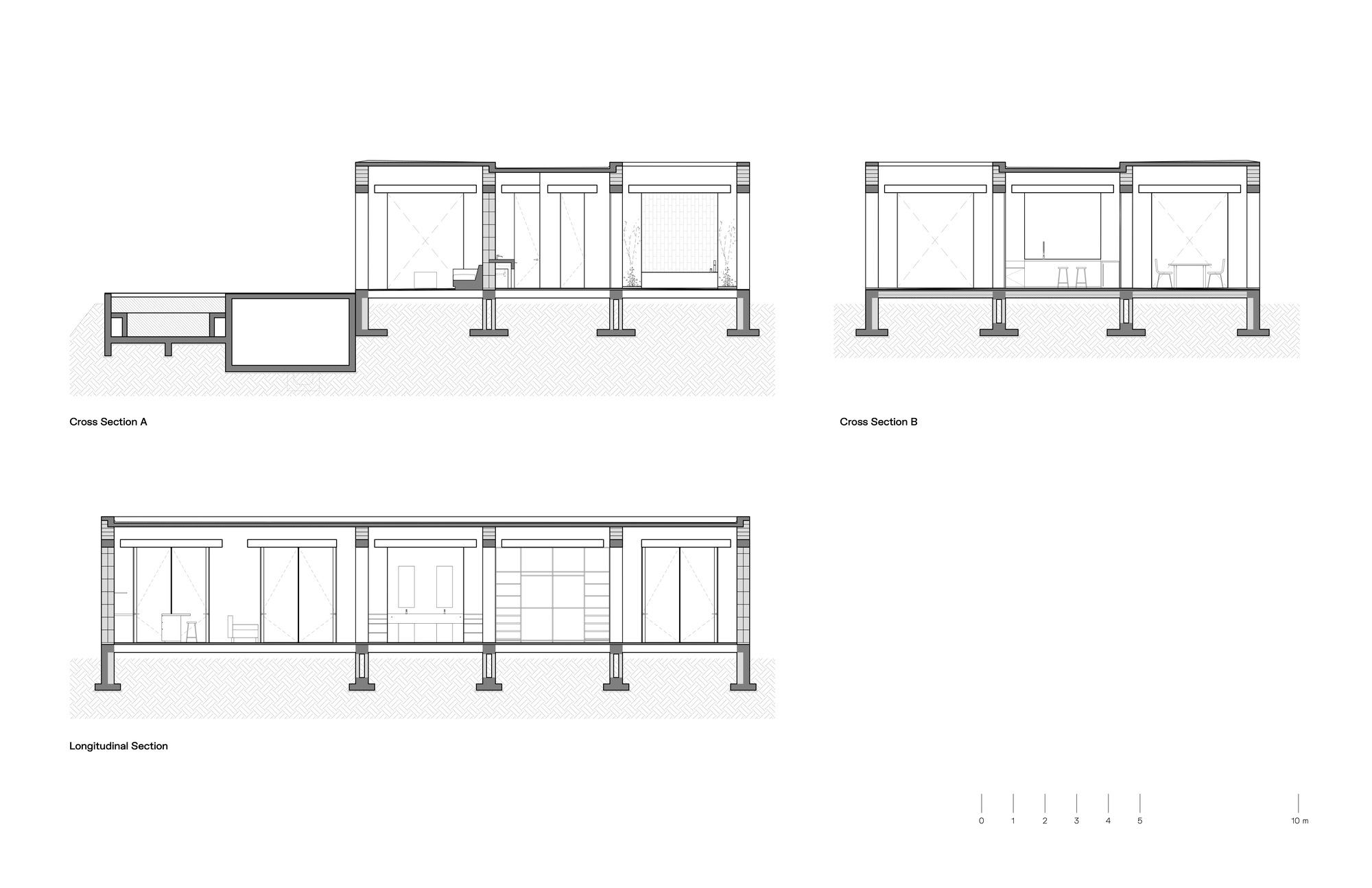
Section | DUST
Photographed by Jeff Goldberg / Esto

The structural system integrates load-bearing rammed earth walls with concrete and steel elements, while large operable glazing systems frame expansive views of Saguaro National Park and facilitate cross-ventilation.

Photographed by Jeff Goldberg / Esto

Arrival is marked by a sequence of fractal concrete cubes that offer an open-ended path toward two separate entries: midway up the ascent, a narrow slit marks the bedroom entry, while a dark square void defines the main entry.
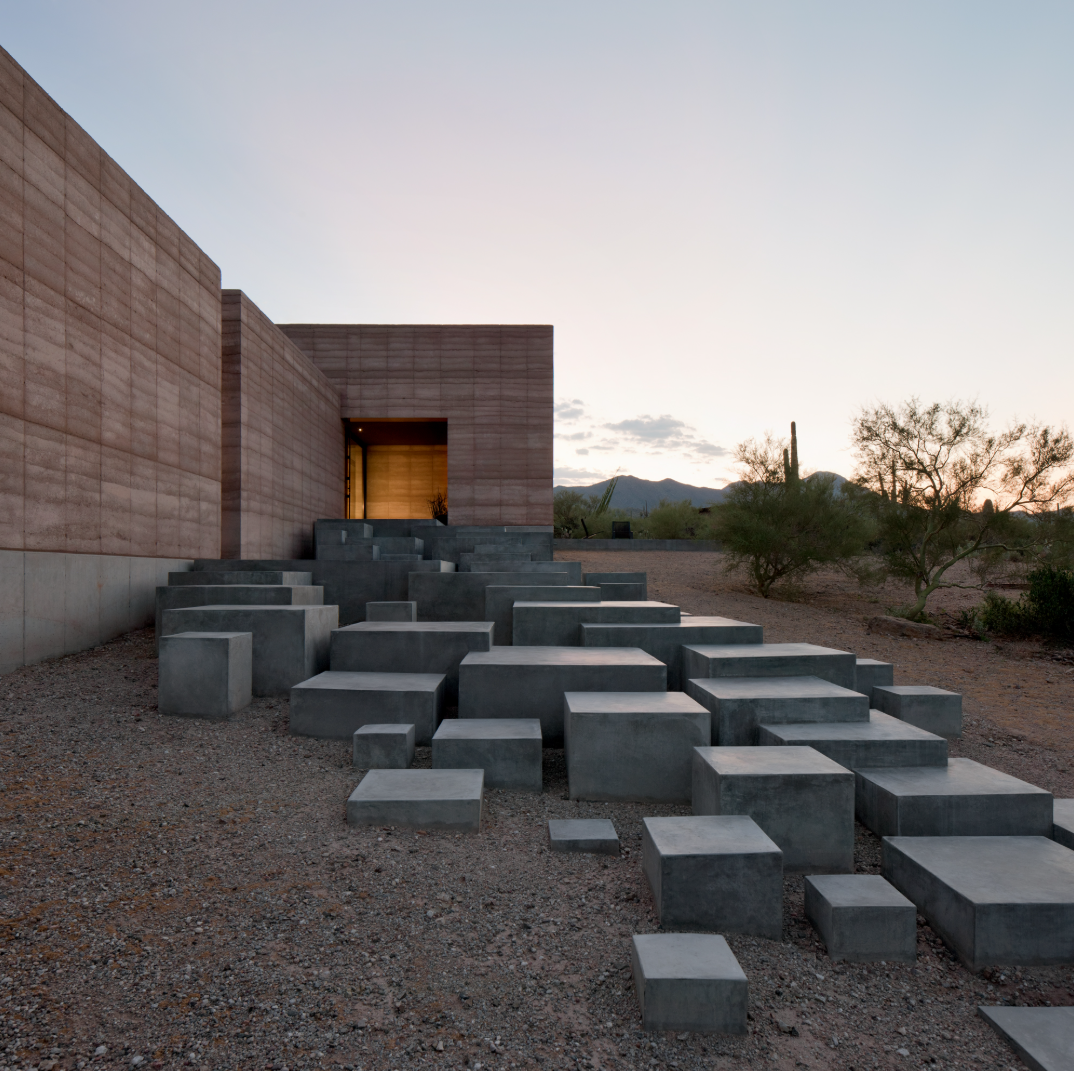
Photographed by Bill Timmerman

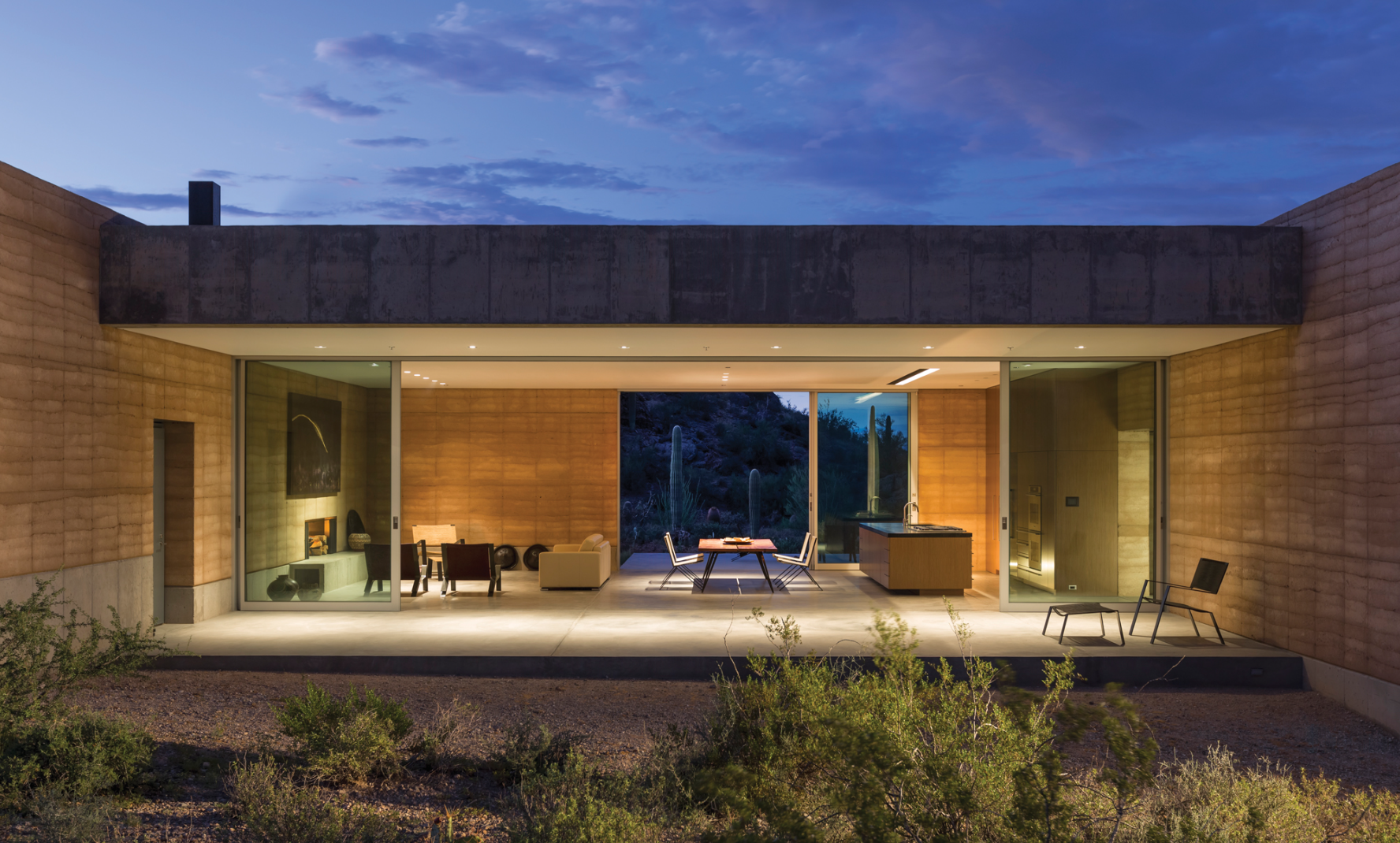
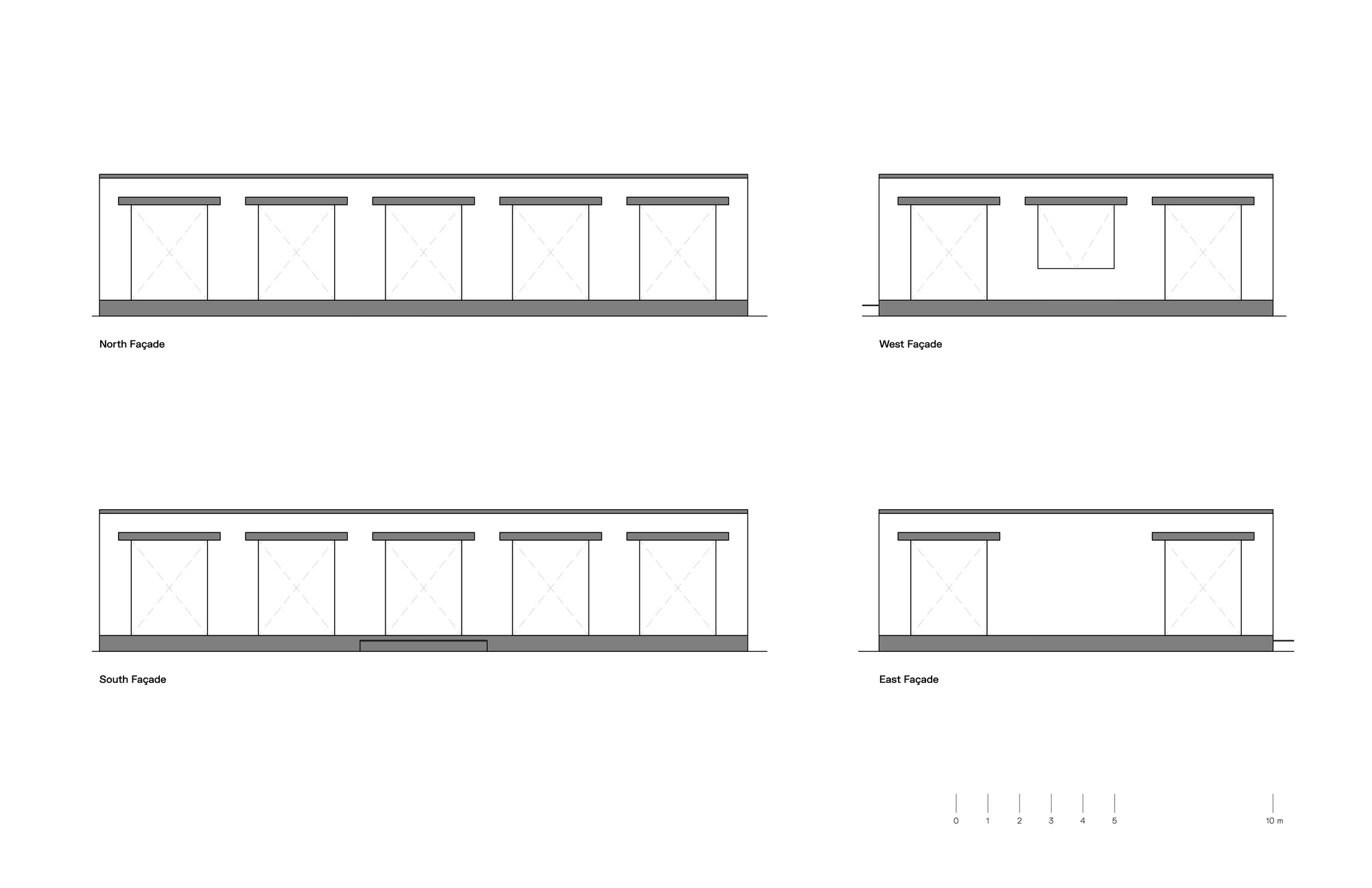
Rammed earth walls traverse the plan, dividing it into three primary zones while providing thermal mass and acoustic buffering. The central living space, open to both north and south, acts as the core of the house and as a transitional buffer between the music studio to the west and the sleeping quarters to the east.
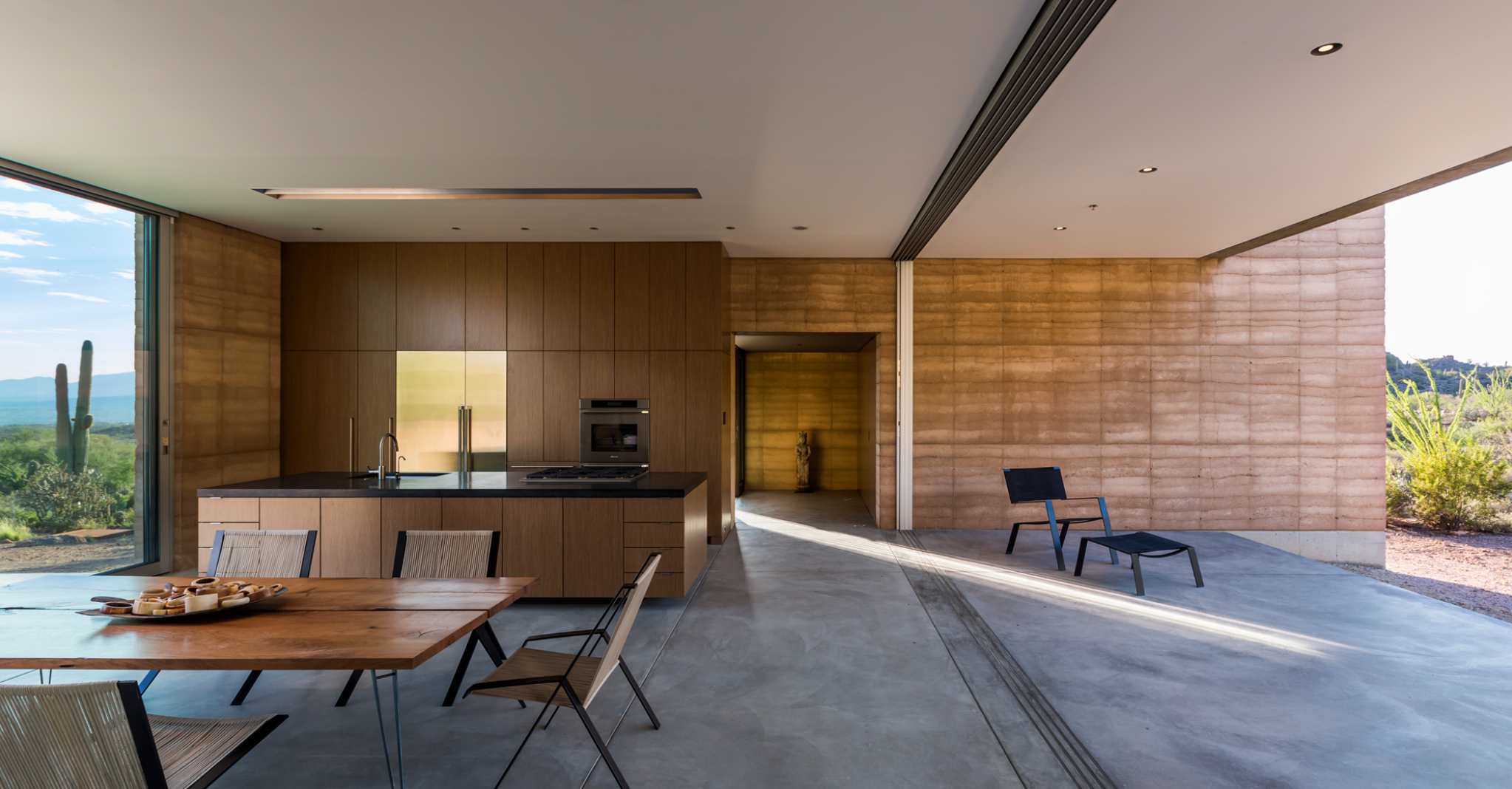
Photographed by Jeff Goldberg / Esto

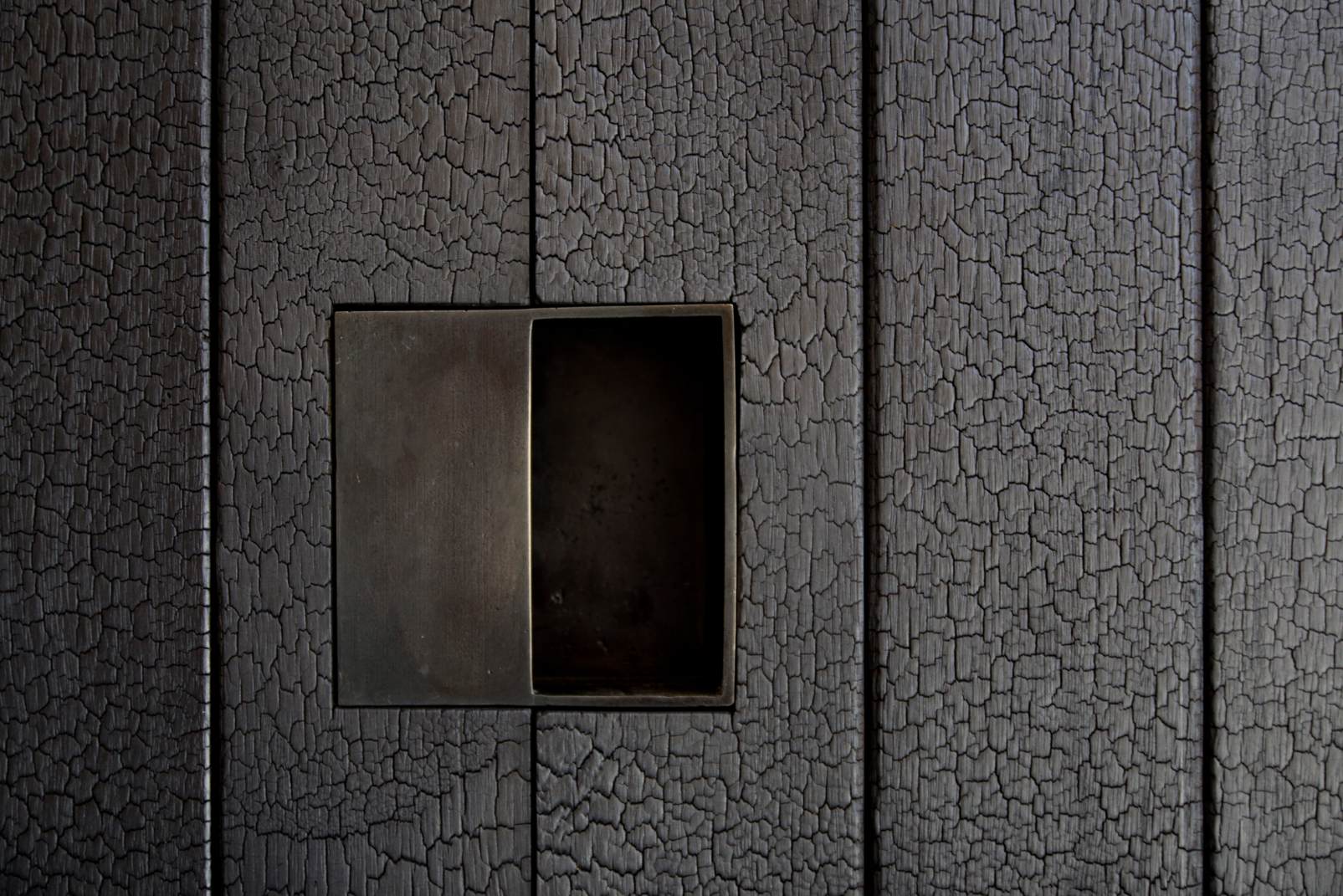
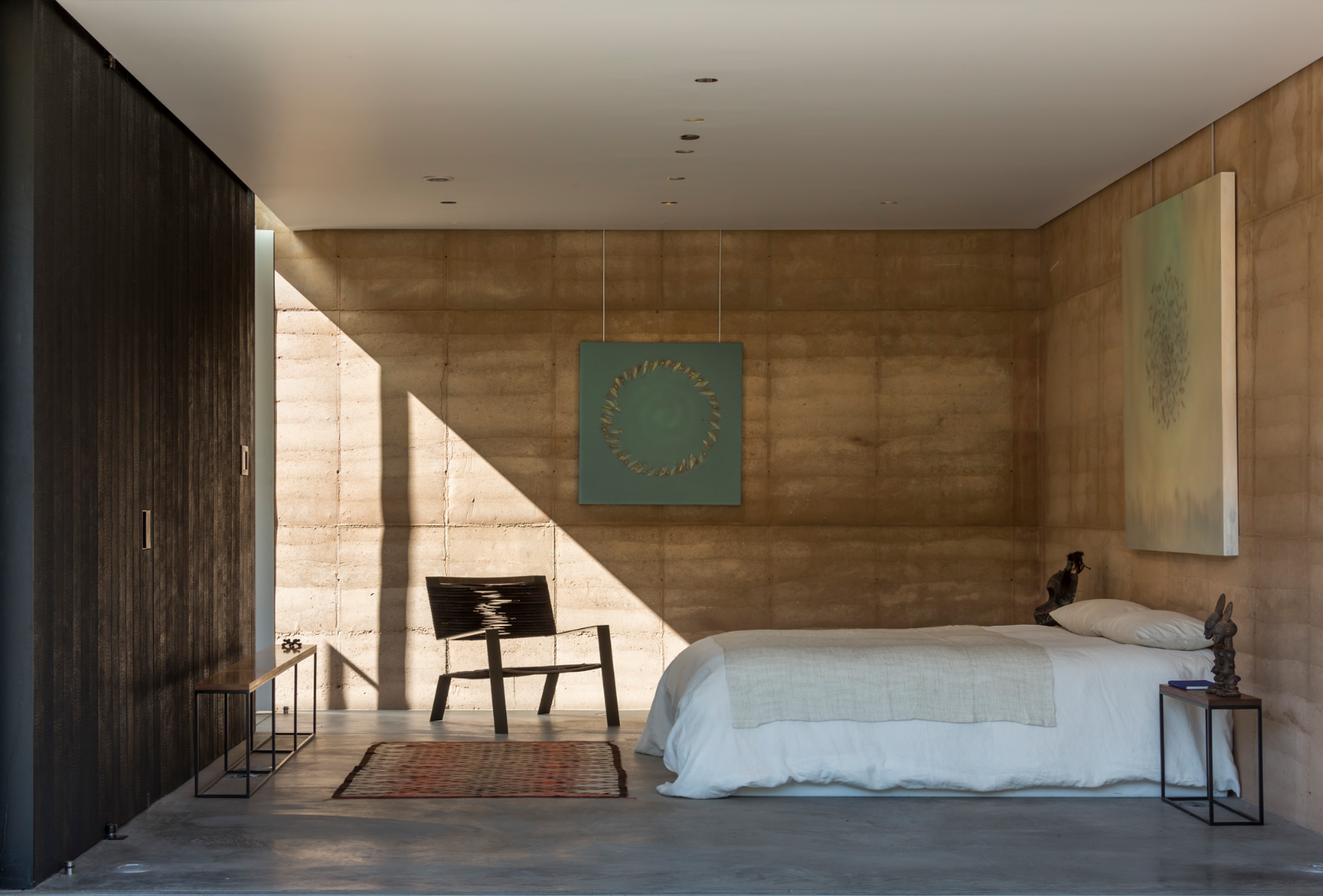
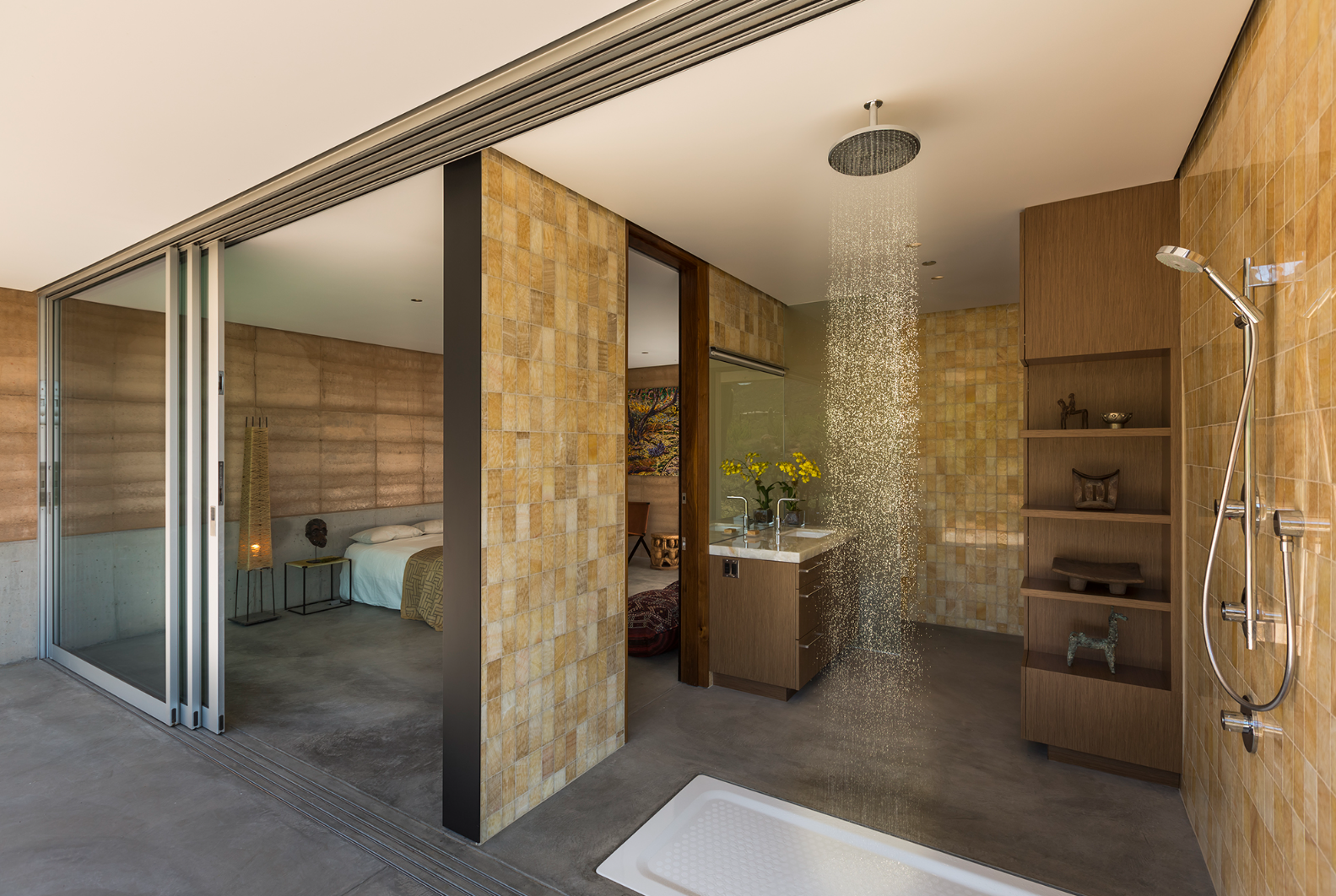
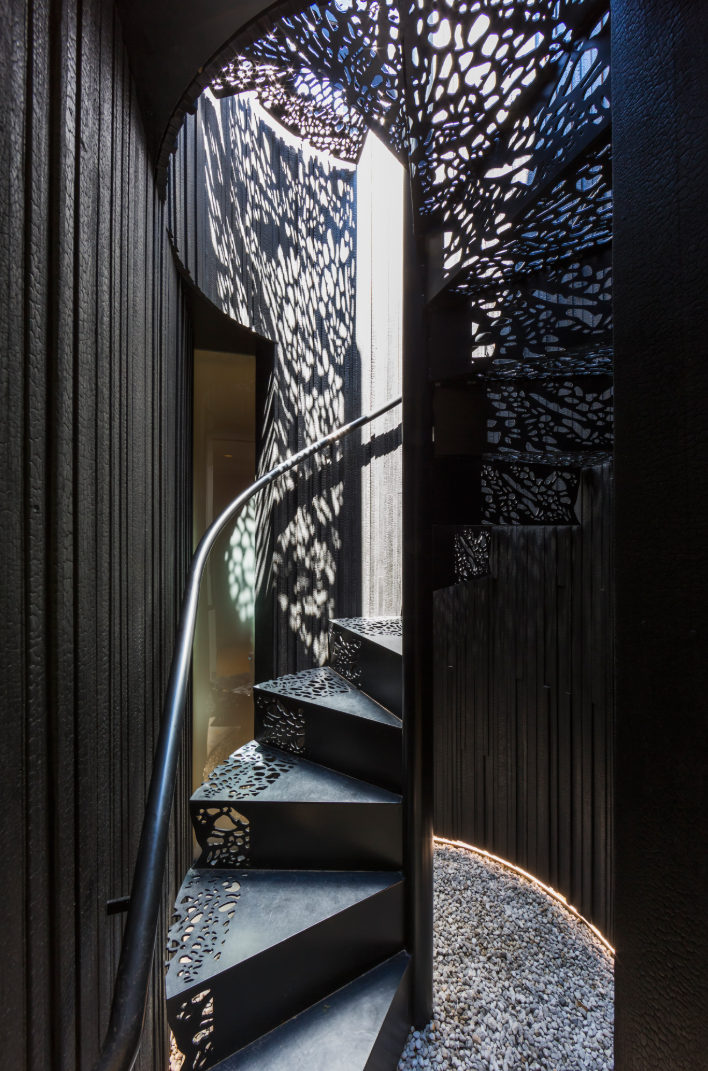
Material and sensory engagement are central to the design. Spanish cedar introduces warmth and scent in the bedrooms, while charred wood surfaces in the bathroom core evoke the cracked textures of a drought-stricken desert floor.
Photographed by Jeff Goldberg  / Esto
Photographed by Jeff Goldberg / Esto
Photographed by Jeff Goldberg / Esto

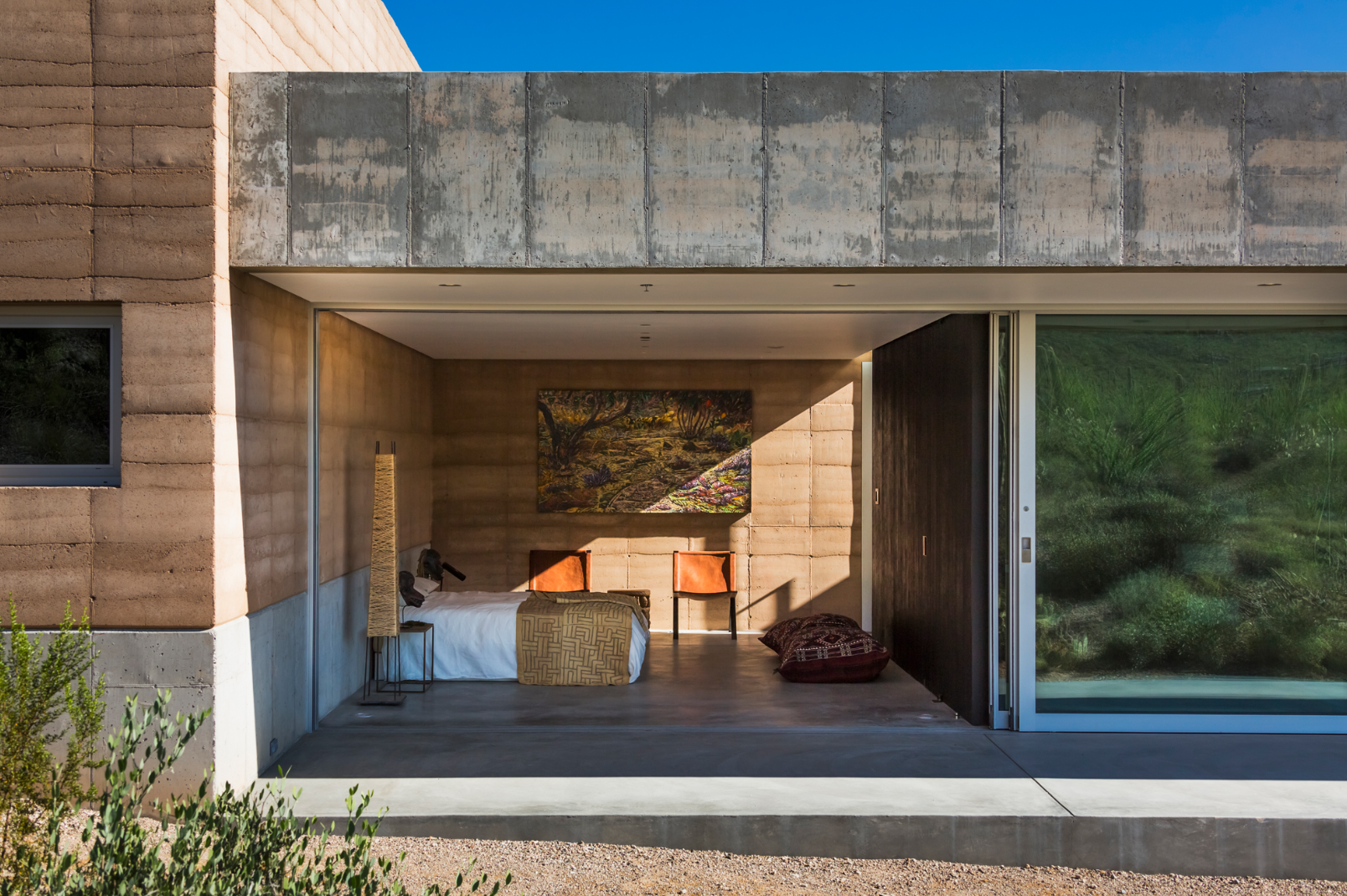
Each programmatic component is accessed via exterior passages, encouraging repeated engagement with the landscape.
Photographed by Jeff Goldberg / Esto

Above, a spiral stair leads to a roof deck oriented toward expansive desert views and night skies.
Photographed by Jeff Goldberg / Esto

When large sliding glass panels retract, the house dissolves into a shaded, ramada-like pavilion, animated by wind, scent, and the changing desert light.
Photographed by Jeff Goldberg / Esto

Lara Fuster Prieto: Earth House

South Facade © Milena Villalba

Architects: Lara Fuster Prieto

Location: Boadilla de Rioseco, Spain

Year: 2022

Area:  142 m² (1,500 sqft)

Construction: Local Adobe

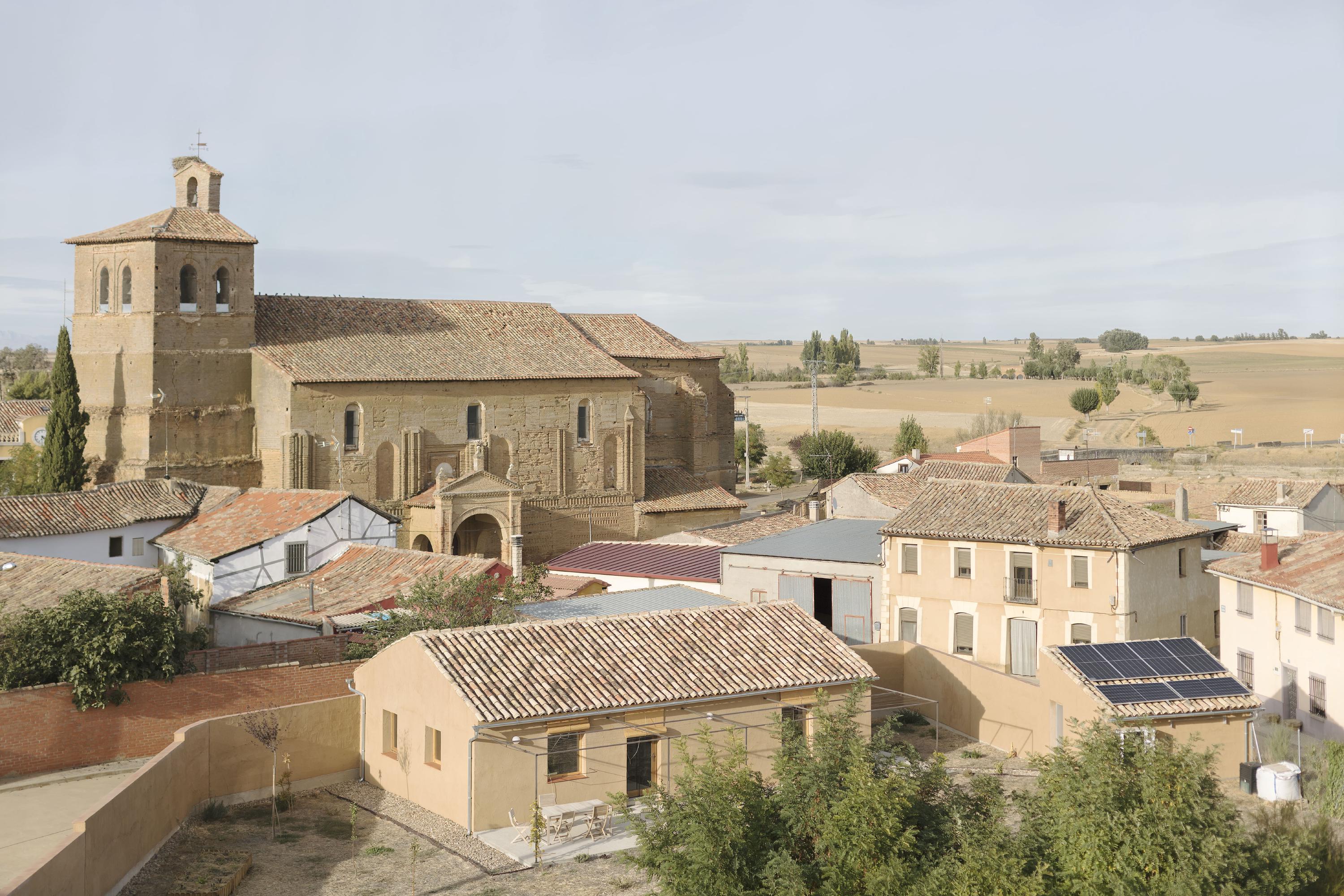
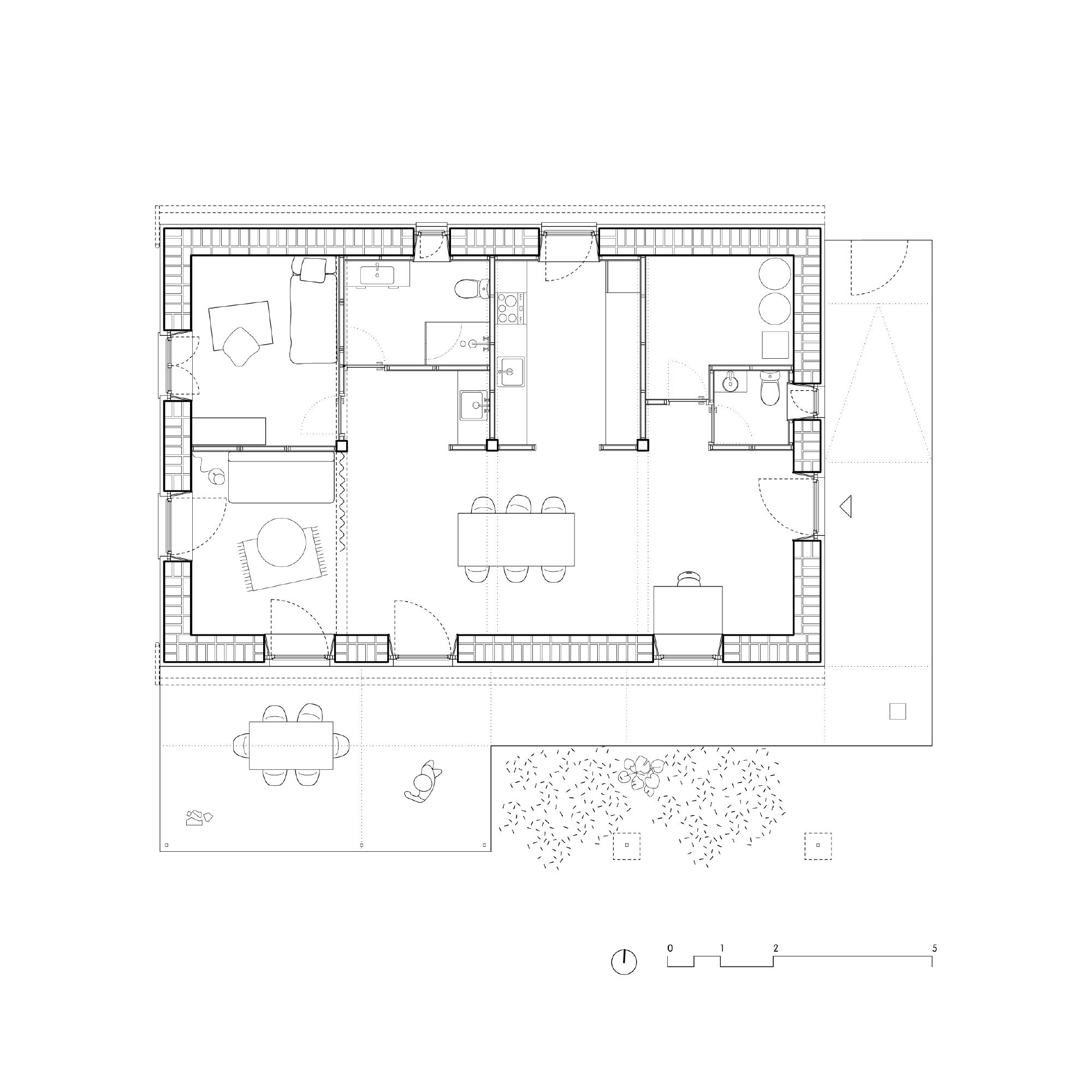
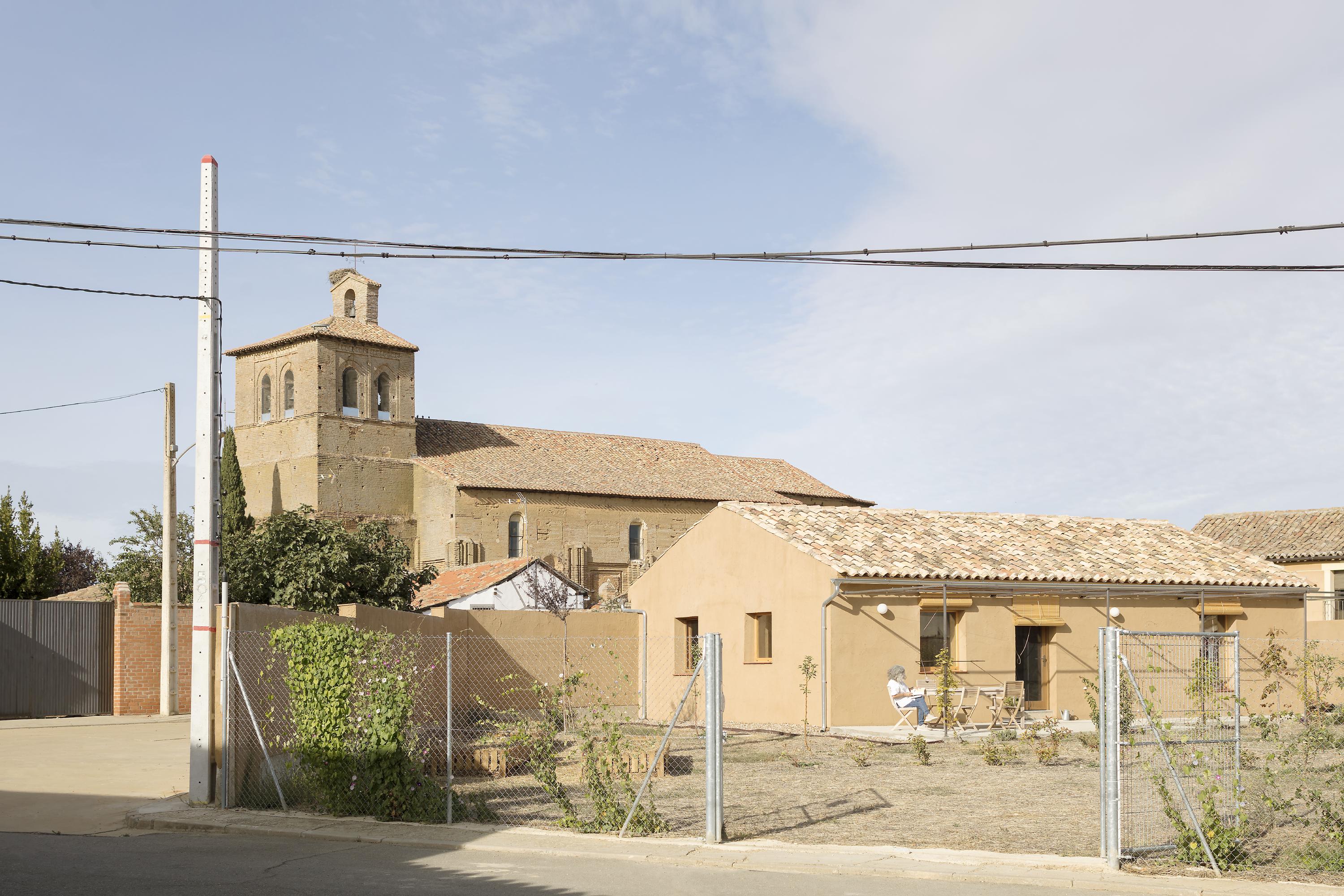
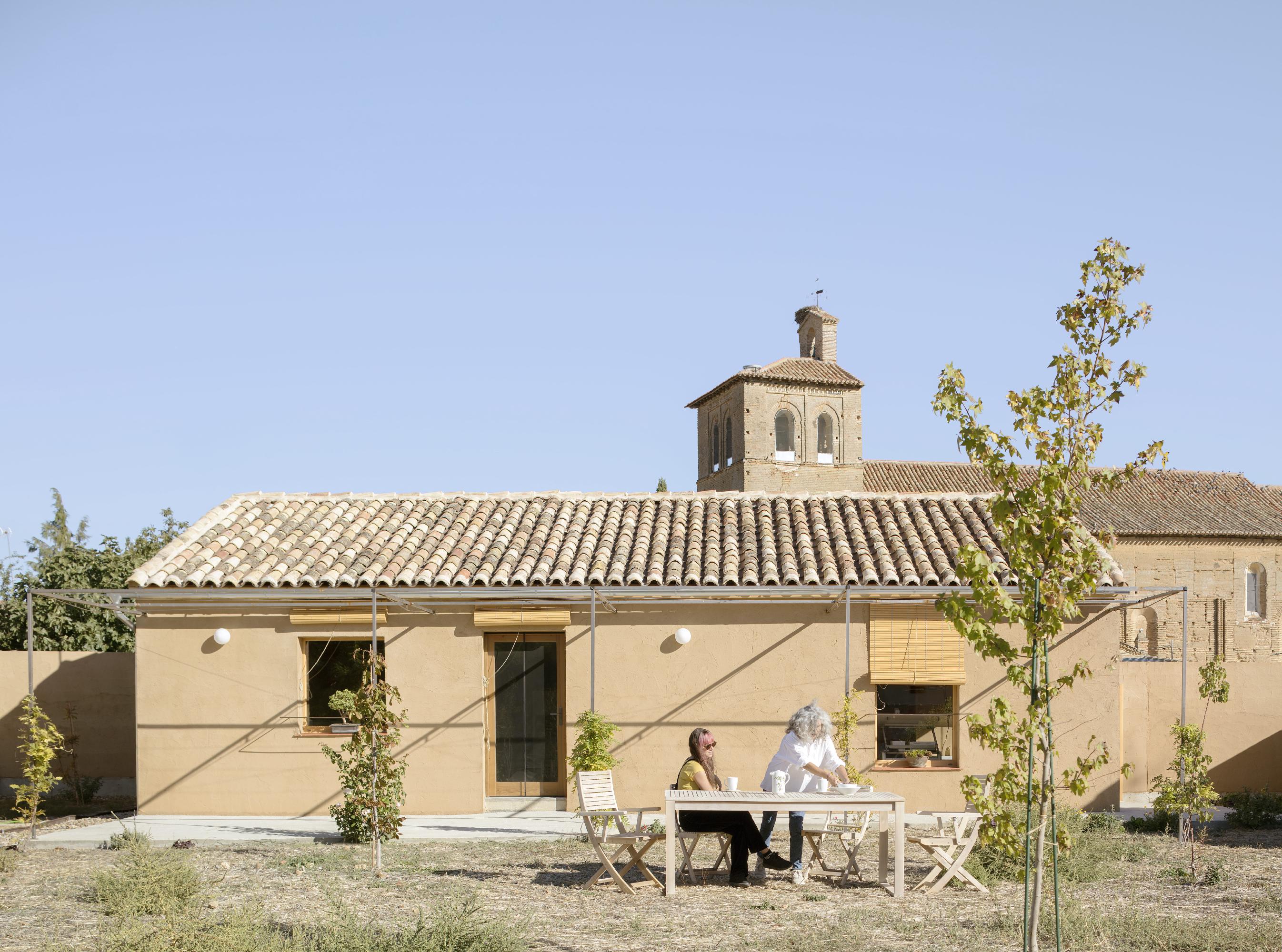
Earth House, designed by Lara Fuster Prieto, is located in the small town of Boadilla de Rioseco in rural Spain. The project explores how traditional building methods can still work for contemporary life. The house is designed as a permanent residence and focuses on sustainability, energy efficiency, and thermal comfort, while keeping its environmental impact low.

Aerial photo of the house and the town © Milena Villalba
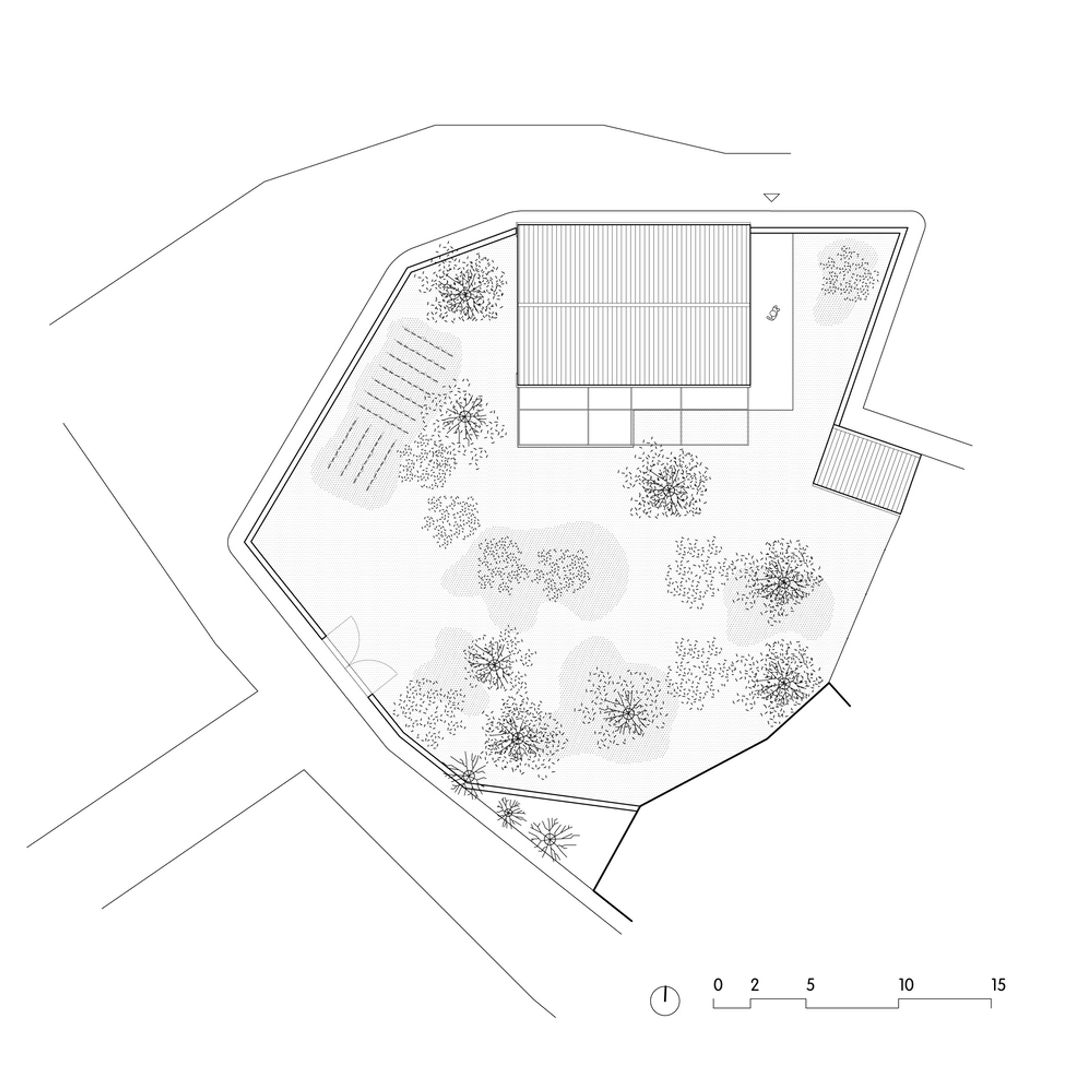
Site Plan © Lara Fuster Prieto
Floor Plan © Lara Fuster Prieto

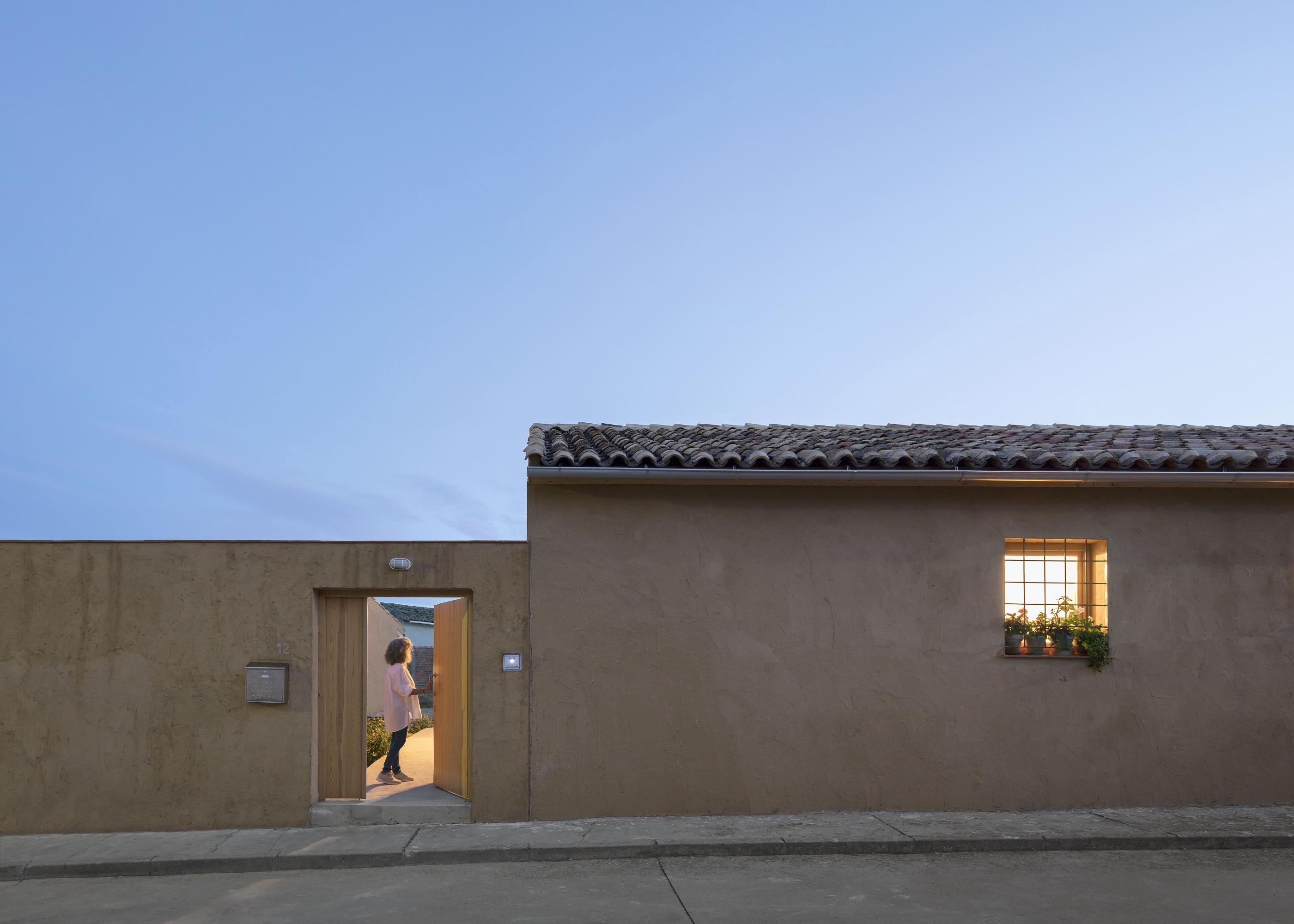
The building has a simple rectangular shape made up of four parallel bays running east to west, which helps maximize sunlight throughout the day. The north façade faces the street and has smaller, unevenly placed windows, similar to traditional houses in the area. On the south side, the house opens up with large windows that act as solar collectors during the winter months. In the summer, wooden shutters and a pergola covered with deciduous vines provide shade and help prevent overheating naturally.

The structure is built using load-bearing adobe walls made from locally produced bricks measuring 33 × 15 × 10 cm, sourced within 40 kilometers of the site. These walls are insulated on the exterior with cork panels, creating an external insulation system that greatly improves energy performance. The gable roof is made from a wooden sandwich panel with cork insulation and finished with reused curved clay tiles, allowing the house to blend in with the surrounding village buildings. Instead of cement, lime mortar mixed with straw is used for the exterior plaster. This material is breathable, helps regulate moisture, and is more sustainable over time. Wooden doors and windows further reduce the home’s carbon footprint, while roll-up shutters act as passive sun protection.

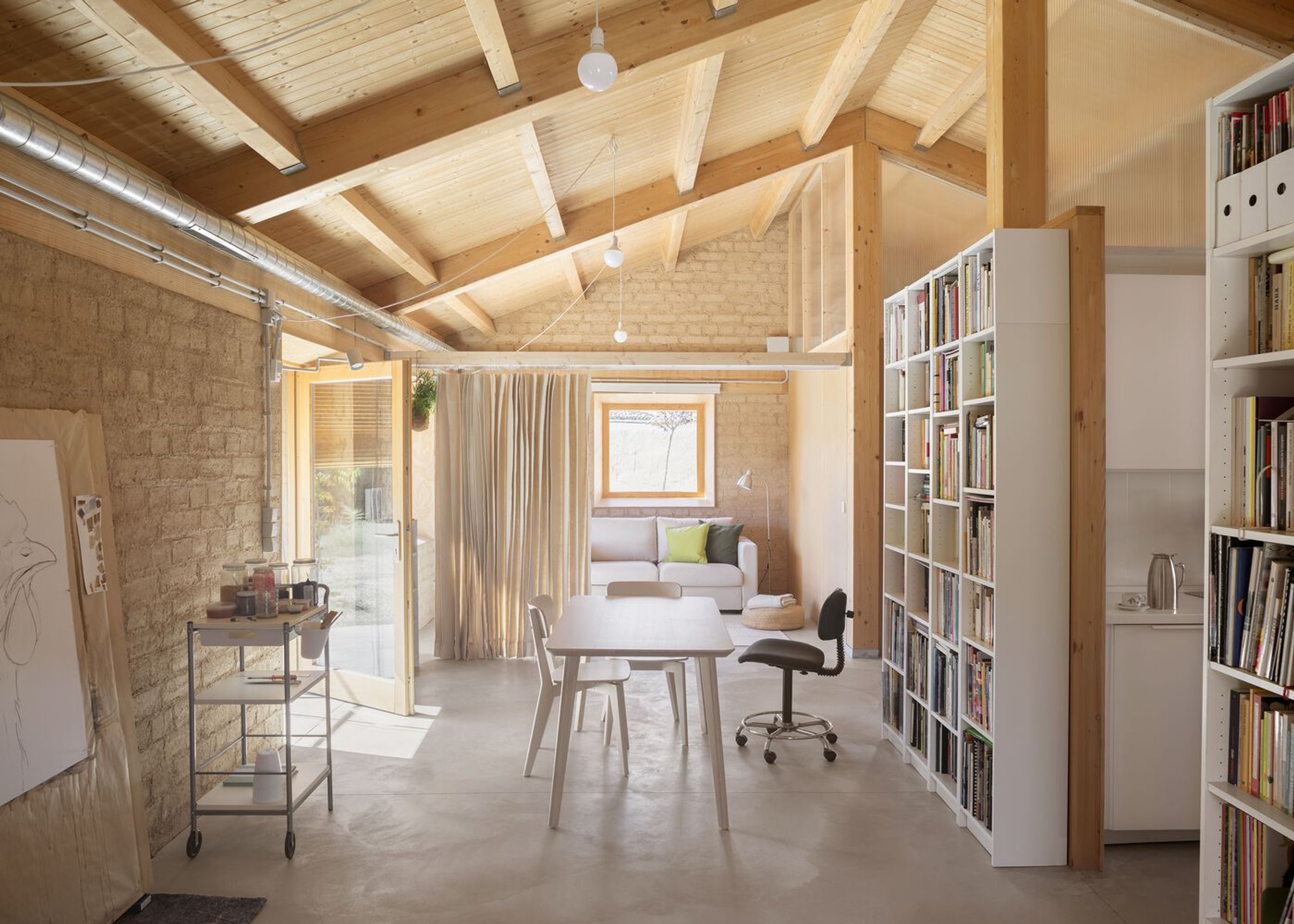
Living Room © Milena Villalba


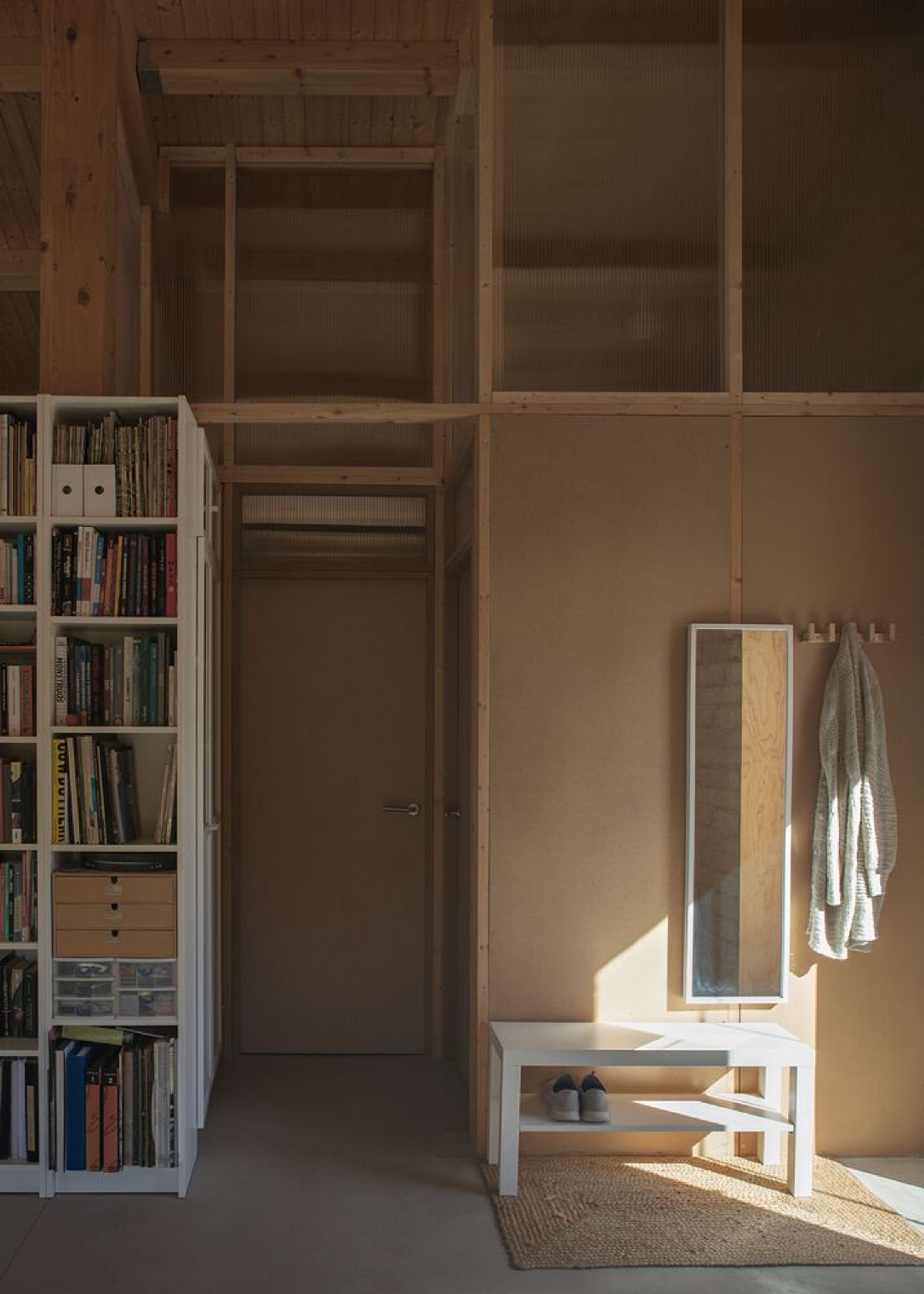
Inside the house, the partitions are lightweight and built with exposed wooden slats, recycled cotton insulation, and medium-density wood boards. To bring in more natural light and create a sense of openness, the upper portions of these walls include polycarbonate panels. Some of the adobe walls are left exposed, highlighting the material and giving the interior a warm, earthy feel.

Thanks to the thermal mass of the adobe, the house maintains stable indoor temperatures between 22 and 24°C during the summer, even when outdoor temperatures reach over 40°C. Because of this passive performance, the house does not require any active cooling systems and achieves an A-rated energy classification. In the winter, underfloor heating is used, inspired by the traditional “glorias” heating system found in the region.

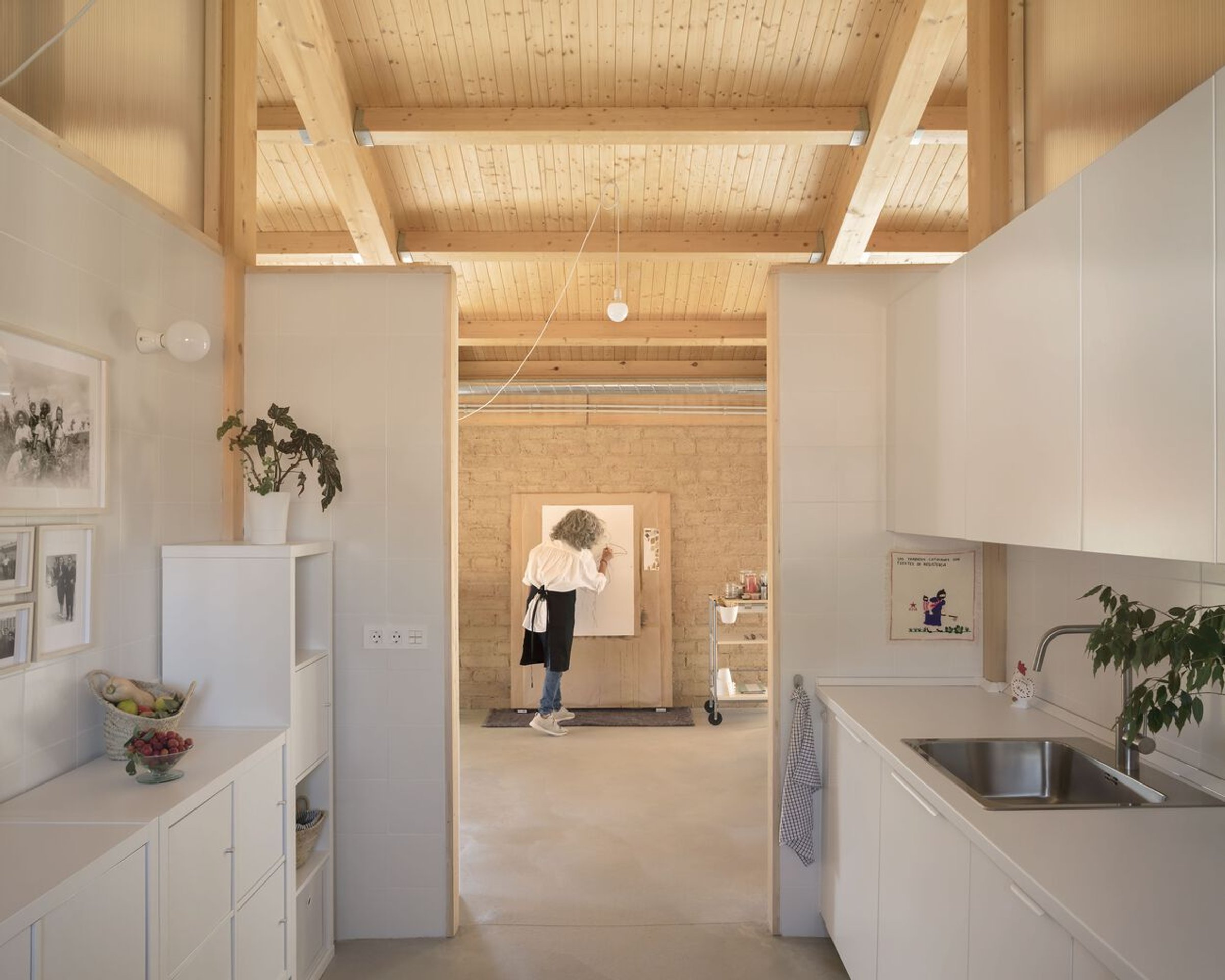
Kitchen © Milena Villalba
Entrance © Milena Villalba

In summary, the Earth House project focuses on reducing environmental impact while using local, traditional materials to stay connected to its cultural context.

Exterior Photo from Street © Milena Villalba
© Milena Villalba

Fuster Prieto, Lara. Earth House by Lara Fuster Prieto: A Sustainable Adobe Home in Rural Spain. UNI.xyz, 2 Apr. 2025, www.uni.xyz/journals/earth-house-by-lara-fuster-prieto-a-sust.

Fuster Prieto, Lara, and Milena Villalba. Casa de Tierra / Earth House Project Details. Divisare, 2023, www.divisare.com/projects/480657-lara-fuster-prieto-milena-villalba-casa-de-tierra


Donald Judd and Adobe

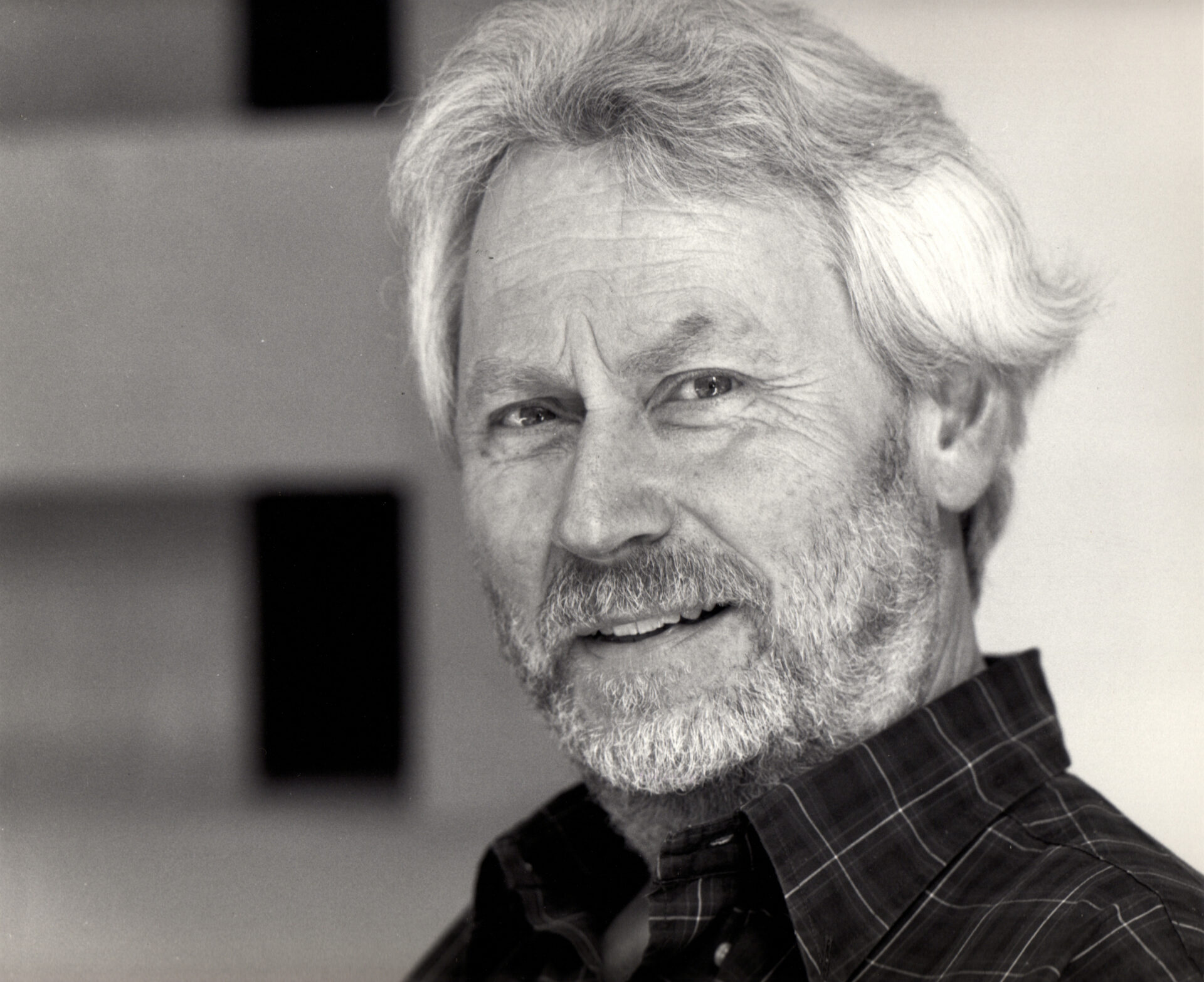
Donald Clarence Judd (1928–1994) was an American artist best known for his role in the development of Minimalism. His work has had lasting influence on art, architecture, and design.

Donald Clarence Judd © Judd Foundation.

Judd was born in Excelsior Springs, Missouri. He studied philosophy and art history at Columbia University and later painting at the Art Students League in New York. He worked as a painter until the early 1960s, when he began producing three-dimensional works that challenged conventional definitions of sculpture. These works emphasized repetition, clarity, and structural logic rather than representation.

By the early 1970s Judd had become dissatisfied with the temporary nature of gallery exhibitions. He believed art needed a permanent and carefully defined setting. In 1971 he moved to Marfa, Texas, where he began purchasing buildings and land in order to establish long-term installations under his own direction.

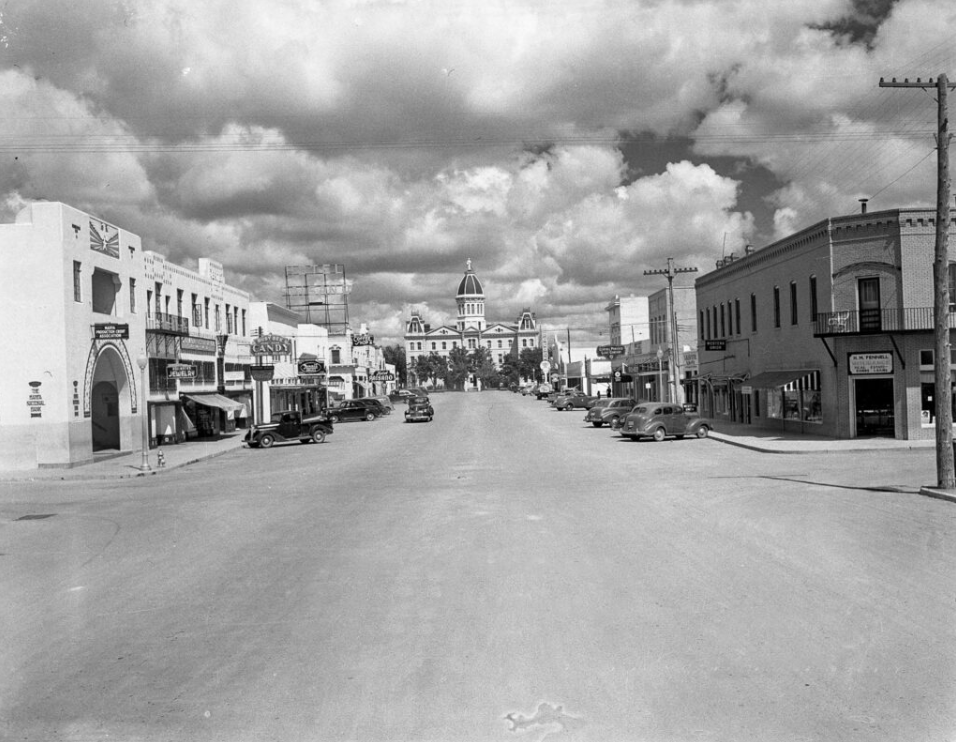
Downtown Marfa, Texas, 1942. © Keith Archive. Courtesy Marfa and Presidio County Museum.

In Marfa, adobe was part of the existing building environment. Rather than bringing industrial construction methods from New York, Judd worked with local builders, reused salvaged adobe bricks, and sometimes produced bricks on site.

For Judd, permanence was not only about duration but about spatial stability. Works were meant to remain in fixed positions, in spaces with consistent proportions and light. Adobe, as a load-bearing and materially durable construction system, allowed the architecture itself to remain stable over time. The walls were not temporary partitions but structural enclosures, creating fixed spatial conditions for installation.
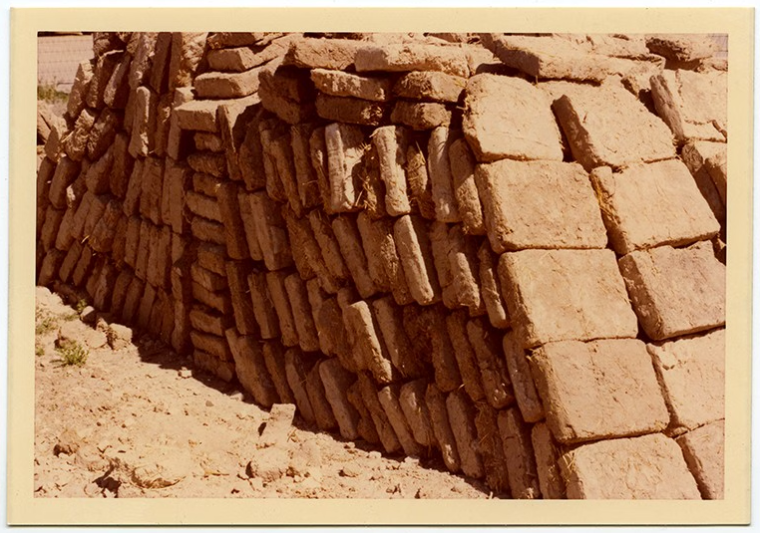
Adobe bricks for The Block/La Mansana de Chinati, 1975. © Jamie Dearing.

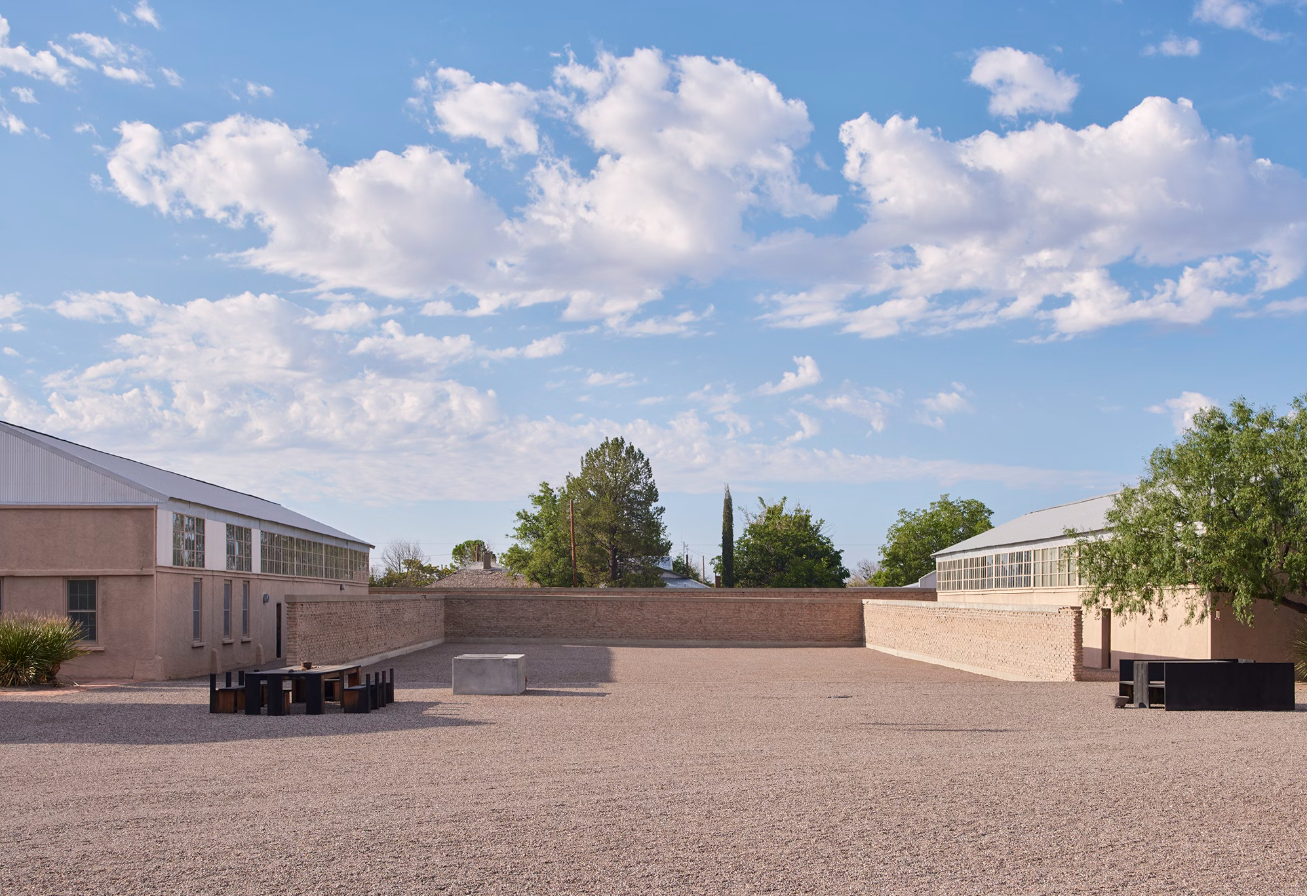
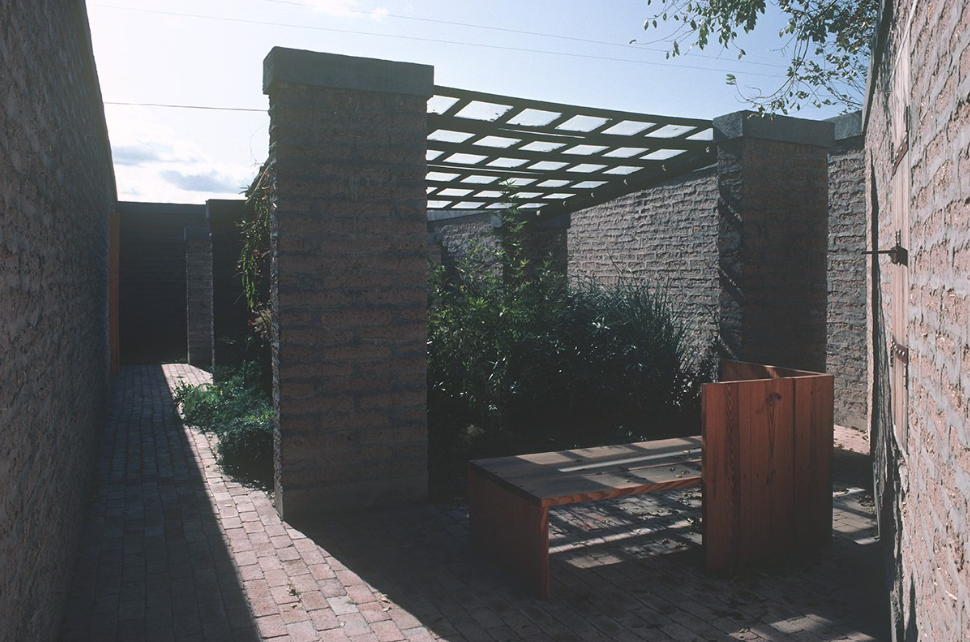
One of the clearest examples of this approach is La Mansana de Chinati, commonly known as “The Block,” located in downtown Marfa. Judd began to install work in the east building of the Block in 1973. Instead of demolishing the three existing buildings, he altered them to suit the purposes of living and working. He constructed a 9-foot adobe wall on the south side of the property using existing adobe bricks from the former Toltec Motel and Virginia Hotel.

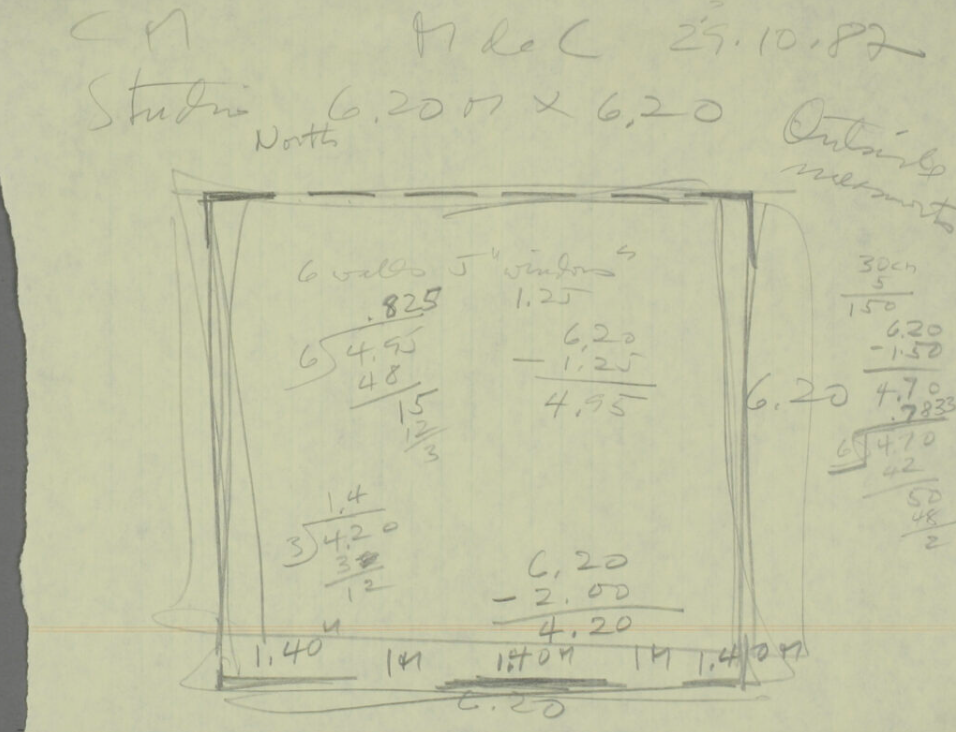
Drawing for La Mansana de Chinati/The Block, October 29, 1982. © Donald Judd
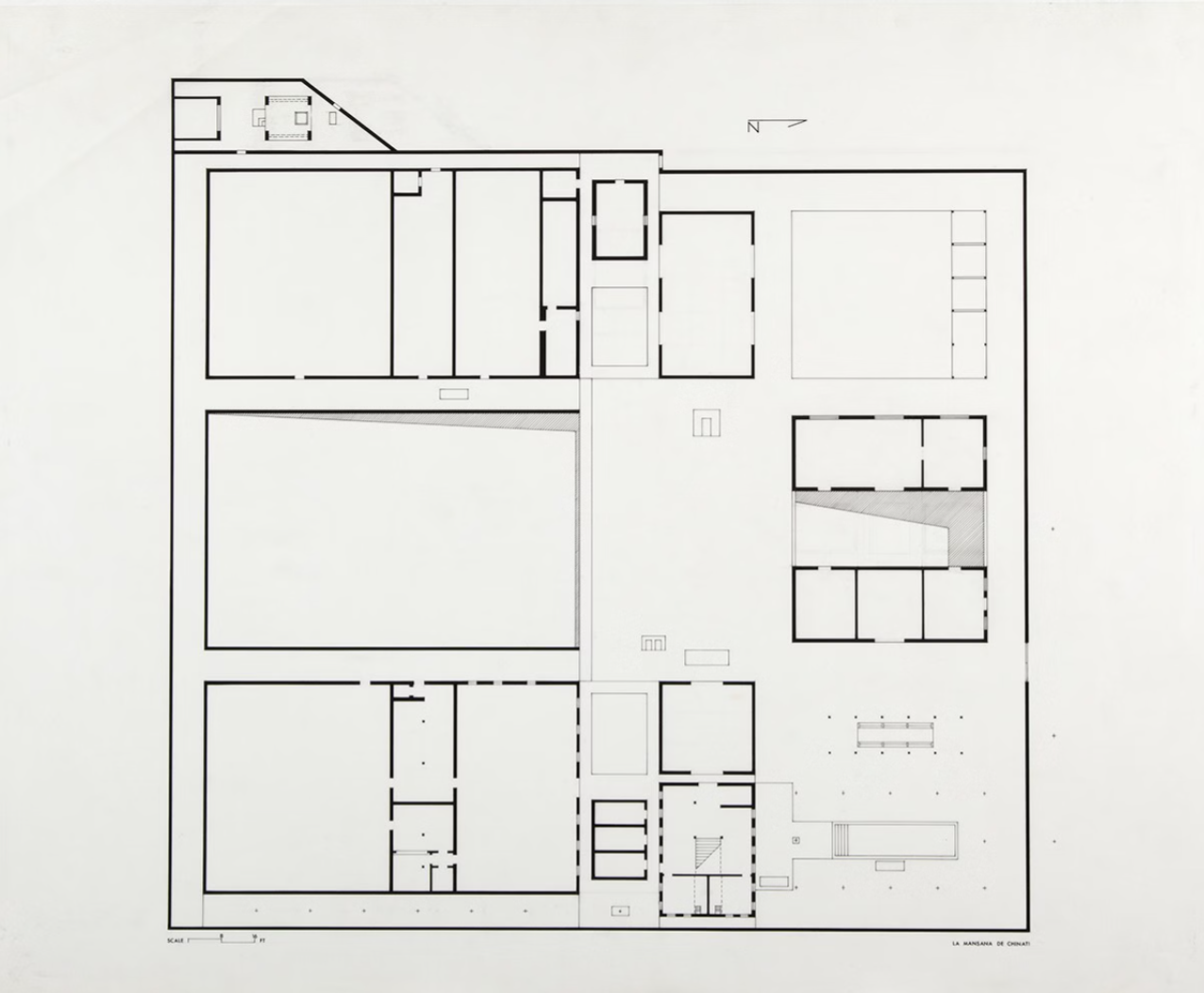
The Block/La Mansana de Chinati Plan

Between 1973 and 1979 the remainder of the exterior wall enclosing the property was constructed, totaling 1,441 feet and approximately 30,000 bricks. Within this perimeter, a second U-shaped wall further articulated the courtyard. Together, these walls establish a sequence of outdoor rooms and reshape the relationship between street and interior space. Openings are carefully proportioned, and the thickness of the walls creates deep recesses and strong shadow lines.

Donald Judd, untitled, 1976-1985, adobe bricks and cement, La Mansana de Chinati/The Block, Judd Foundation, Marfa, Texas.
Winter garden at The Block/La Mansana de Chinati, 1982. © Lauretta Vinciarelli.
Interior view of the south room of Donald Judd’s, La Mansana de Chinati West Building (artwork © Judd Foundation / Artist Rights Society (ARS), New York).
© 2024 Judd Foundation / JASPER, Tokyo E5493

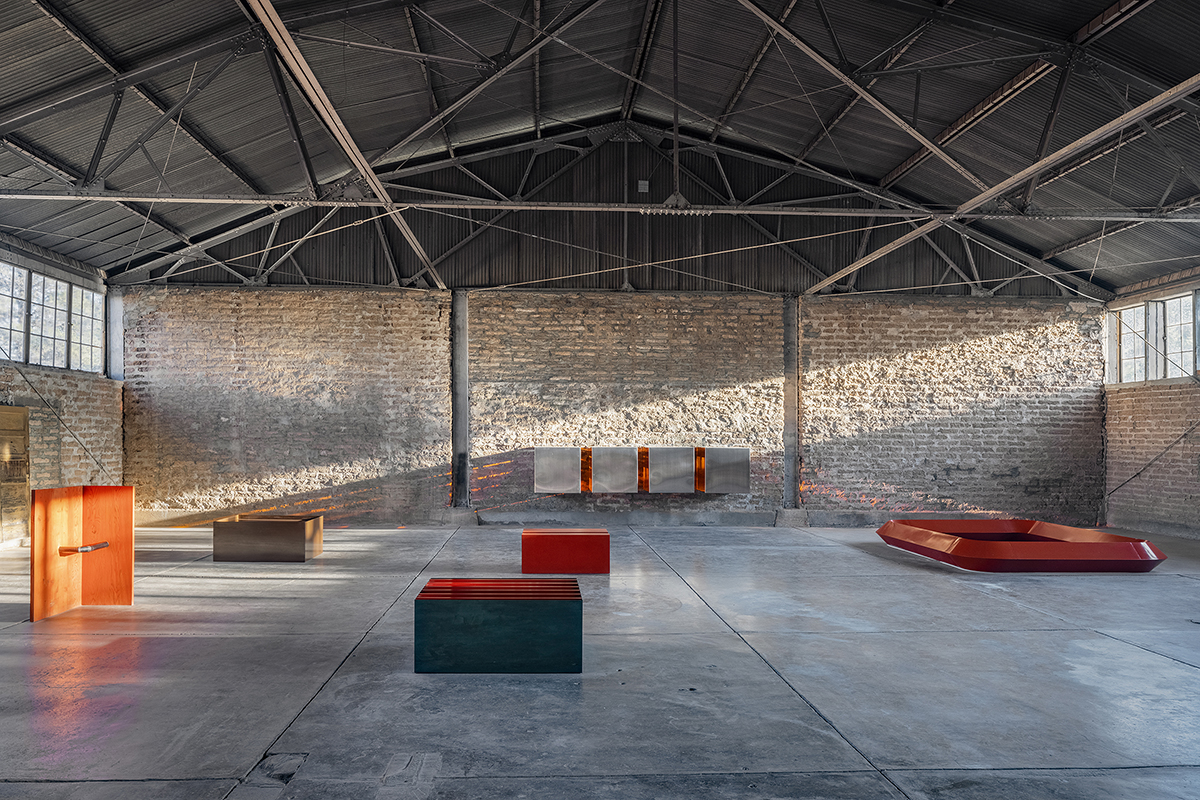
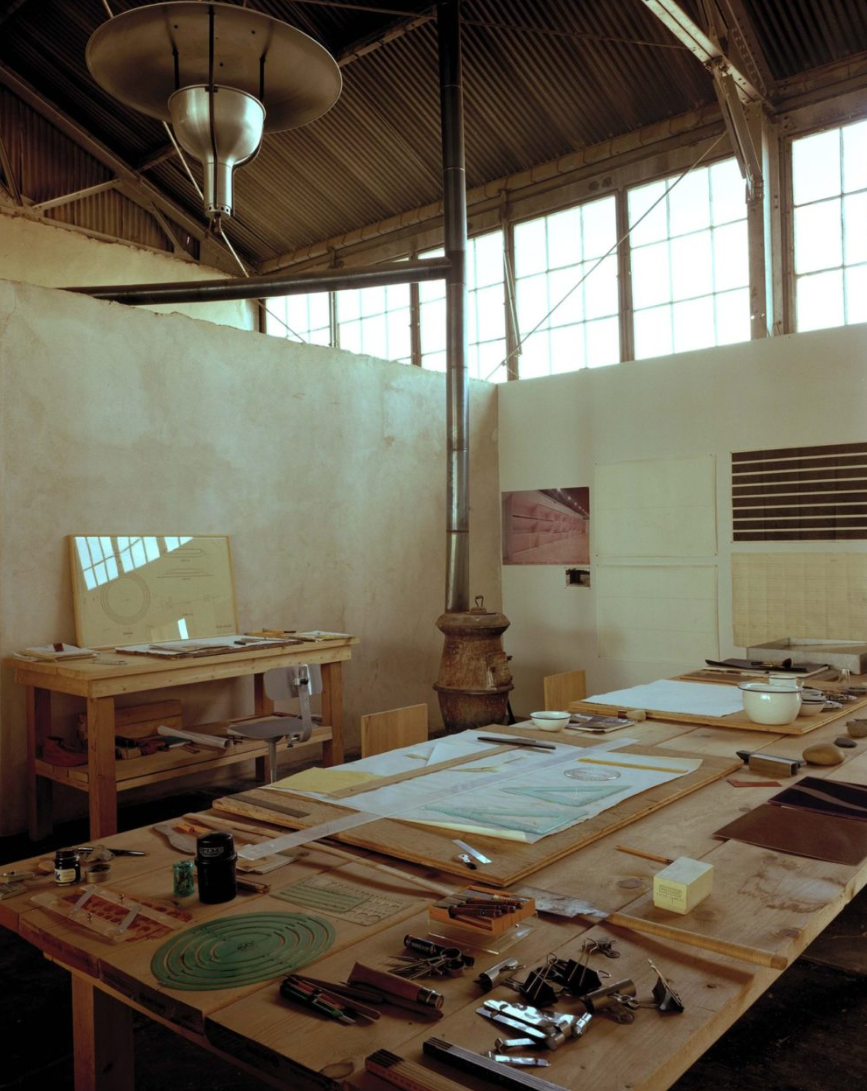
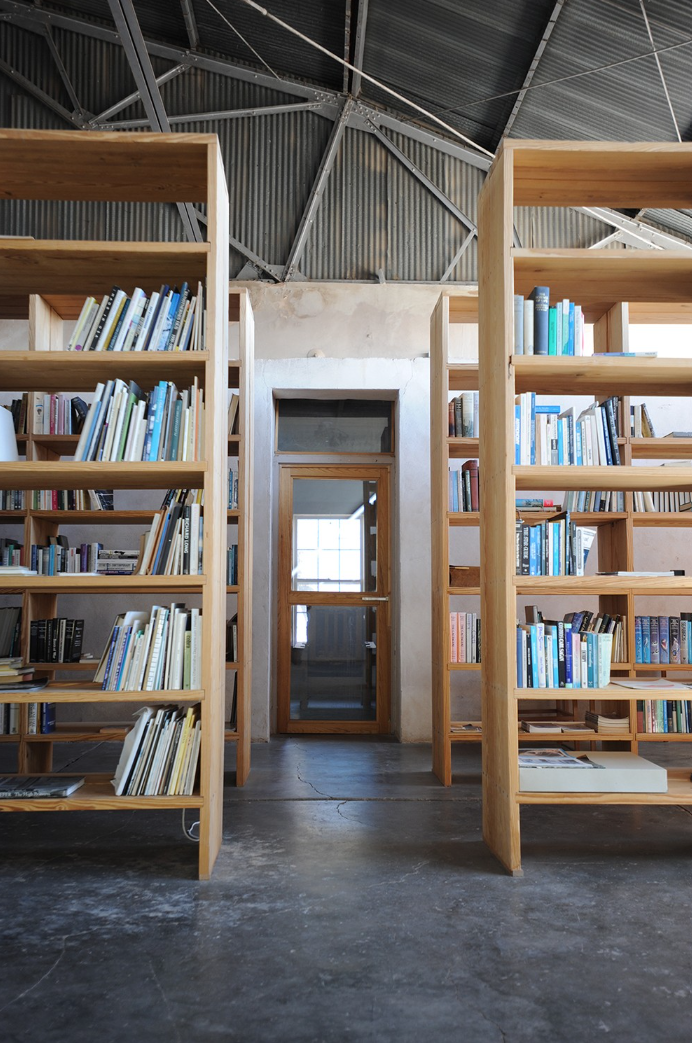
The Block accommodates residence, studio space, a library, and open courtyard areas. Domestic life and artistic production are not separated but integrated within a continuous spatial framework. Adobe functions simultaneously as structure, boundary, and climatic mediator in the desert environment. The geometry remains restrained—rectilinear volumes, planar walls, orthogonal alignments—yet the earthen material introduces weight and physical presence distinct from Judd’s earlier industrial works.

Interior, Print Studio, La Mansana de Chinati/The Block, Judd Foundation, Marfa, Texas, c. mid-1980s. © Adam Bartos.
Interior, Second library, La Mansana de Chinati/The Block, Judd Foundation, Marfa, Texas, 2012. © Flavin Judd.

Another important project is the adaptation of what is now called the Chamberlain Building in central Marfa. Here Judd transformed former warehouse structures to house the permanent installation of works by John Chamberlain. Although the existing buildings were not constructed entirely of adobe, Judd introduced adobe elements to clarify enclosure and spatial hierarchy, including the construction of a new west-end wall. Roofs were rebuilt, skylights installed, and openings adjusted to refine the quality and distribution of light.
John Chamberlain Building, 2022. © Alex Marks
John Chamberlain Building restoration, 2022. © Alex Marks.
Courtyard of the John Chamberlain building with adobe wall. © Alex Marks.

Across his projects in Marfa, adobe was used as a structural and spatial material rather than as decorative reference. It serves as a means of achieving permanence and spatial definition. Its thickness reinforces enclosure; its method of construction shows labor and process; its mass anchors the buildings to the desert landscape. These interventions create measured and continuous spatial fields in which art, habitation, and landscape coexist.

Toronjos House

Casa Toronjos | Houses

Casa Toronjos, PPAA | Fabian Martinez

Architect: PPAA 

Location: Valle de Bravo, State of Mexico, Mexico

Year: 2024

Area: 312 m² (3358 ft²)

Construction: Adobe

PPAA (Pérez Palacios Arquitectos Asociados)  founded in 2018 by Pablo Pérez Palacios. (Mexico City, 1980)

Pablo is an architect from the Universidad Iberoamericana from Mexico City and the Polytechnic University from Catalonia, Barcelona. He has a Master of Science in Advanced Architectural Design by the Columbia University in New York.

“… architecture of ideas and not form.” Their studio focuses on simple, clear ideas shaped by context, using void as an active space, developing concepts through drawing, and allowing time to test and strengthen the connection between architecture and place.

Site View | PPAA
Side Exterior View | Fabian Martinez

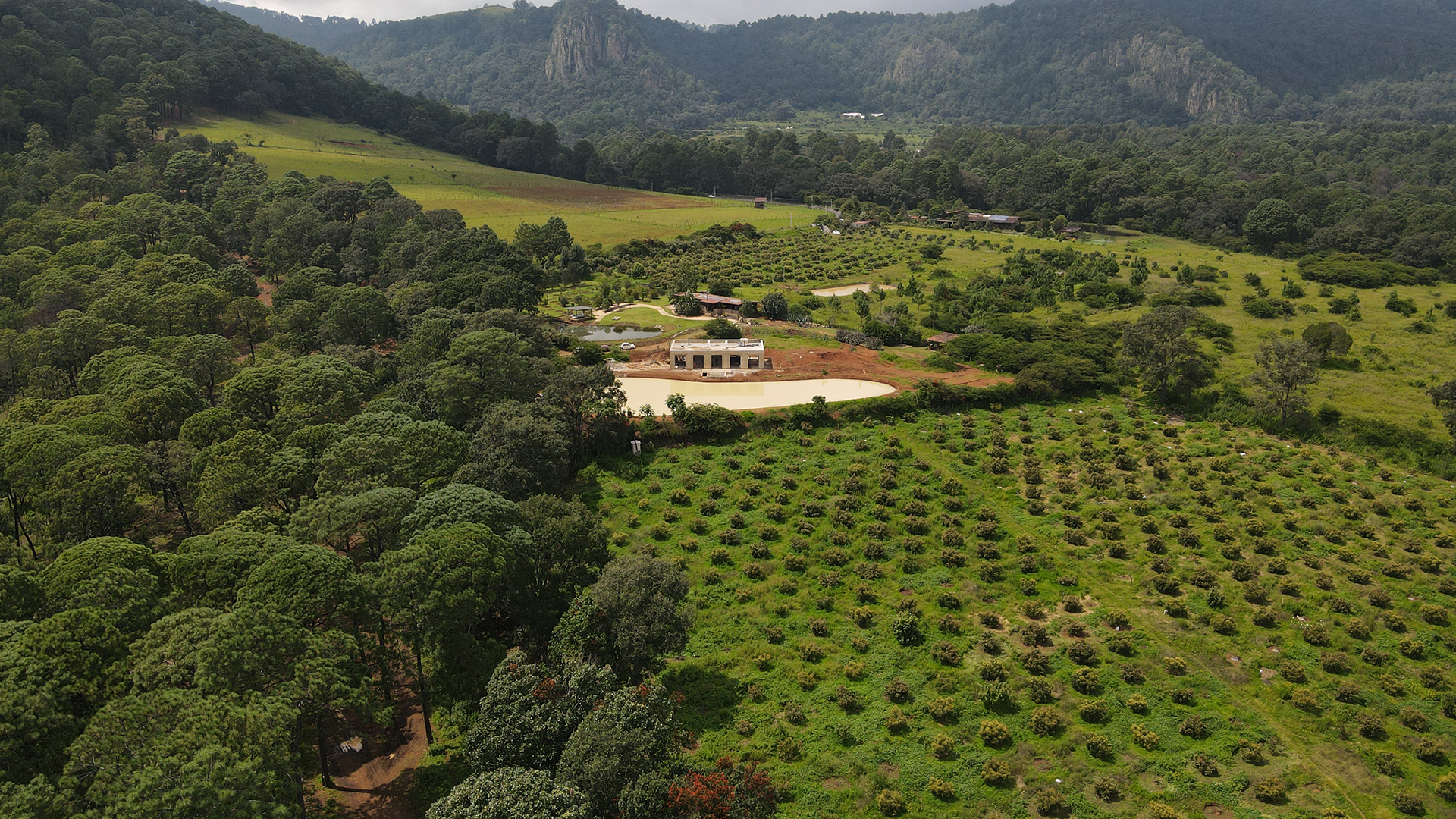
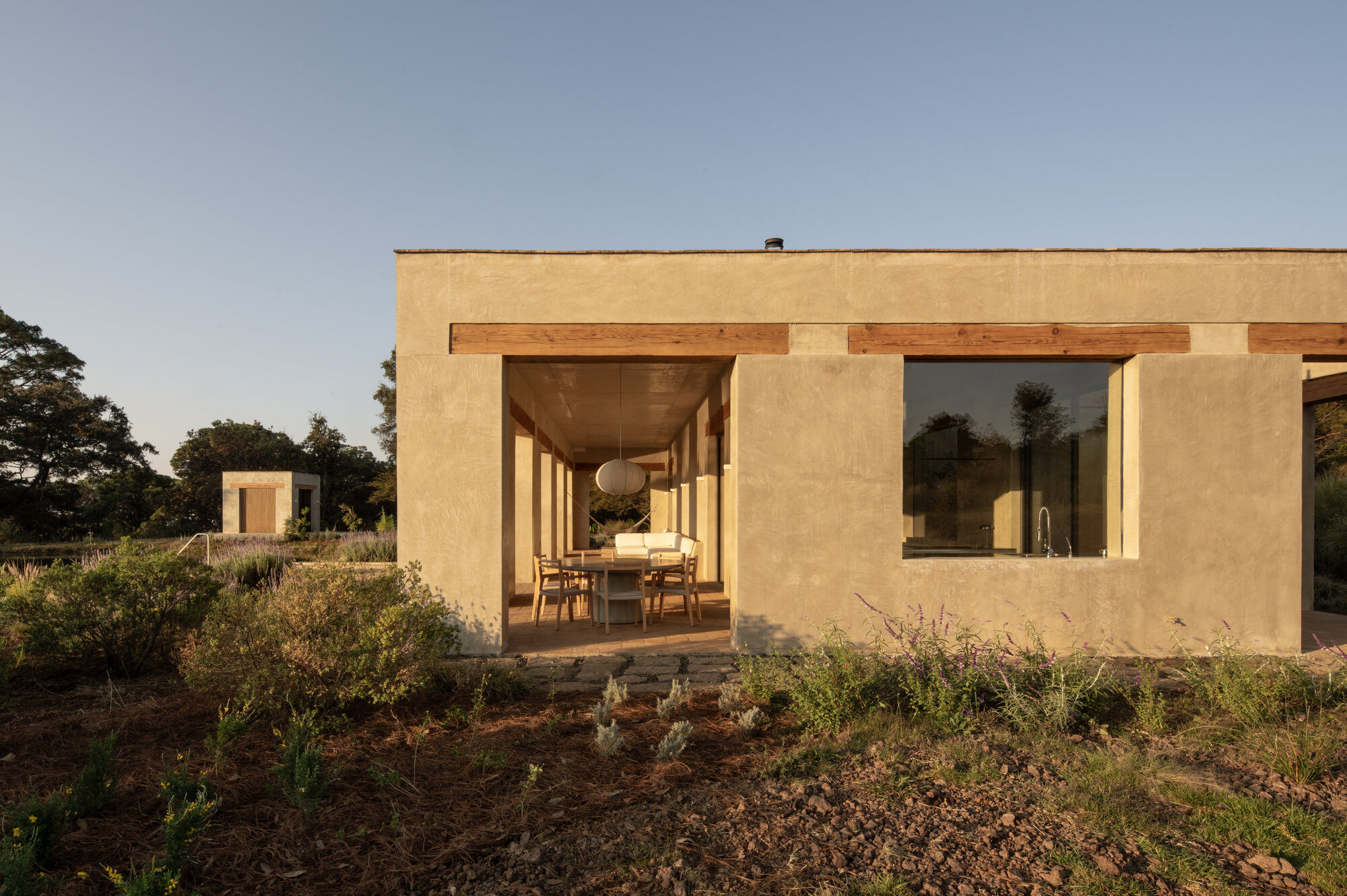
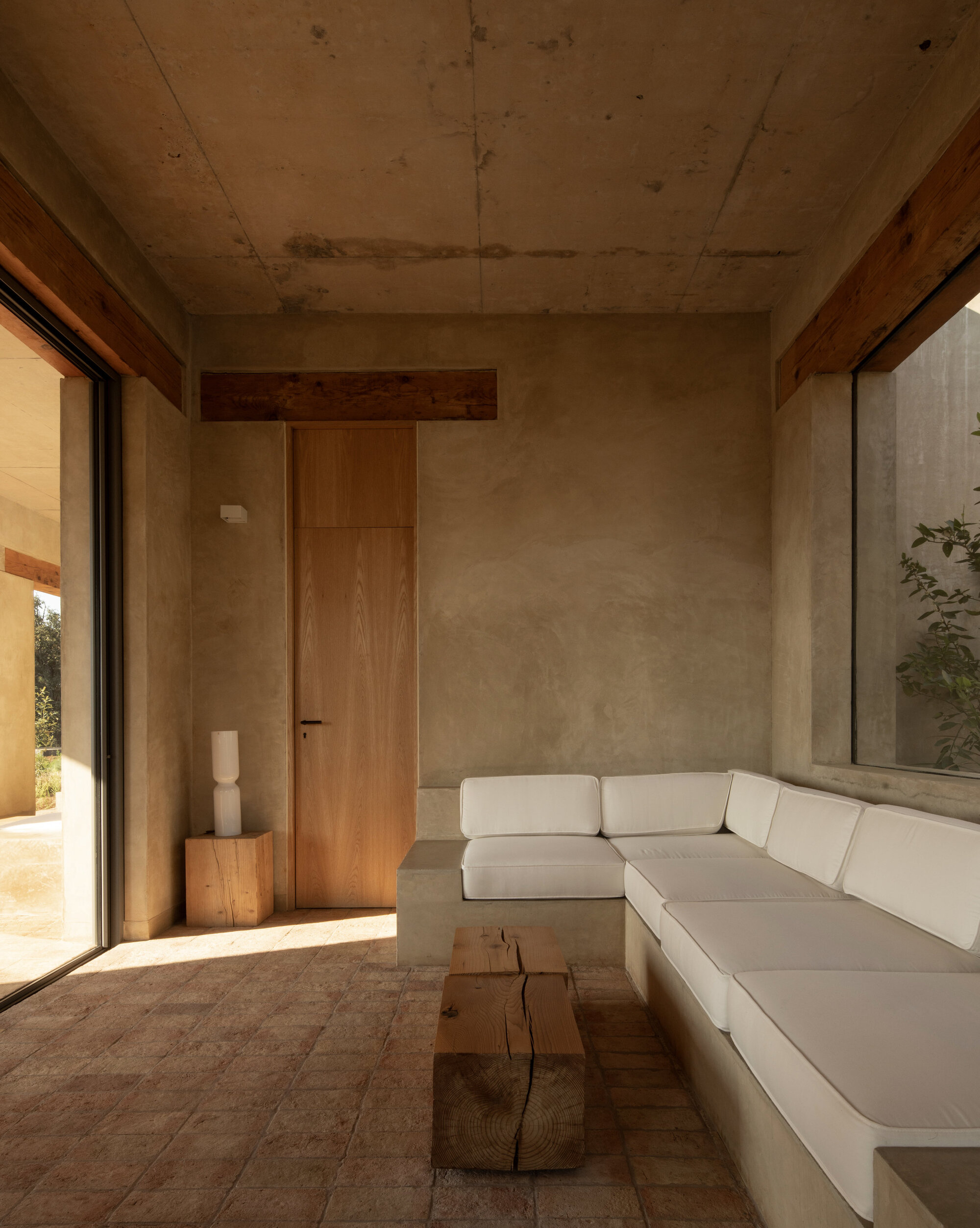
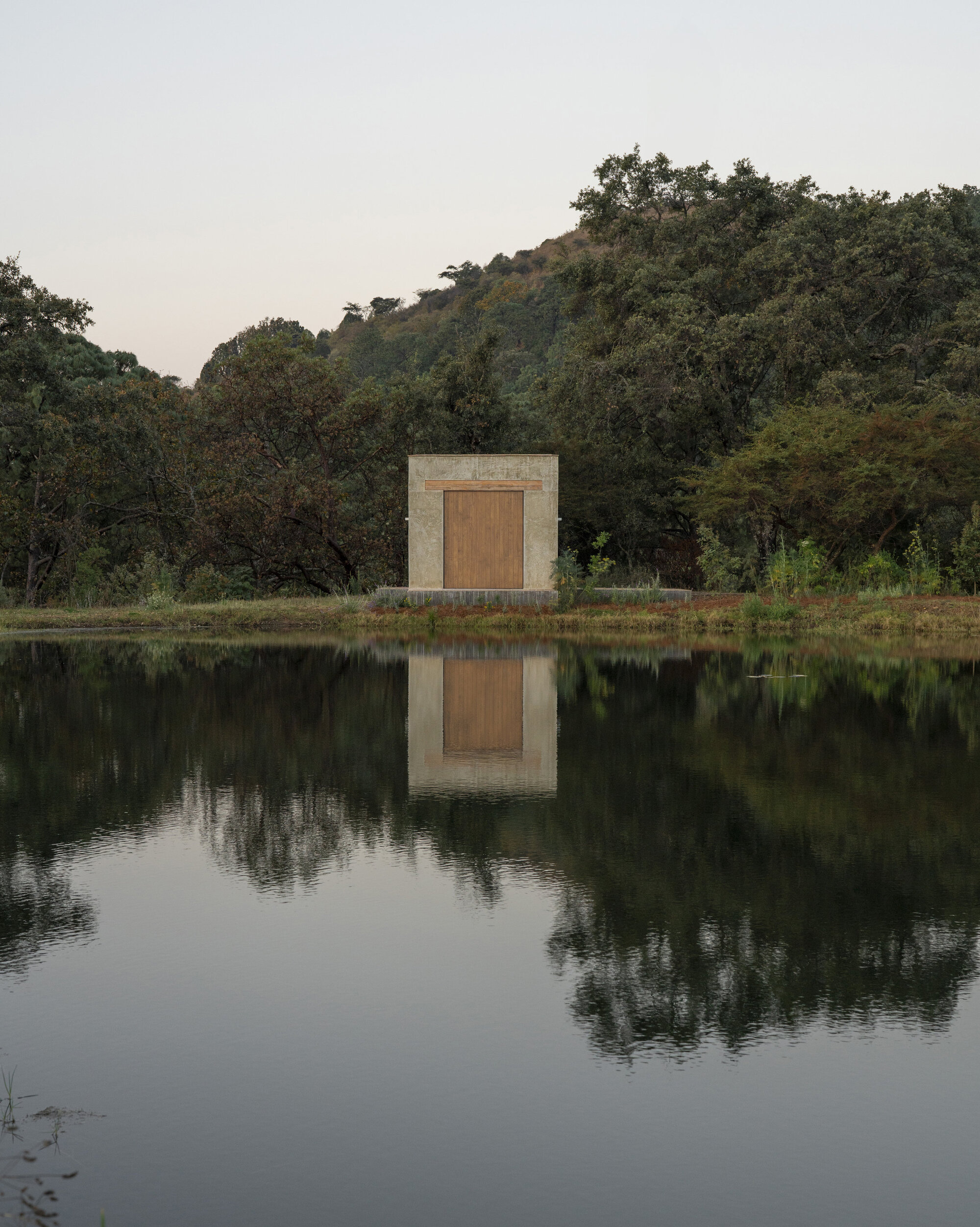
Toronjos house is a single-story vacation home designed to harmonize with its natural surroundings. Conceptually, it is an extension of the landscape, prioritizing a minimal footprint and a fully sustainable design.

Exterior Balcony | Fabian Martinez
Dining Area | Fabian Martinez

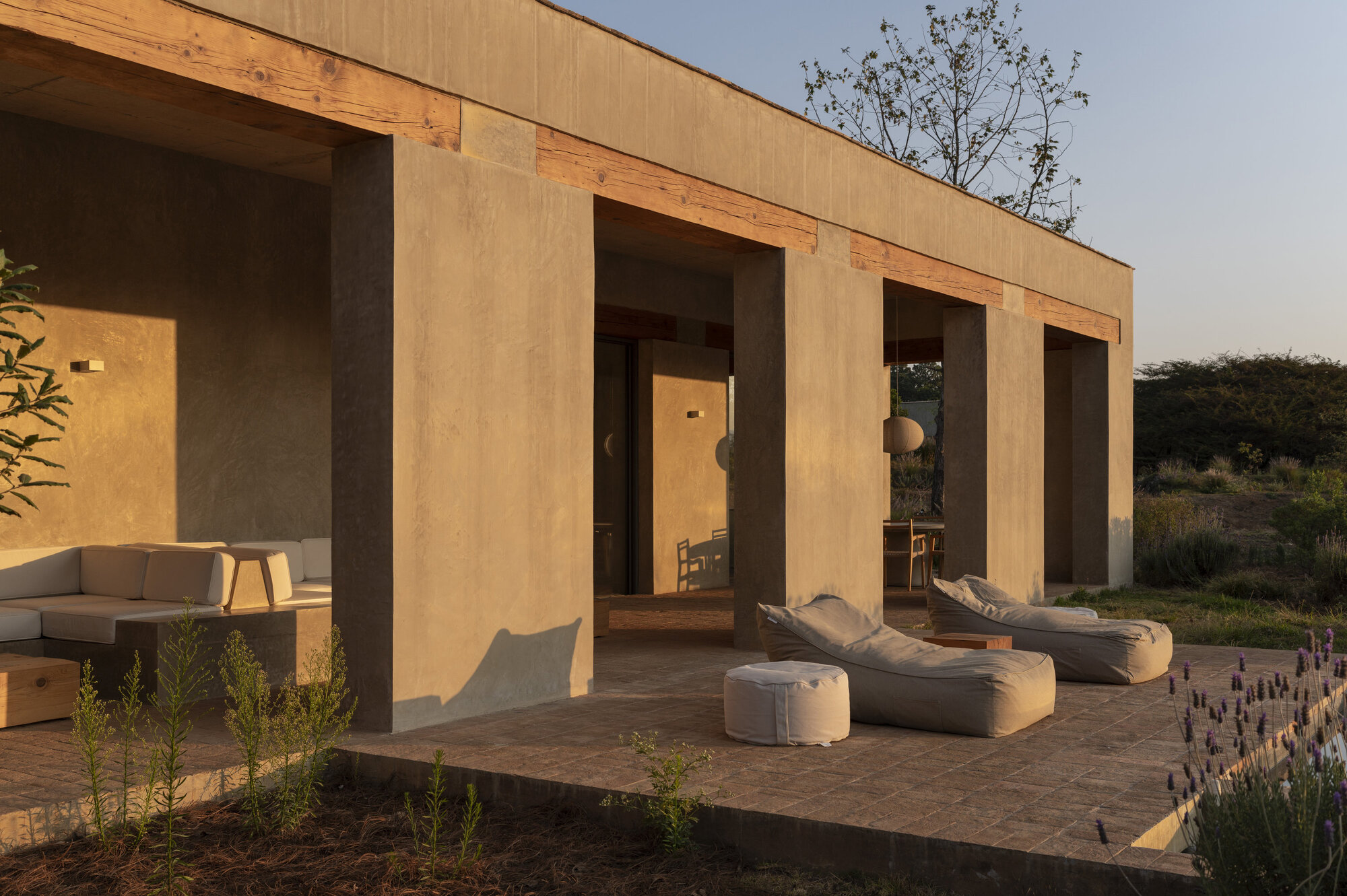
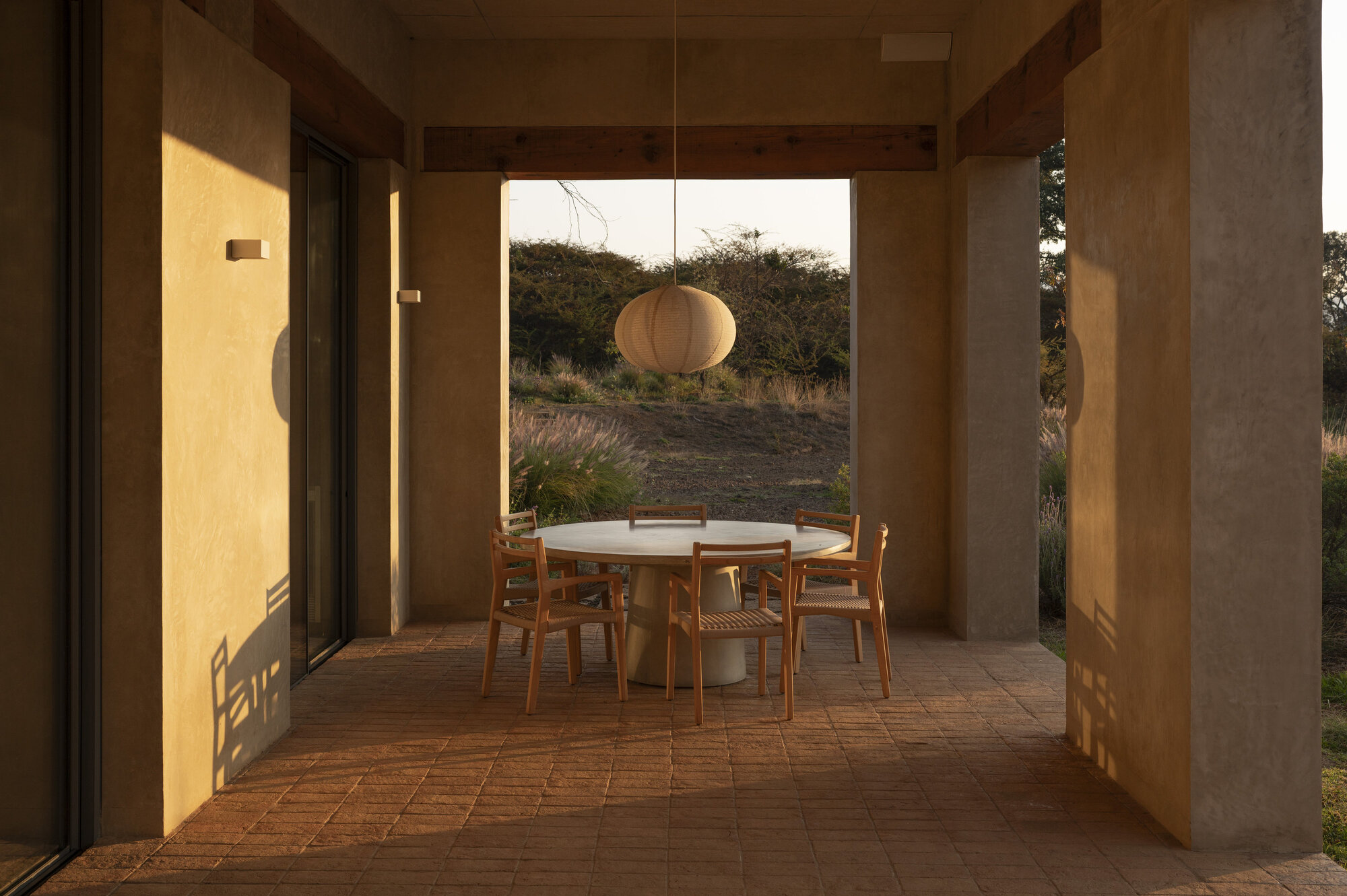
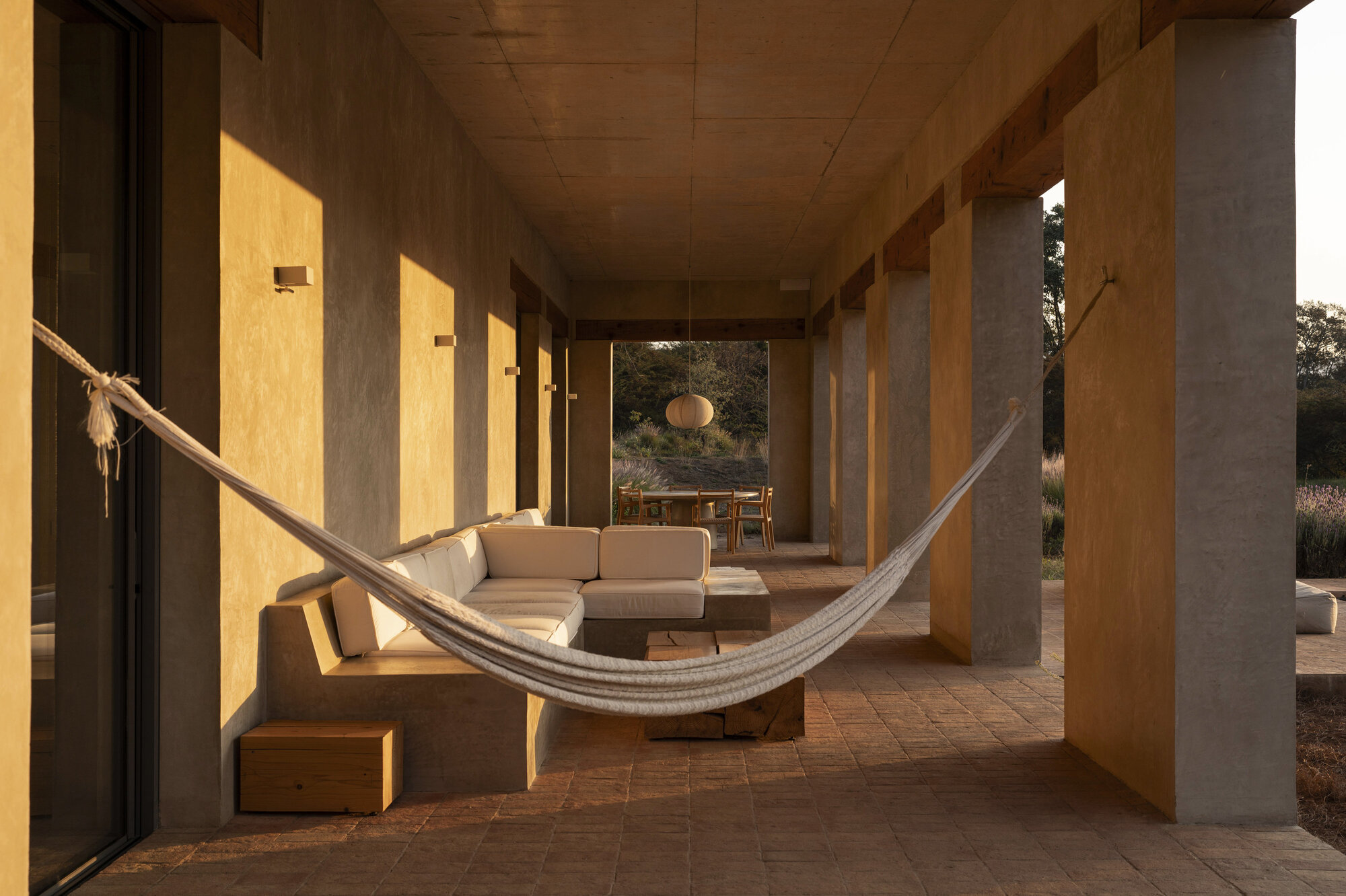
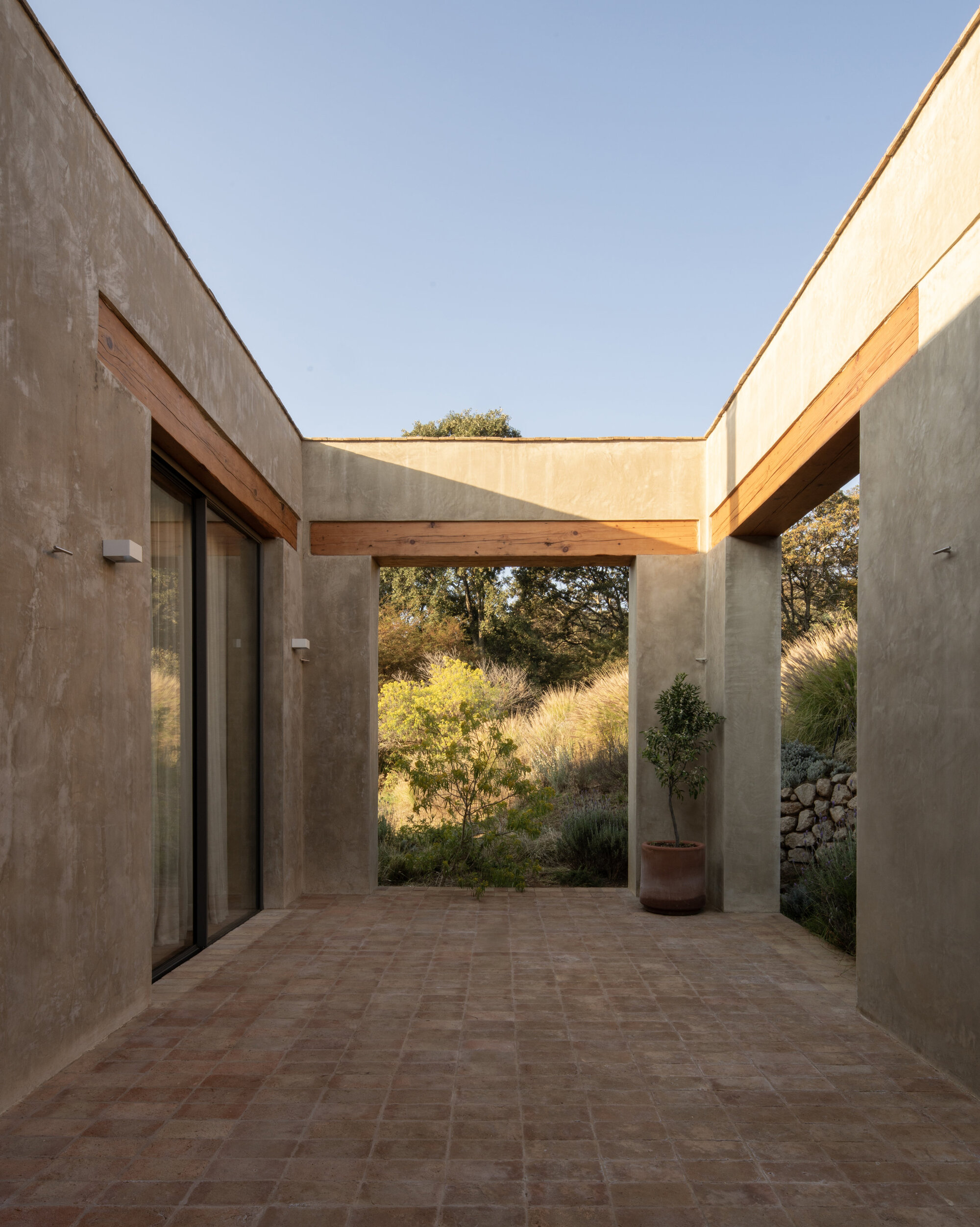
The house acts as a sanctuary for contemplation where nature is centered.  Staggered walls and large openings create protection while framing views and letting the landscape pass through the space. This allows natural light and ventilation while maintaining a close and continuous relationship with the outdoors.

Living Room | Fabian Martinez
Balcony | Fabian Martinez

The design centers on relaxation and enjoyment. Semi-outoor social spaces and hammock areas encourage pause and connection with nature. The goal of Toronjos is to experience and preserve the natural landscape.

Courtyard | Fabian Martinez
Kitchen | Fabian Martinez

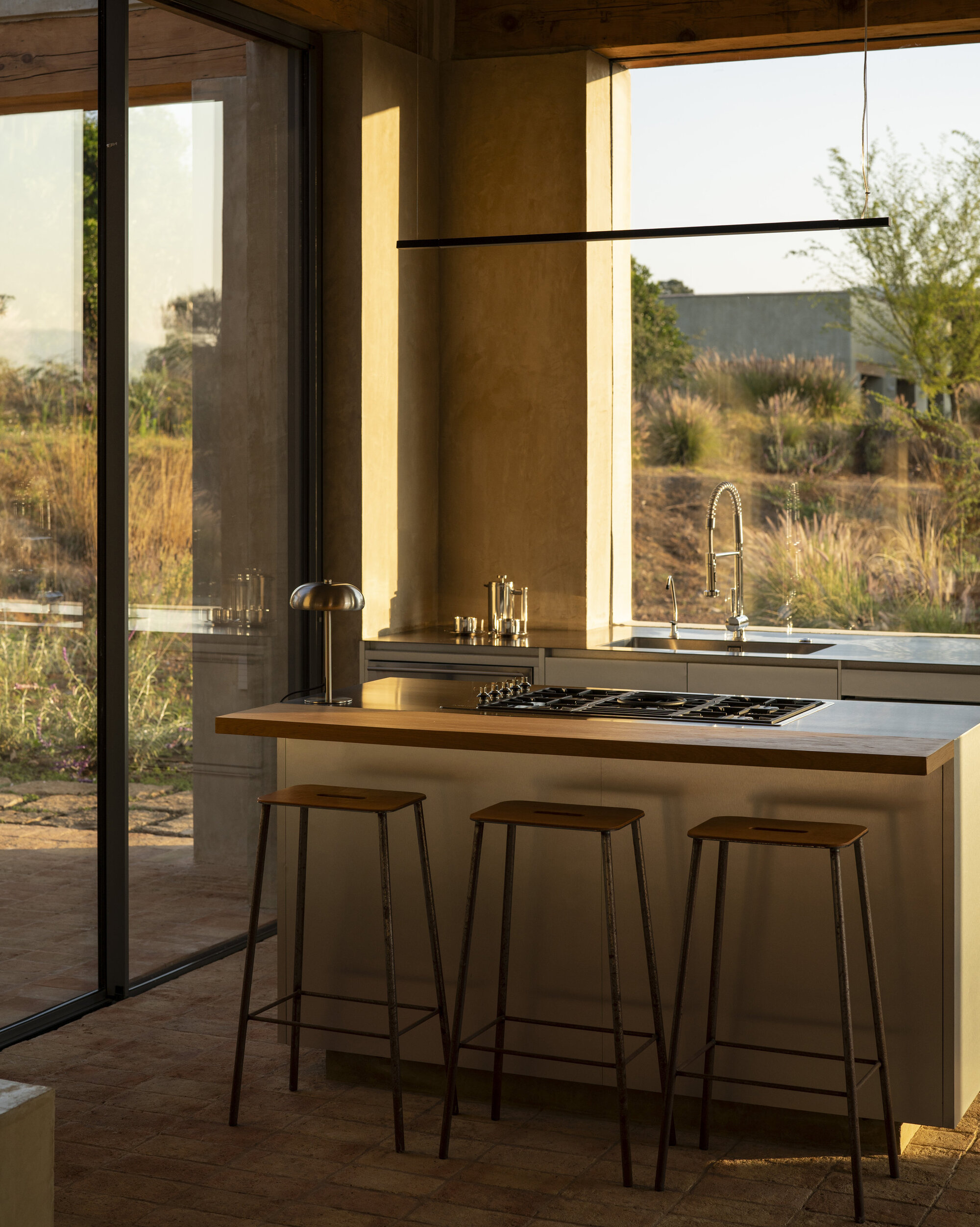
The project was constructed by adobe and wooden beams, which were left exposed to add warmth. The floor was handcrafted with adobe produced on-site, and the walls are finished with an adobe plaster that harmonizes with the surrounding color palette.

Exterior View from Lake | Fabian Martinez

Not only using local labor and materials, the commitment of sustainability is embodied in every aspects: it collects rainwater and supports the site’s ecosystem, turns the house into a sustainable system.


Bedroom | Fabian Martinez
Parti Diagram | PPAA
Floor Plan | PPAA

The modulation follows the maximum 3-meter span allowed for mud brick construction without steel reinforcement. The adobe is produced on site, minimizing transport and supporting a local micro-economy through local materials and labor. Toronjos house responds directly to its site and conditions.

Elevation | PPAA
Section | PPAA
Exterior View | Fabian Martinez

Toronjos is, essentially, architecture that doesn’t dominate. It blends seamlessly with the landscape, enhancing it and becoming a natural extension of it. The building doesn’t seek to stand out, but rather to disappear among the vegetation, water, and earth, embodying a way of living in harmony with the environment.


Le Corbusier: Les Maisons Murondins

Les Maisons Murondins is a series of conceptual earthen refugee housing projects proposed by eminent architect Le Corbusier in collaboration with his partner Pierre Jeanneret during the mid-20th century.[1] In the wake of Germany’s invasion of France and Belgium in May of 1940, France was partitioned into three zones: a military zone in the north occupied by Nazi forces, an Italian colony in the East, and the collaborationist Vichy government in the South.[2] This process saw millions displaced as a result of the German invasion, and forced many refugees into abject conditions bereft of housing or sufficient infrastructure.

Elevation of a “Murondins” unit showing facade and openings, attributed to Pierre Jeanneret, 1940.

Respondent to the devastation of the Second World War, Corbusier and Jeanneret began working on a proposal for refugee housing known as Murondins— a combination of the French words for wall (mur) and logs (rondins). Murondins prioritized earth and wood materials and construction techniques, owing to their accessibility and exceptional performance. Earth and logs did not require advanced industrial infrastructure in order to manufacture and assemble, meaning residents were equipped to construct Murondins themselves.[3] Furthermore, walls could either be constructed out of rammed earth, or blocks of earth combined with lime depending on the circumstances. In essence, Murondins sought to use whatever materials were readily accessible, and designed to be built quickly, without special expertise. 

Sketches of the “Murondins” structural system by Le Corbusir, 1940.

This idea did not only operate materially through the use of earth and wood construction, but also formally through the use of long, rectangular walls, and an offset gabled roof— forms that ensured stability, and that those without technical knowledge or experience in construction could produce them. The internal structure of Murondins was proposed to be entirely constructed out of earth, arranged in L-shaped formations to ensure structural stability.

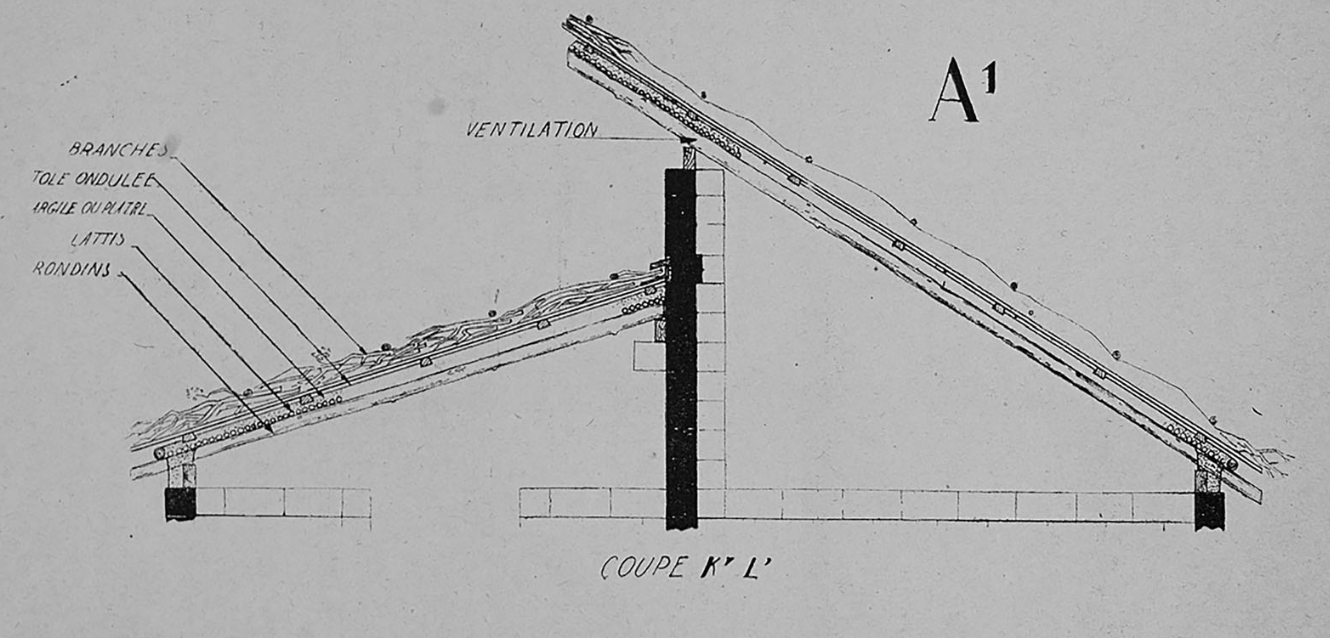
Roof Section of a “Murondins” Unit by Pierre Jeanneret, 1940.

As for the roofs, they were to be made out of logs and waterproofed using sod, plaster, and tar paper. For purposes of ventilation, roofs were also offset, with one side of the gable taller than the other, to accommodate for daylighting and passive ventilation.[4] With this Murondin system, a range of buildings accommodating whatever programs were necessary for life could be constructed for refugees, by refugees using natural and readily available materials. Although this proposal never made it to fruition, Le Corbusier and Pierre Jenneret’s Murondins continues to serve as an instrumental historical proposal for accessible, communal earthen construction.

Sources:

[1] McLeod, Mary, “To Make Something out of Nothing: Le Corbusier’s Proposal for Refugee Housing” in The Journal of Architecture, 421–47, 2018.

[2] Hart, B.L, “Battle of France,” in Encyclopedia Britannica, 2026. https://www.britannica.com/event/Battle-of-France-World-War-II.

[3] McLeod, Mary, “To Make Something out of Nothing: Le Corbusier’s Proposal for Refugee Housing” in The Journal of Architecture, 421–47, 2018.

[4] Mary McLeod, On the Maisons Murondins, 2024. https://www.youtube.com/watch?v=Wt94ZA8TkVw.

David Easton’s Rammed Earth Works

Photo by U.S. Green Building Council

Californian David Easton (1948-2021) was a pioneer in the use of rammed earth in contemporary construction. David Easton first learned of rammed earth through a book titled “Build Your House of Earth” by G.F. Middleton. Trained as both an engineer and architect at Stanford University, Easton was surprised to learn that the “moist soil compacted directly into movable forms wielding immediately load-supporting walls,” claiming it “seemed too good to be true” [1]. 

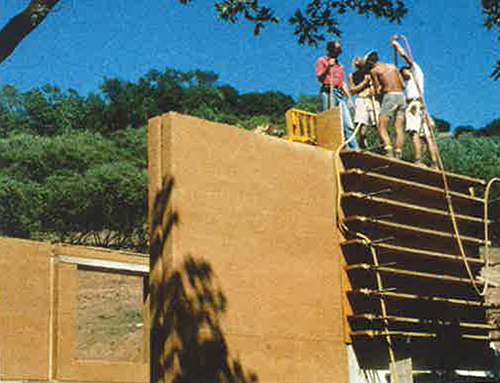
Enamored by the little literature and research available on rammed earth, Easton set out to perfect the methods and applications of the material and founded his company, Rammed Earth Works, in 1976. In the 50 years since, Easton and Rammed Earth Works have worked on hundreds of both residential and commercial projects across the nation, cementing themselves as one of the world’s leading firms in the research and application of rammed earth construction technologies [2]. Easton’s company has also helped push the envelope to make the building codes around the nation be more accepting of rammed earth construction and developed various rammed earth technologies such as PISE (pneumatically impacted stabilized earth), Terratile, and the Easton (California) Forming System for rammed earth and cast elements [3].


Easton Forming System in action, photo by Cynthia Wright.
 

PISE in action, photo by David Easton.

In 1996, Easton published The Rammed Earth House, an exploration of the history and modern use of rammed earth construction with beautiful photographs taken by Cynthia Wright of both modern and historical examples [4]. Easton has since revised The Rammed Earth House, and in the years since its initial publication, it has been widely accepted as one of the most informative and influential works on rammed earth, showing an ancient building technique that is exactly suitable for today’s resource-conscious and environmentally friendly building needs.

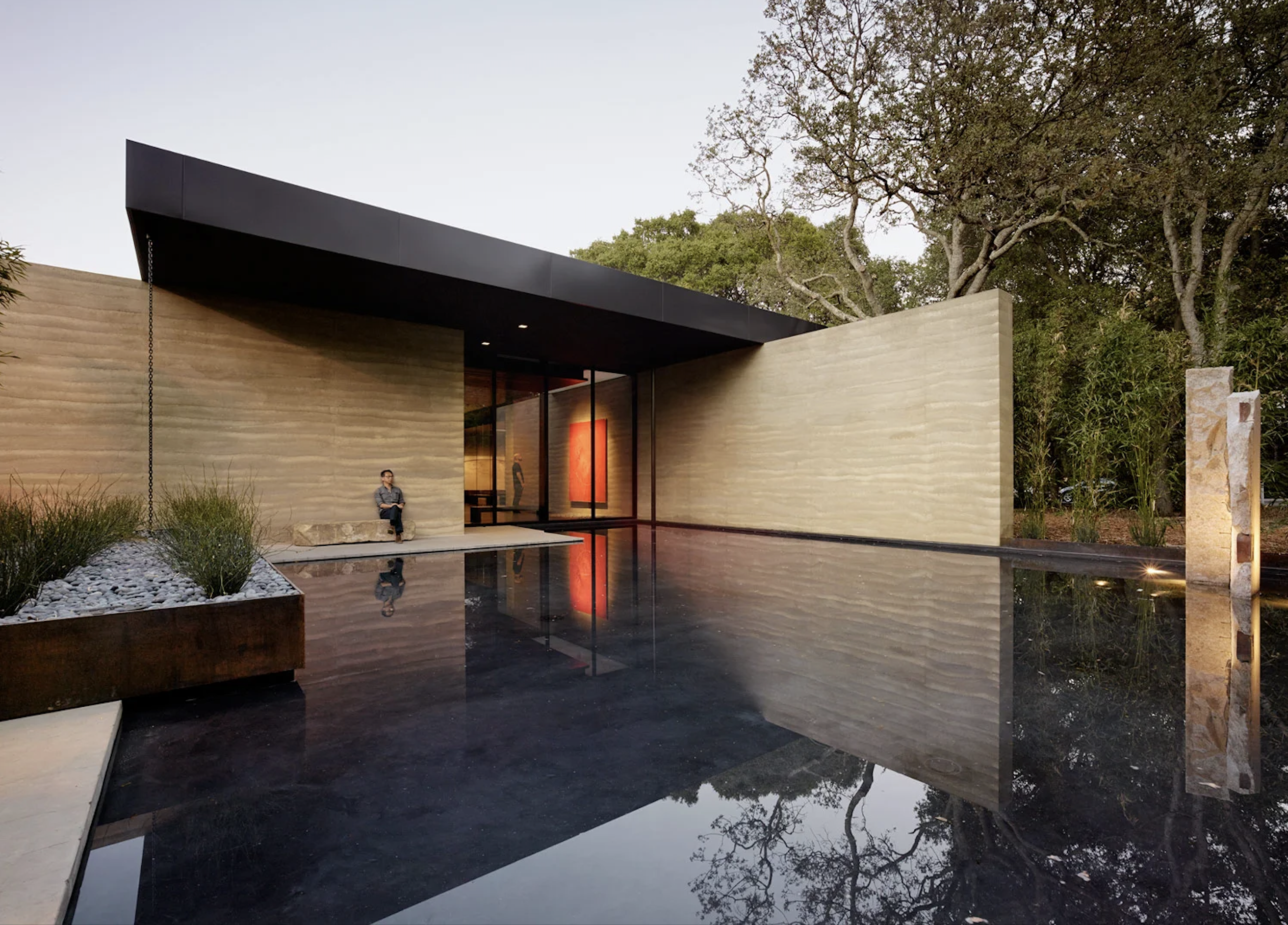
One of David Easton’s most notable rammed earth projects is the Windhover Contemplative Center at Stanford University. This project, designed to be a spiritual refuge on the college campus, was created in collaboration with architects Aidlin Darling and Andrea Cochran, as well as artist Nathan Oliveira.  

Photo taken by Matthew Millman.

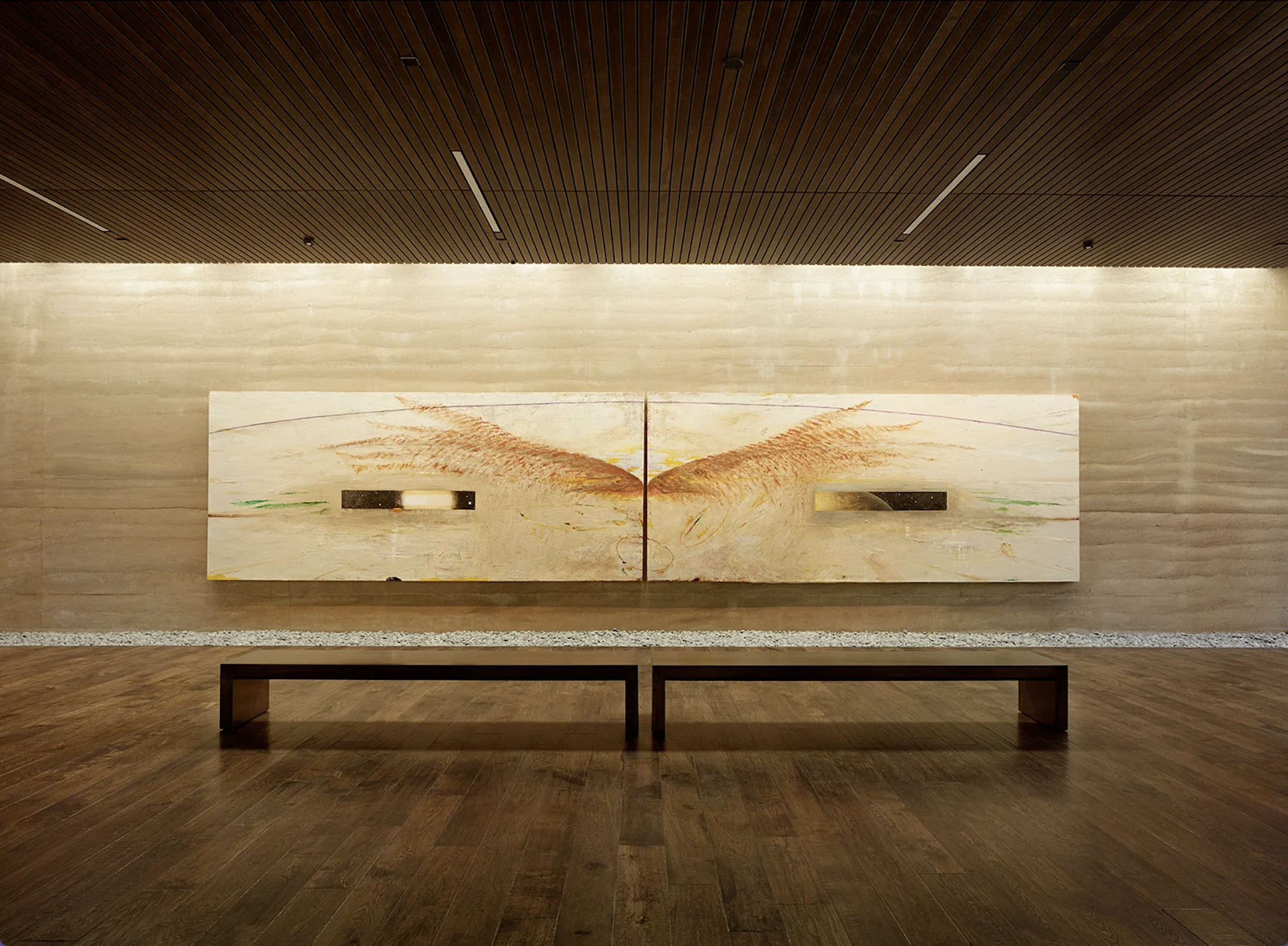
The project contains three large rammed earth walls designed to be a backdrop to Oliveria’s paintings. In the center of the largest wall, a 234,000 pound rammed earth wall 20 feet tall and 60 feet long, sits a large diptych painted by Oliveira. 

Photo taken by Matthew Millman.

The project was extremely labor extensive: each wall was built “in 42 six-inch lifts pounded to four-inch courses by eight men on rammers.”

Credit Aidlin Darling Design.

Sources: 

  1.  Block, David. “Looking at the Legacy of Legendary Earth Builder David Easton: February 25, 1948 — February 12, 2021.” Medium, 6 June 2021, davidyblock.medium.com/looking-at-the-legacy-of-legendary-earth-builder-david-easton-february-25-1948-february-12-b63e8c7677be. Accessed 16 Feb. 2026.
  2. English, Mark, AIA. “David Easton – 45 Years of Rammed Earth.” The Architects’ Take, 16 Nov. 2018,thearchitectstake.com/interviews/david-easton-45-years-of-rammed-earth-construction/. Accessed 16 Feb. 2026.
  3. Rammed Earth Works. “About Us.” Rammed Earth Works, www.rammedearthworks.com/about-us. Accessed 16 Feb. 2026.
  4. Aidlin Darling Design. “Windhover Contemplative Center.” Aidlin Darling Design, aidlindarlingdesign.com/projects/windhover-contemplative-center/. Accessed 16 Feb. 2026.


Quincho Bernarda Community Center


Quincho Bernarda Community Center  I  ArchDaily

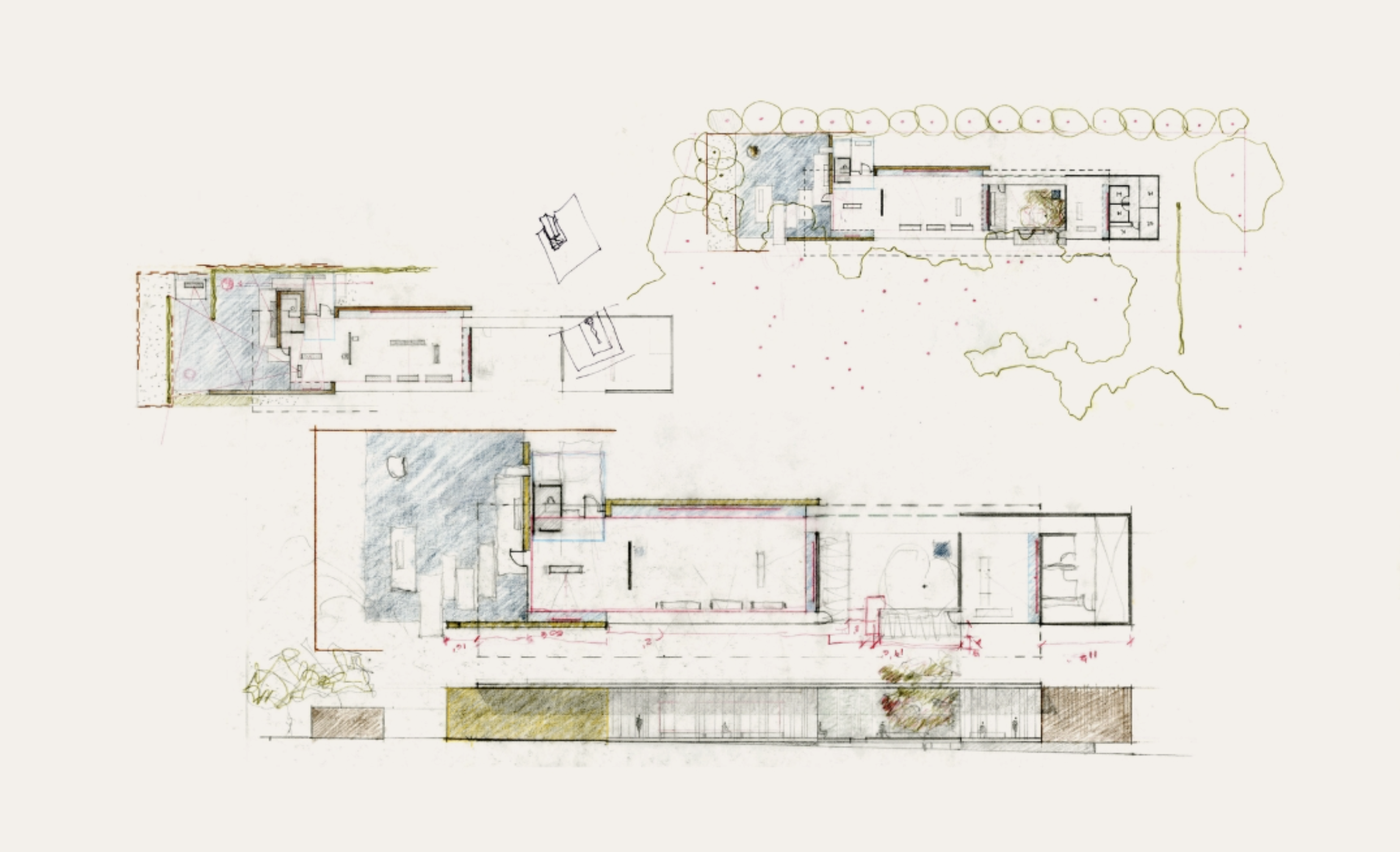
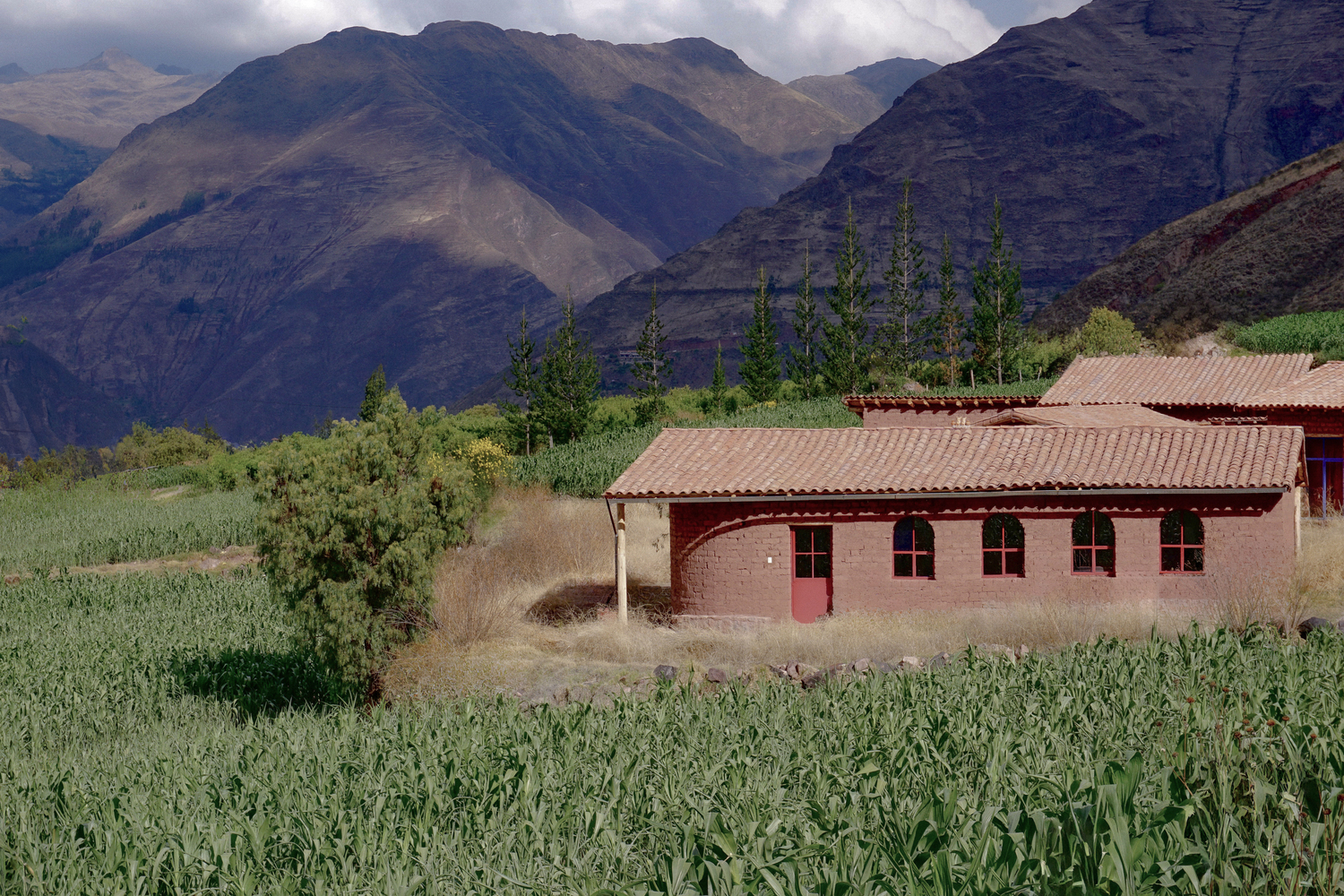
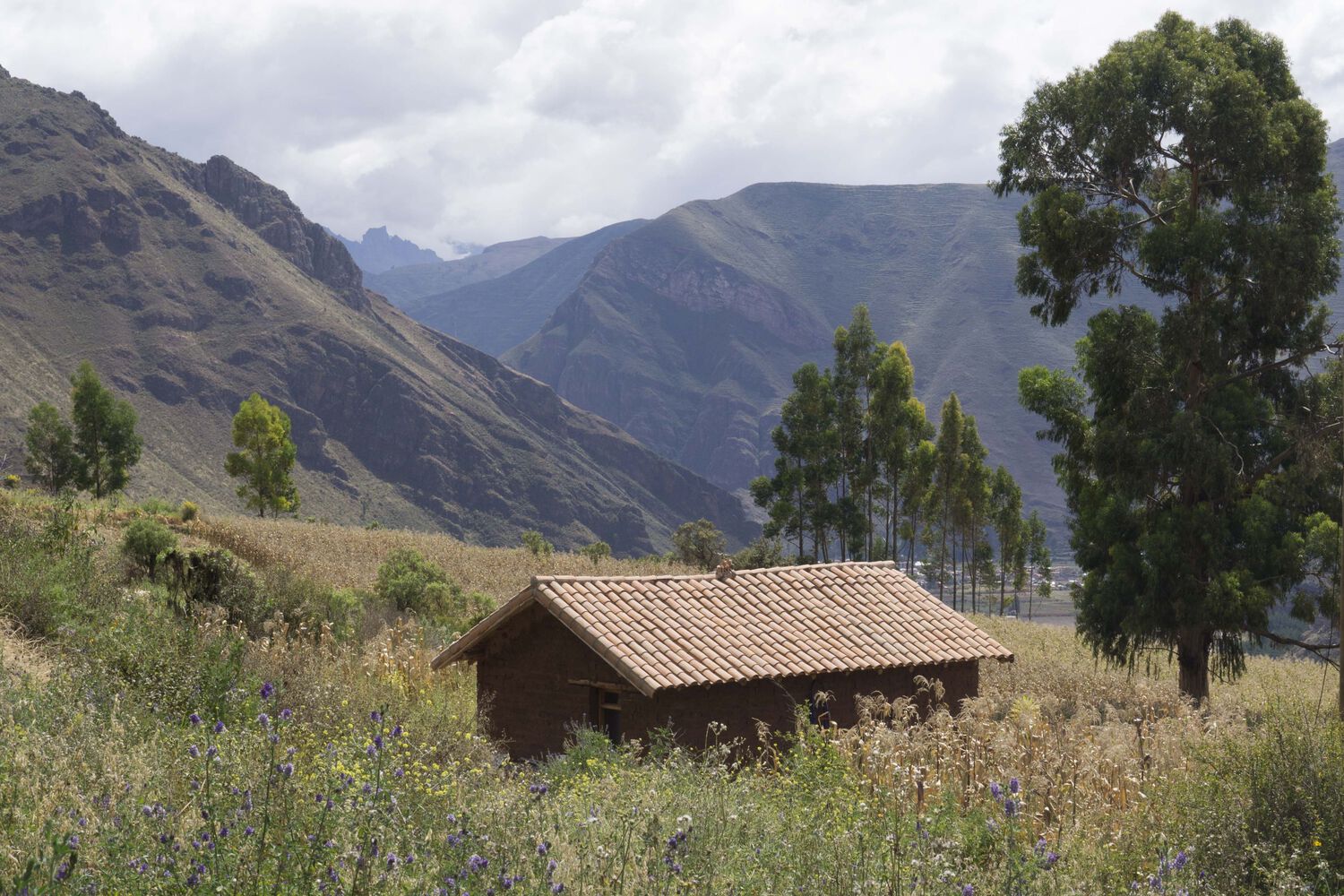
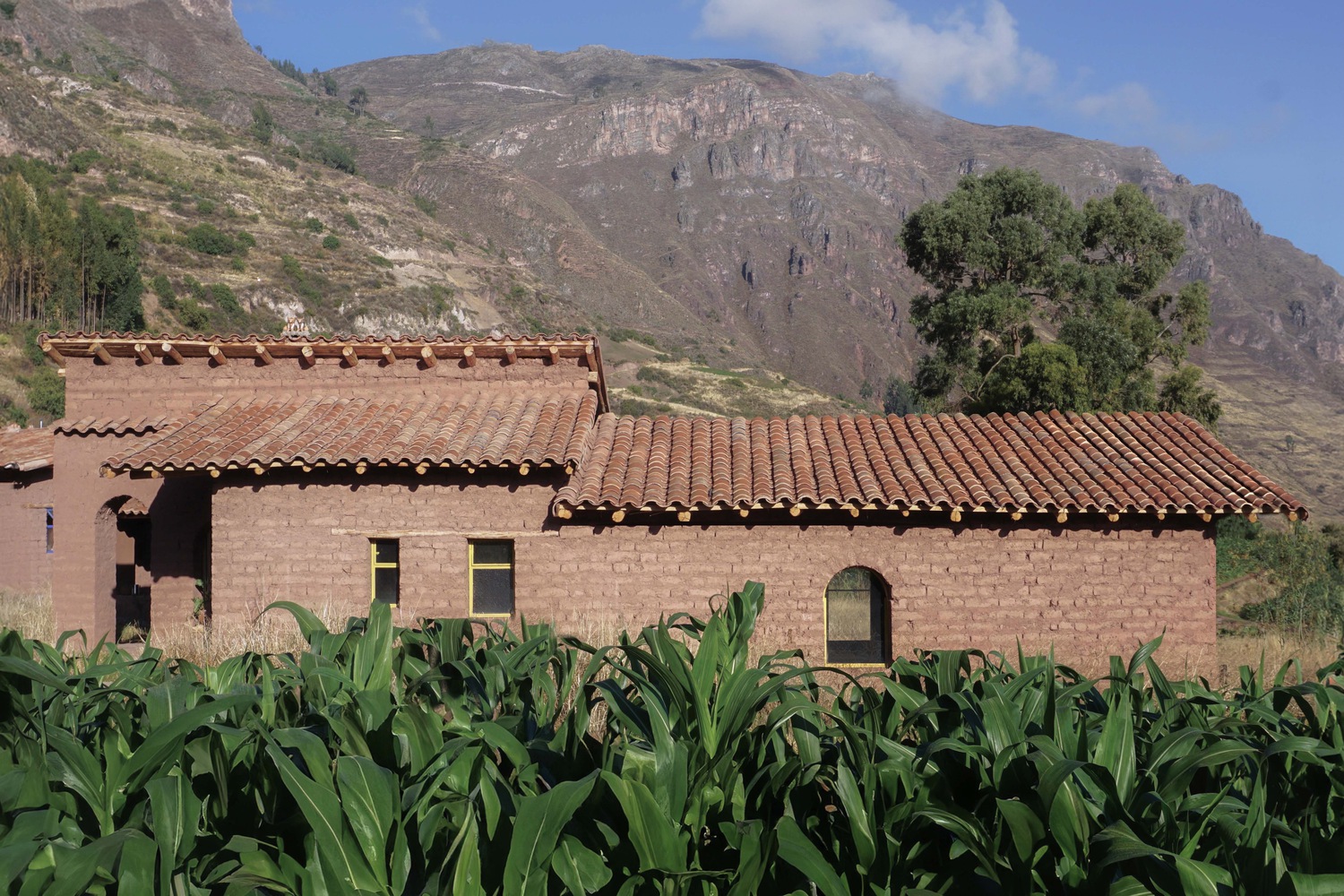
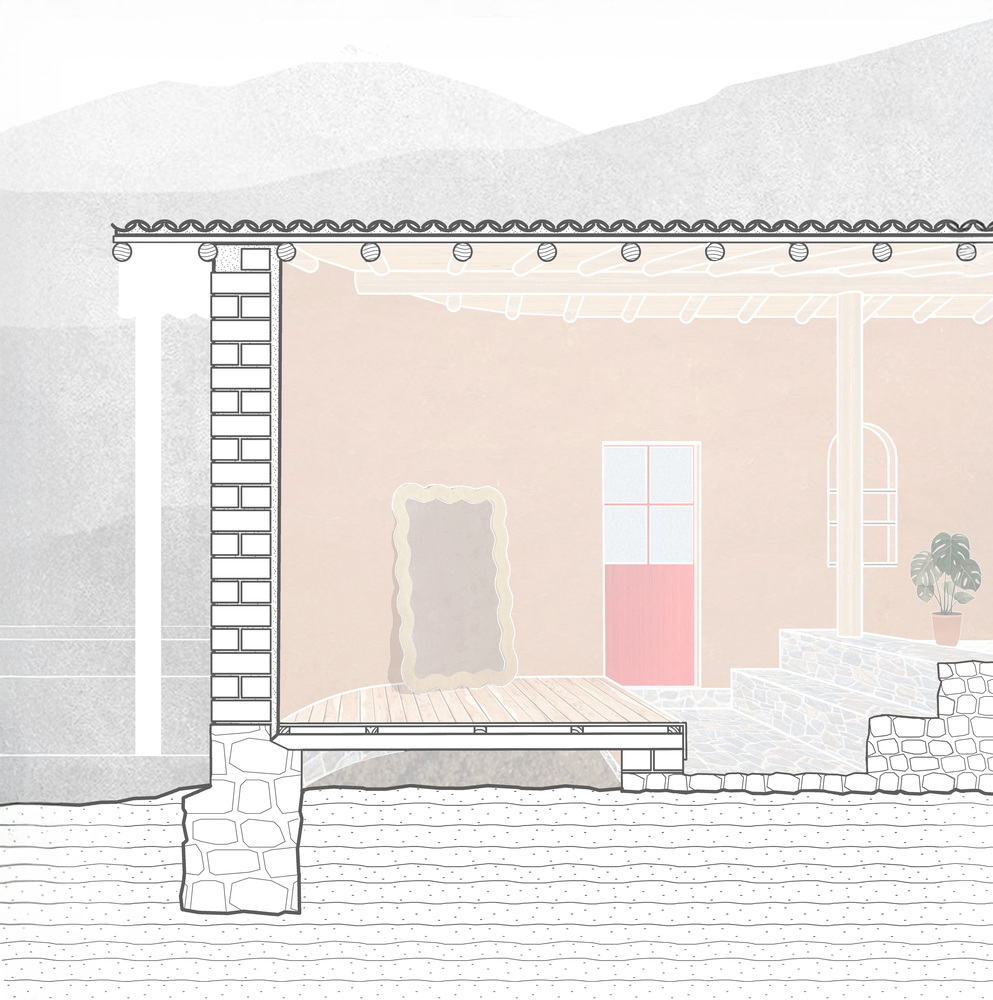
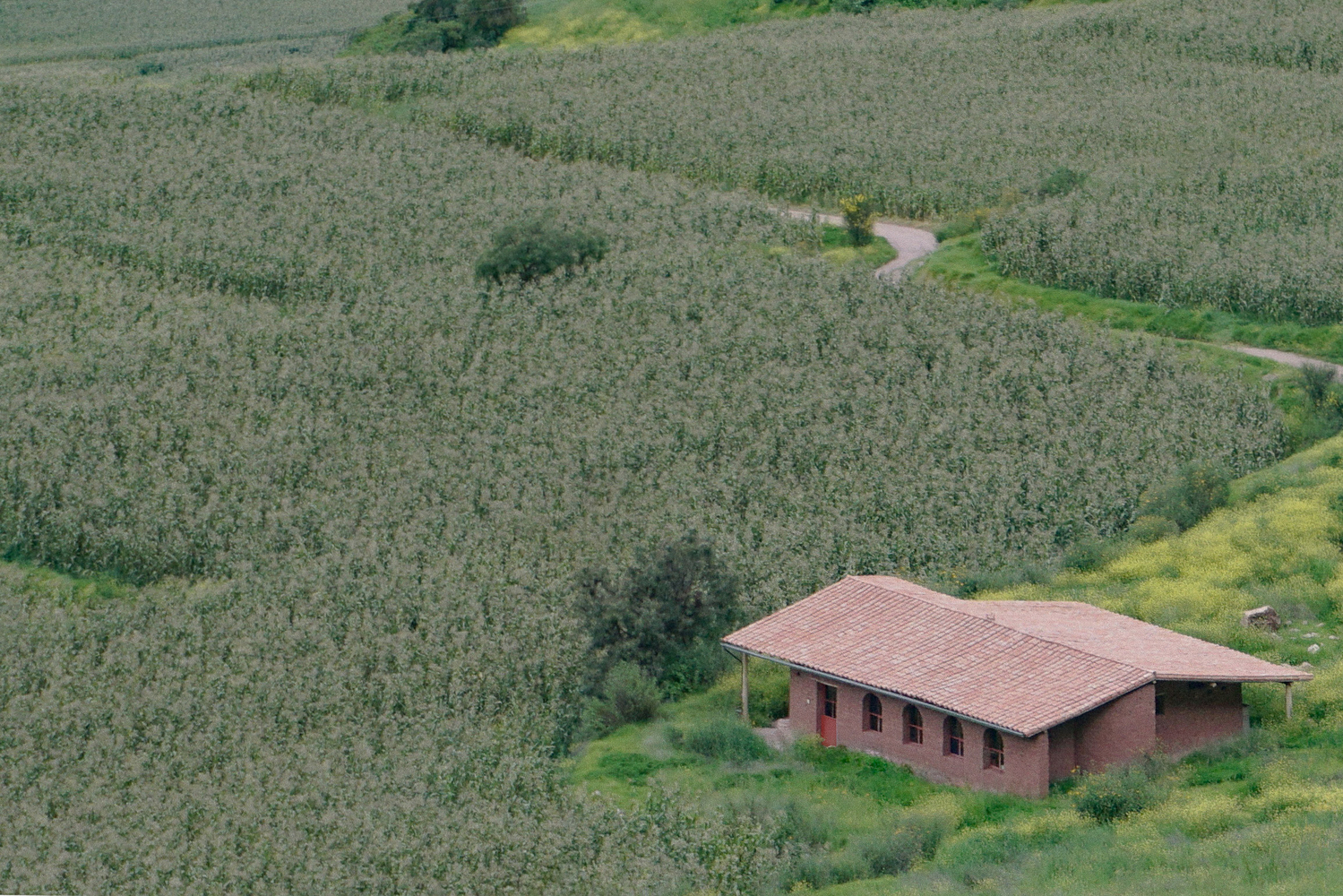
The Quincho Bernarda Community Center in Taray, Peru, is a 140m² collective space for residents that completes the KUSKA, a set of habitable structures situated in the South American Andean landscape. Designed in 2025 by Taller MACAA and led by architect and photographer Rafael Ortiz Santos, the Cusco-based practice focuses on residential and public architecture rooted in local context. The firm values the preservation of Andean cultural heritage by honoring traditional adobe construction techniques while regenerating existing buildings through sustainable materials and contemporary methods.
La Cabaña Feliciana, Taller MACAA, 2022   I  ArchDaily
Hogar Florencia, Taller MACAA, 2025   I  ArchDaily

The Quincho Bernarda Community Center is part of the firm’s broader regeneration of KUSKA, which also includes the La Cabaña Feliciana and Hogar Florencia, two additional adobe structures that contribute to the revitalization of the village. Through these projects, the firm demonstrates a commitment to community-centered design, material continuity, and the long-term resilience of rural Andean settlements.

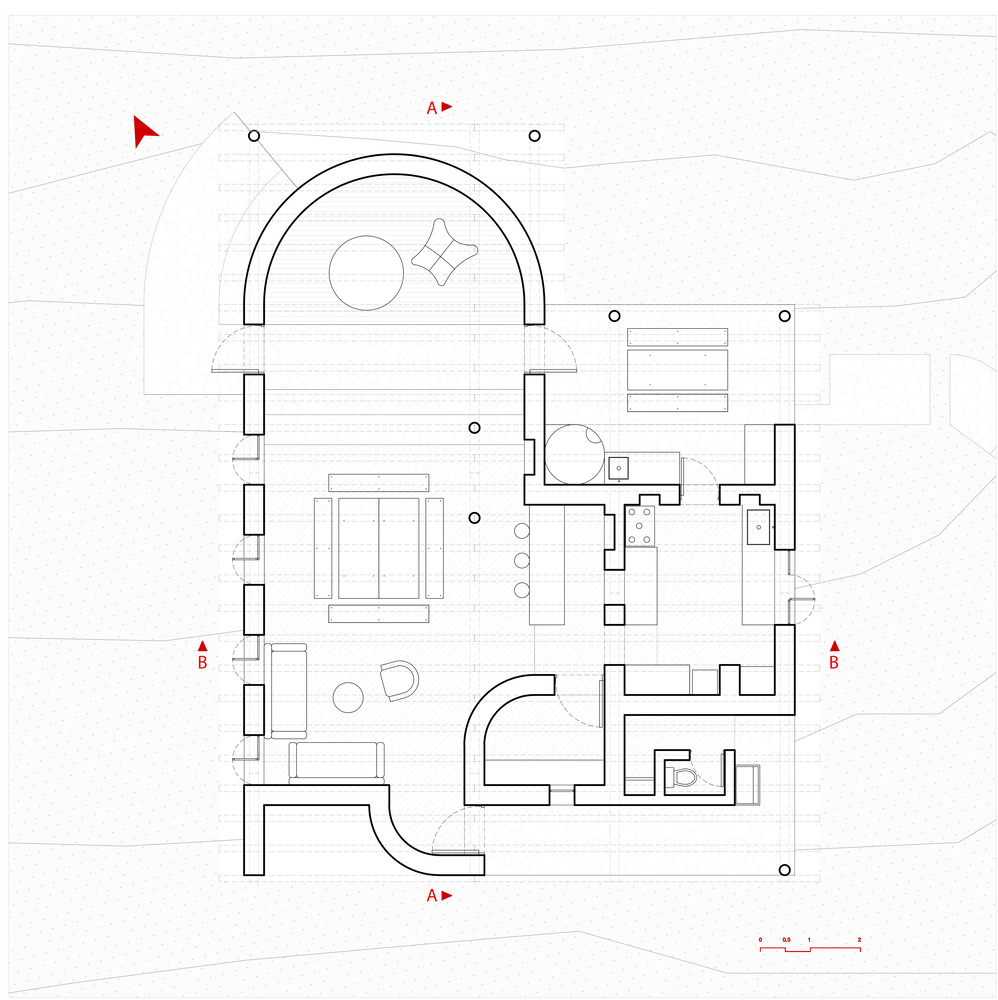
Ground Plan   I  ArchDaily

The term “Quincho” originates from an Argentine tradition describing a dedicated space in the home for gathering, eating, and socializing. This project reimagines that tradition through the spatial framework of a basilica, detached from its religious meaning and adapted into a shared domestic environment organized around a central nave, a kitchen, and two outdoor dining terraces.

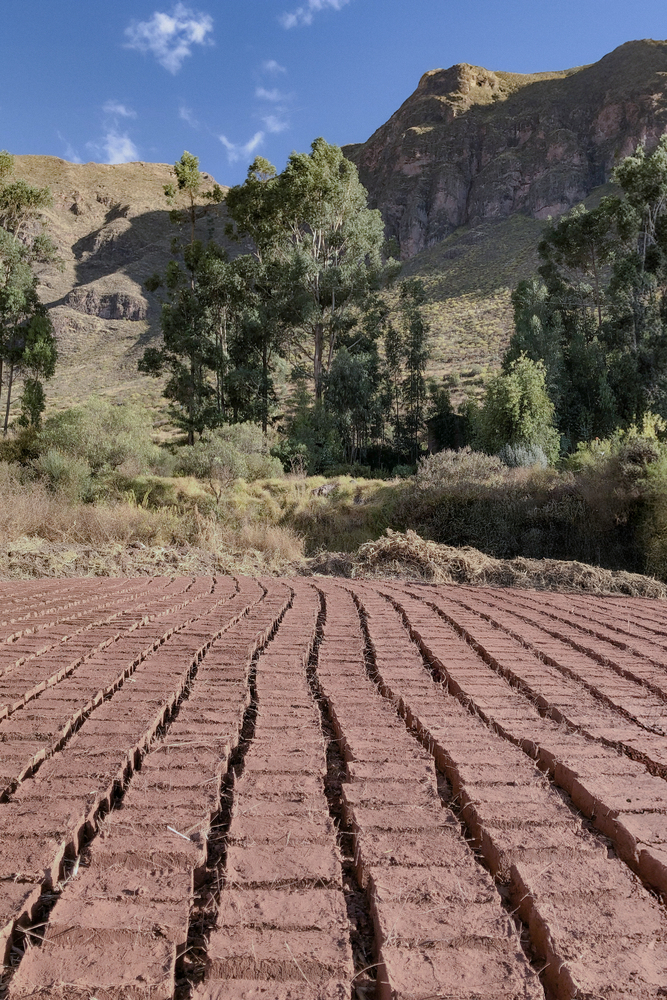
Locally Sourced Adobe   I    ArchDaily

Across the center, locally sourced red adobe remains the primary material exposed as both structure and surface, expressing its mass, texture, and construction logic. Traditional load-bearing methods are combined with a contemporary spatial approach that highlights the material’s thermal, tactile, and structural strengths, resulting in an environment that feels both solid and inviting.

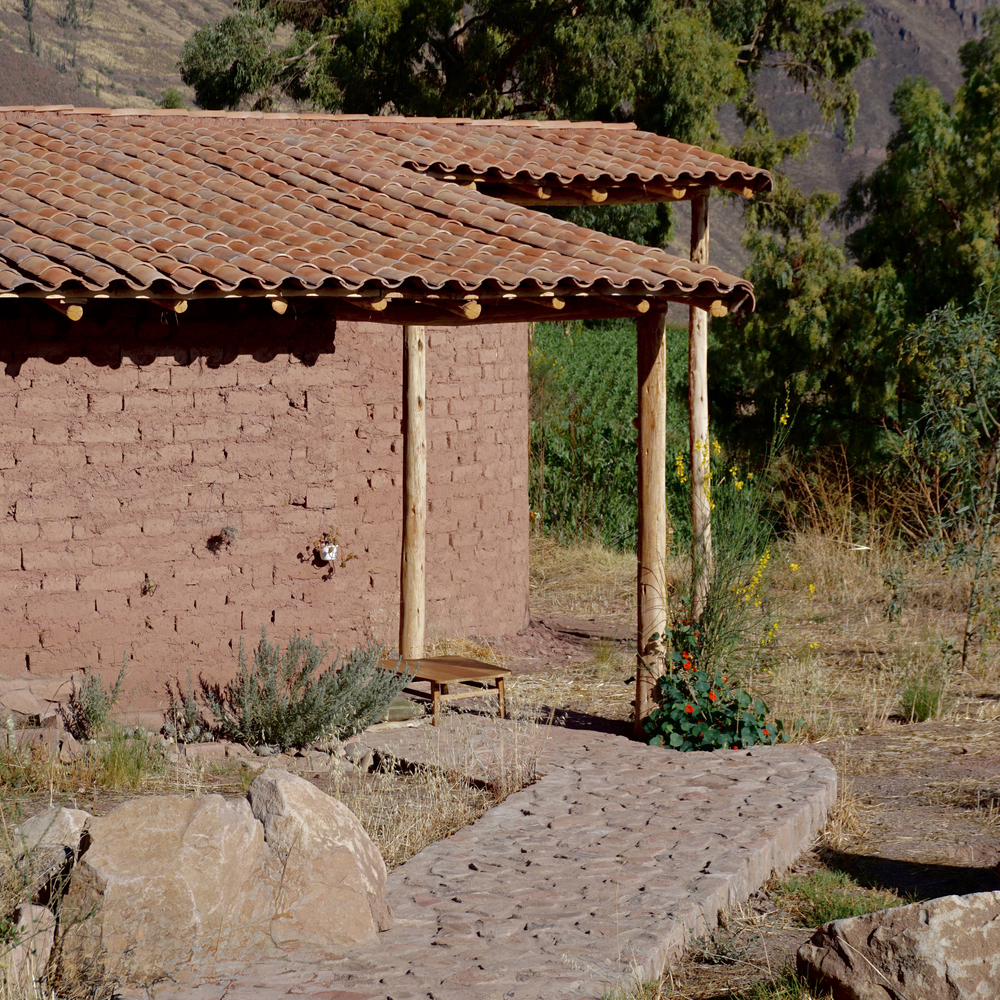
Exterior of Community Center   I  ArchDaily

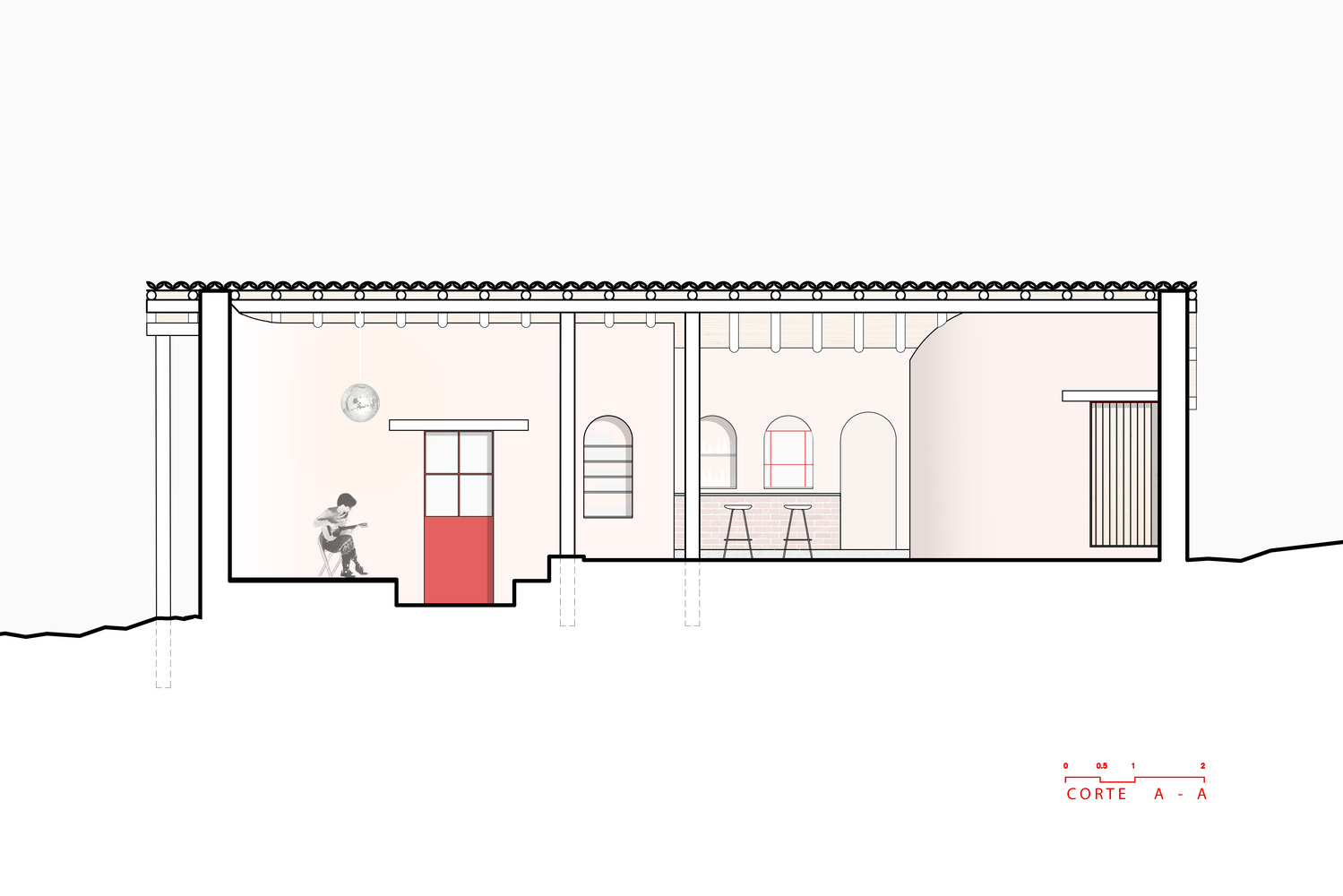
The project is arranged around a single main volume covered by a pitched tile roof. A ridge beam, supported by adobe walls and two eucalyptus columns, is positioned off the central axis of the hall, shifting the structural balance of the roof. This displacement creates a clear internal hierarchy while maintaining a free, continuous plan within the structure.

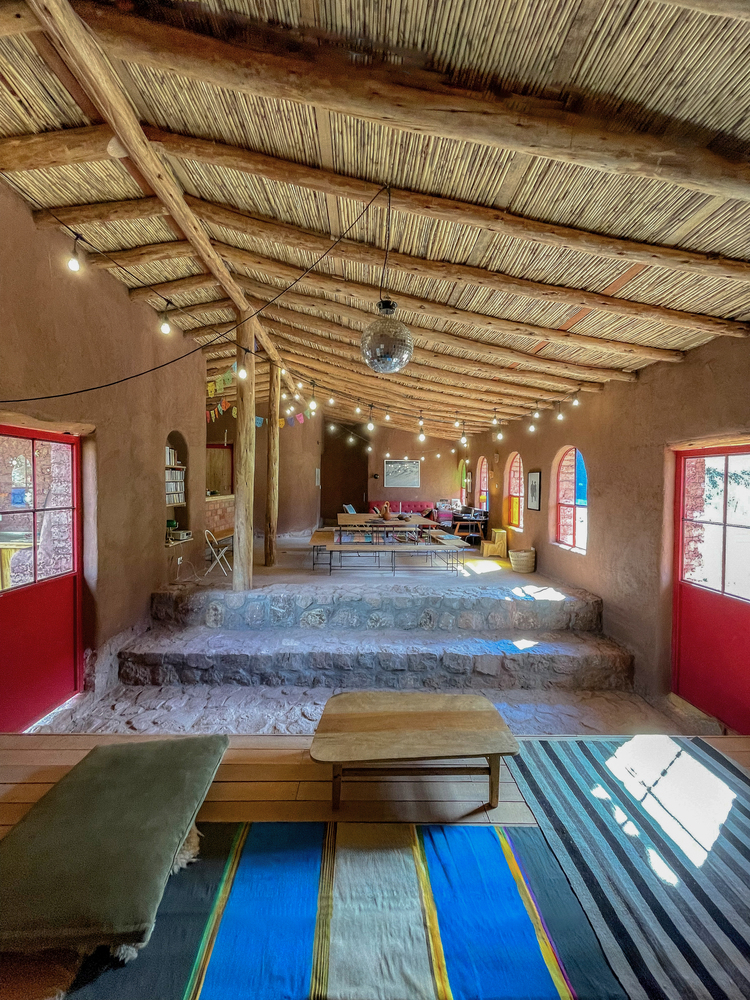
Interior of Community Center   I  ArchDaily
Construction Detail of Interior Stage   I  ArchDaily

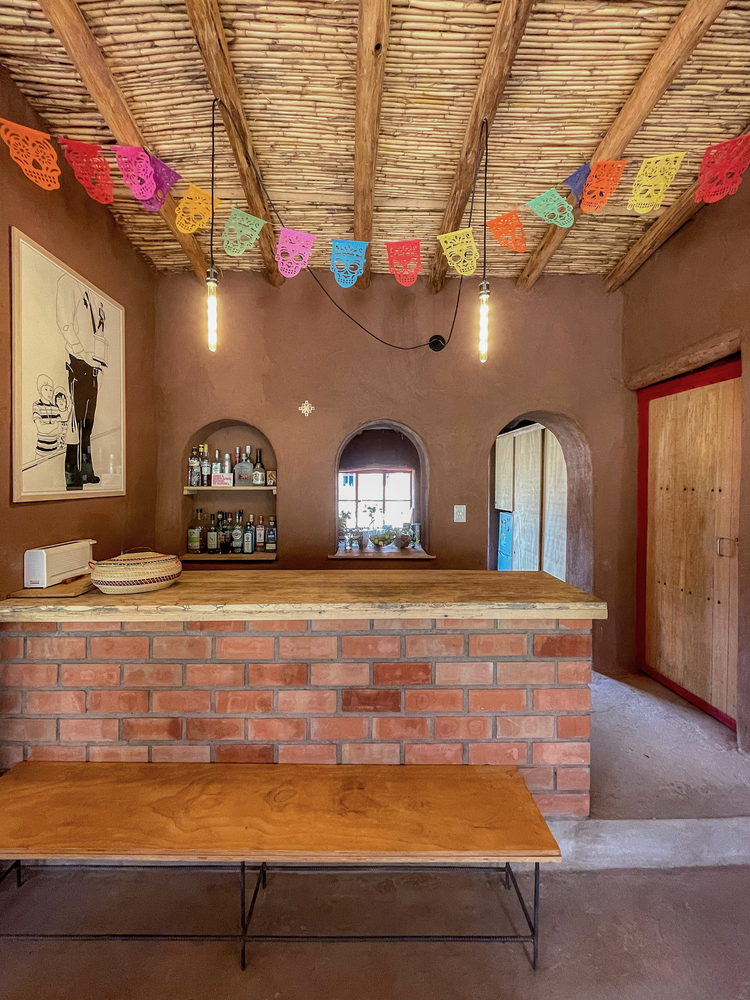
The main hall accommodates a lounge, a long communal table, and a bar that connects directly to the kitchen through both a pass-through opening and a door, while a small stage sits slightly below the primary floor level. Stone steps positioned between the hall and stage double as casual seating, allowing the space to shift easily between everyday use and cultural or community.

Section of Main Hall   I  ArchDaily
Community Center Kitchen & Bar   I  ArchDaily

The use of arches replaced conventional lintels to span openings, improving structural performance under seismic conditions, while allowing for more continuous, open interiors. Within the kitchen, the thickness of the adobe walls is used to carve out built-in niches that seamlessly accommodate storage, and the use of curved walls not only introduces a sculptural presence but also shapes movement and reinforces the space’s sense of enclosure and cohesion.

Outdoor Patio of Community Center   I  ArchDaily

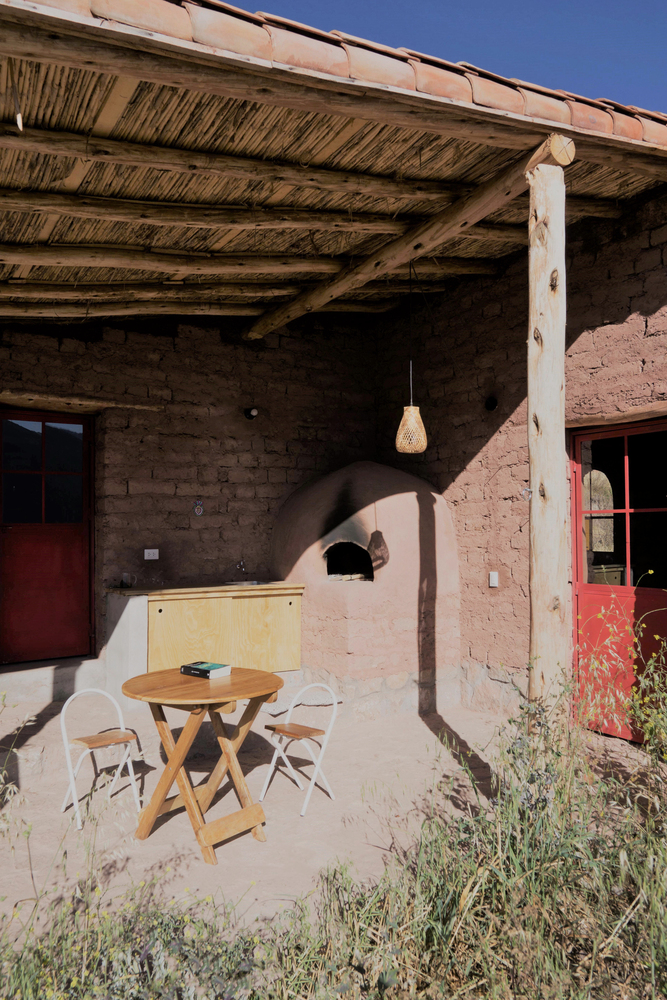
The center establishes a strong connection to the Andean terrain, with terraces that extend the interior outward into the landscape. These outdoor platforms are carefully oriented to receive the morning sun, allowing the spaces to warm gradually throughout the day and creating an inviting setting for early gatherings and shared meals. The northwest terrace, partially sheltered and shaped by the natural slope, frames views toward the Andes, reinforcing the building’s relationship to its surrounding geography.

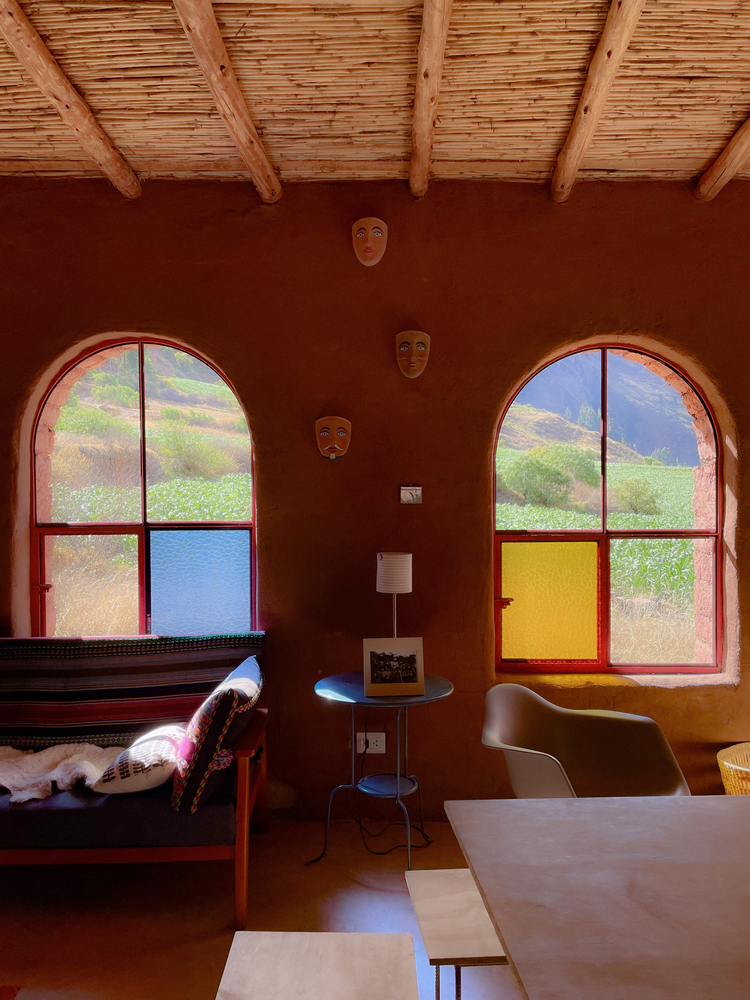
Stained Glass Arched Windows   I  ArchDaily

On the western elevation, panels of stained glass are embedded within the facade to catch the fading light of the afternoon. As the sun sets, these panes diffuse and refract its rays, casting saturated tones across the interior surfaces and enriching the atmosphere with warm blue and yellow colors that compliment the red adobe. Beyond their visual effect, the filtered light works in tandem with the adobe’s thermal mass, allowing the thick walls to absorb and slowly release heat accumulated throughout the day.

Quincho Bernarda Community Center   I  ArchDaily

Ultimately, the Quincho Bernarda Community Center positions locally sourced construction not merely as a matter of economy or sustainability, but by reframing material as a mediator between interior and landscape, dissolving rigid boundaries and allowing climate, topography, and collective life to shape space. In doing so, it suggests that vernacular techniques are not nostalgic gestures, but active cultural frameworks capable of generating contemporary architecture grounded in place, memory, and communal identity.

Compiled by Fernanda Loyola Cardoso

Citations:

ArchDaily. “Quincho Bernarda Community Center / Taller MACAA (Misión de Arquitectura, Construcción y Arte en los Andes).” ArchDaily, January 5, 2026. https://www.archdaily.com/1037047/quincho-bernarda-community-center-taller-macaa-mision-de-arquitectura-construccion-y-arte-en-los-andes.

ArchDaily. “Feliciana Cabin / Taller MACAA.” ArchDaily, April 27, 2023. https://www.archdaily.com/1000057/feliciana-cabin-taller-macaa.

ArchDaily. “Hogar Florencia / Taller MACAA (Misión de Arquitectura, Construcción y Arte en los Andes).” ArchDaily en Español, May 15, 2025. https://www.archdaily.cl/cl/1030130/hogar-florencia-taller-macaa.

1 Year in Argentina. “Quincho.” 1 Year in Argentina (blog), April 6, 2014.  https://1yearinargentina.com/tag/quincho/.

Luis Barragán and Adobe

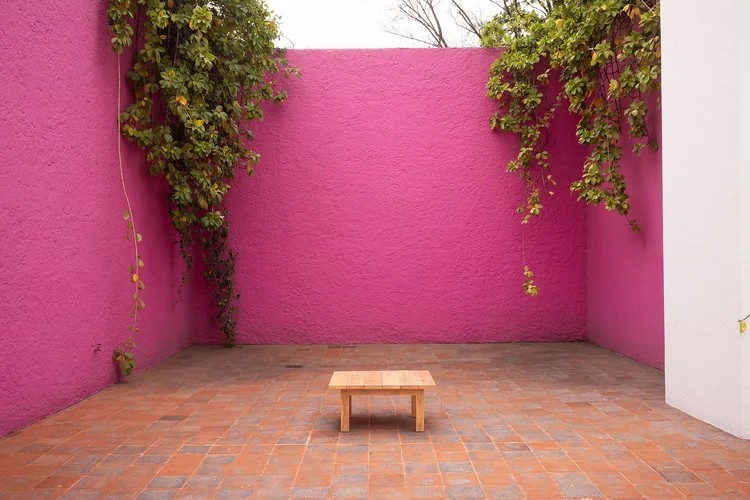
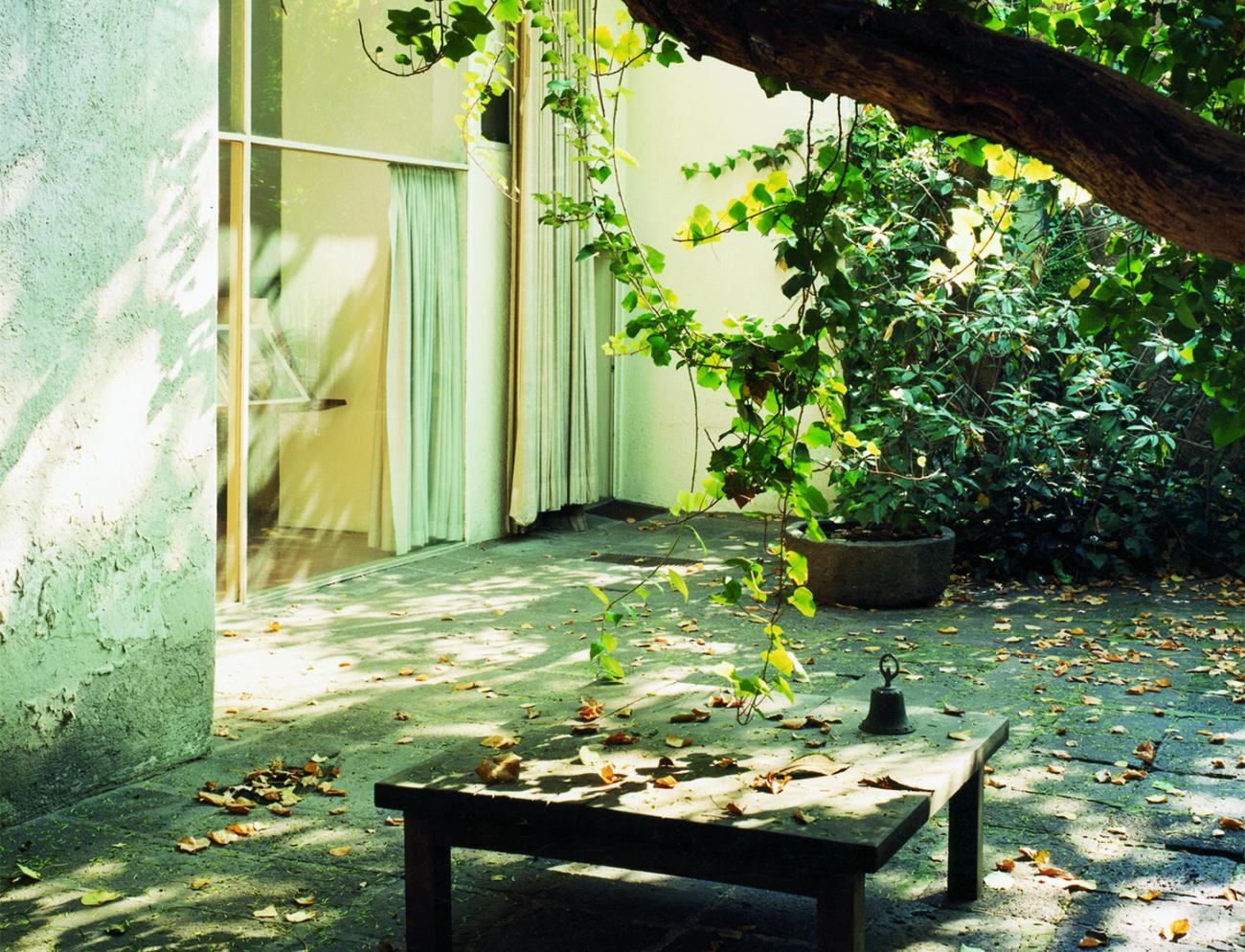
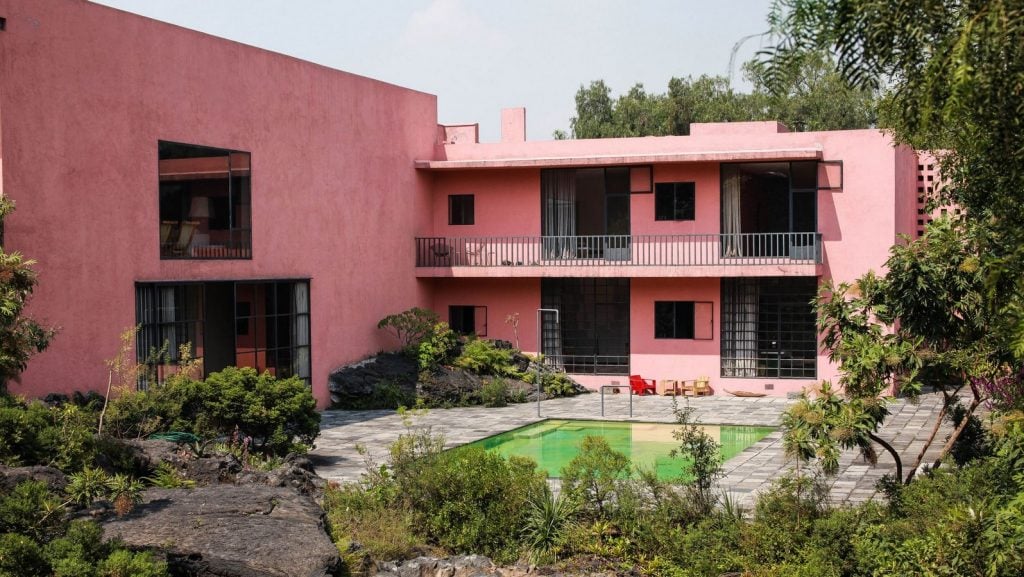
Casa Luis Barragan Courtyard

Luis Barragan was a Pritzker Architecture Prize winning Mexican architect known for exceptional work in combining modern architectural concepts with traditional ideas and earthen materials. He was born in Guadalajara, Mexico in 1902 and he passed away in Mexico City in 1988. Even though his works were in the field of architecture, Barragan did not receive a formal degree in architecture, instead he attended Escuela Libre de Ingenieros in Guadalajara and obtained a degree in civil engineering. As a result, the majority of Barragan’s architectural knowledge and skills were self-taught, taking inspiration from the buildings and landscapes that he saw when he traveled to other countries such as France and Spain. 

Photo by Ursula Bernath, 1963

Part of what makes Luis Barragan’s buildings and works so noteworthy is his use of traditional Mexican ideas of materiality, like working with adobe, wood, stone and clay as well as taking inspiration from Mexican cultural ideas of light in the home, the presence of nature, and the dynamic relationship between life and death. In a sense his architectural philosophy involved viewing the buildings and built environment in more than a conventional use based way, instead focusing on the emotions and presence that are invoked by architecture in tandem with modern and contemporary ideas. Barragan’s philosophy, or the reason he made his works based on these ideas of nature and tradition was because he wanted the people and other professionals to think about concepts like art, serenity, light, and beauty because to him they went hand-in-hand with the architectural field. 

Casa Luis Barragan

The Pulitzer Architecture Prize was awarded to Barragan in 1980 for the many exceptional buildings he designed during his lifetime. Some of his more known and prominent works include Casa Prieto Lopez (also known as Casa Pedregal), Cuadra San Cristobal, and Casa Estudio Luis Barragan. 

While not made from adobe bricks, Casa Prieto Lopez showcases his deep range of natural and earthen materials, given that he used the lava rock already present at the location where the house was to be built. This use of local earthen materials provides that sense of harmony between the natural and the built environment that Barragan strived for in his works. 

Casa Prieto Lopez

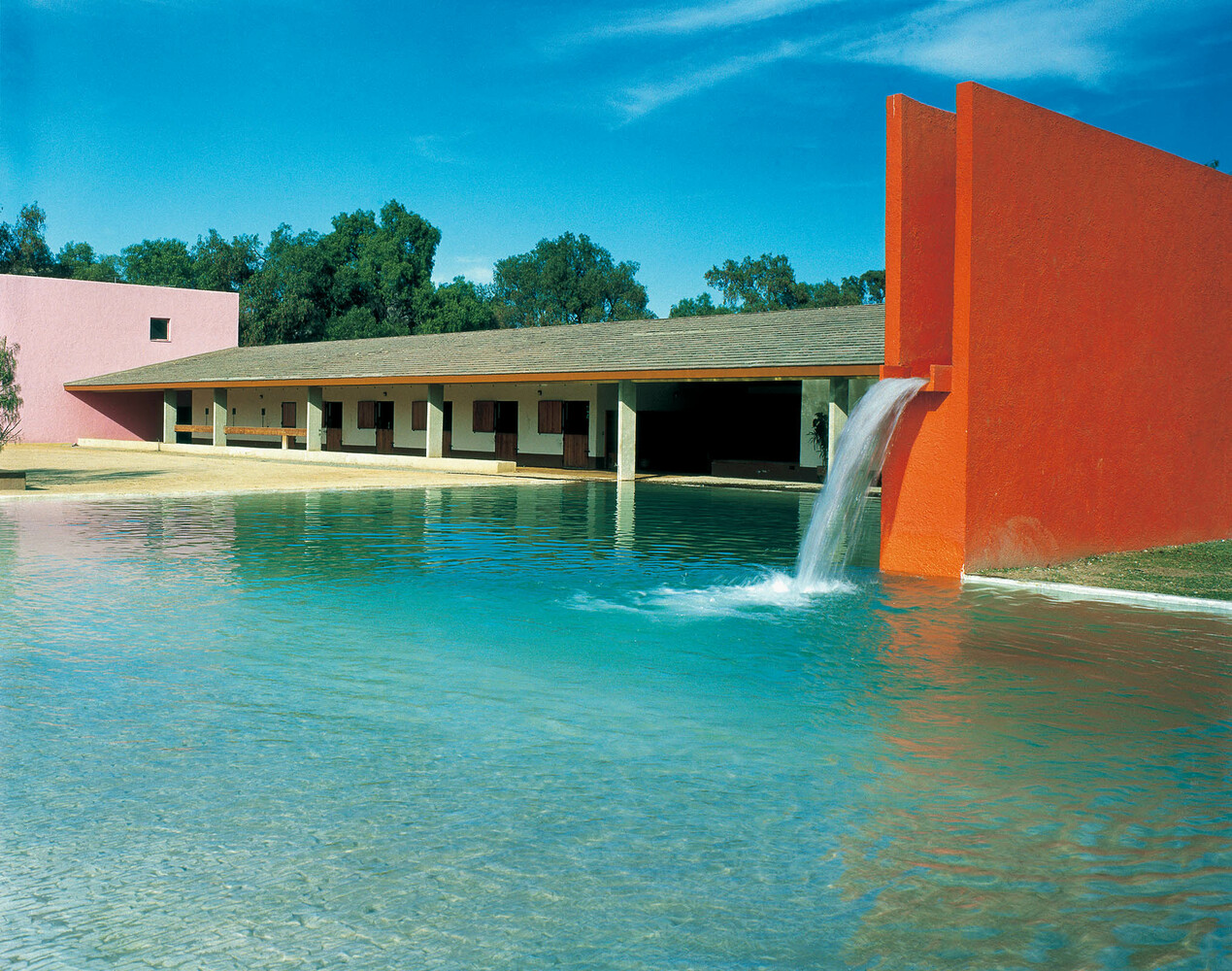
Cuadra San Cristóbal is located in Mexico City, in an area called Los Clubes, where the geometrical design and emotions conveyed through the shapes of the walls exemplifies the power that natural materials carry when used in modern architecture. Cuadra San Cristobal is in part made with rammed earth and other earth materials displayed in various bright colors that bring in light and serenity into the space. 

Cuadra San Cristóbal

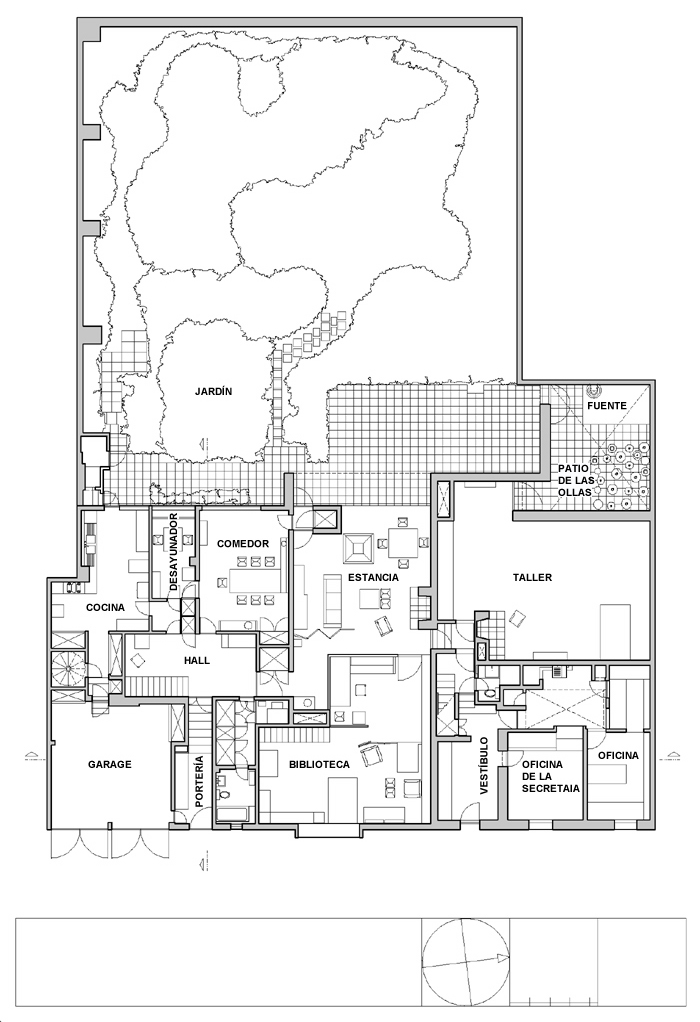
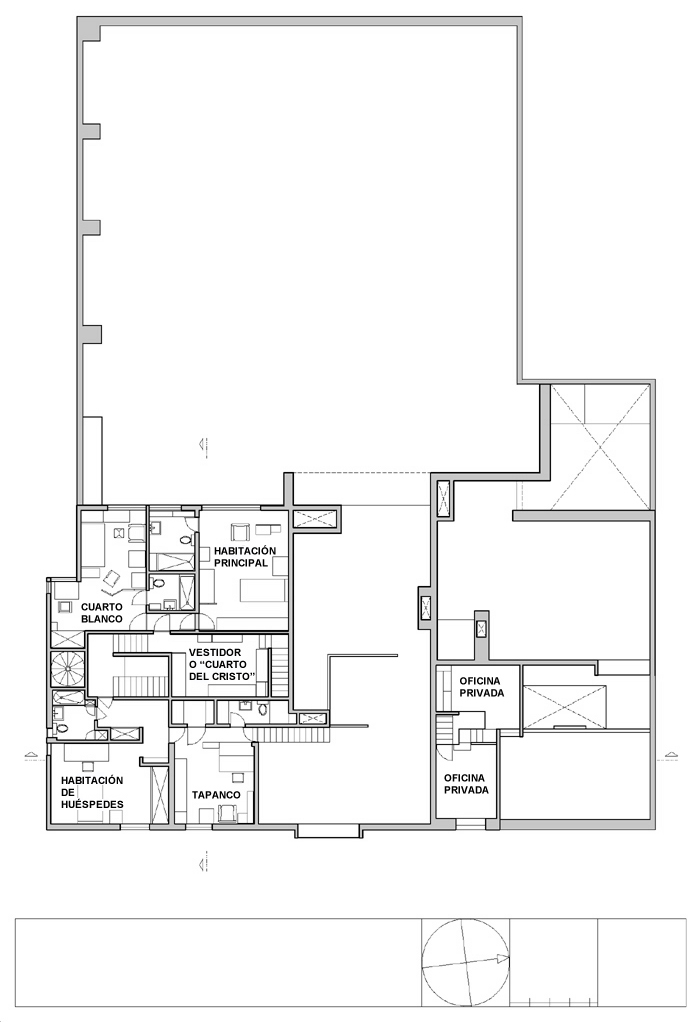
Perhaps Luis Barragan’s most well known work is his Casa Estudio Luis Barragan, located in Mexico City on General Francisco Ramírez Street. The influence of this building was deemed important enough to be recognized by the UNESCO World Heritage Convention in 2004. The house was built in 1947 and has three floors and a private garden, being 1,161 m2 and occupies two lots adjacent to each other.

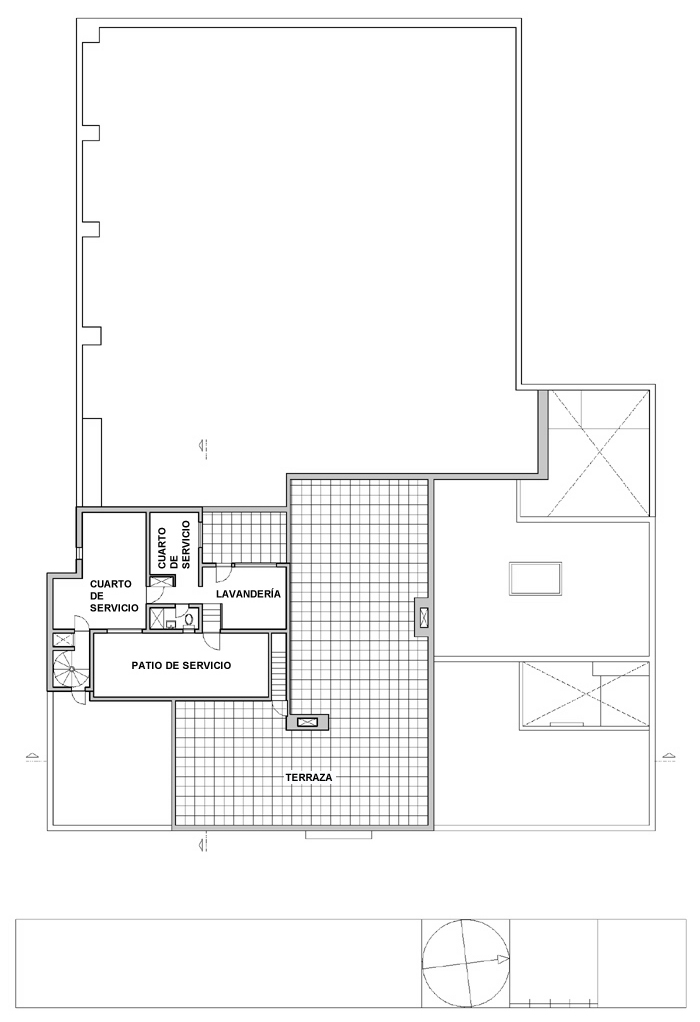
Casa Luis Barragan – Ground Floor
Casa Luis Barragan – Second Floor
Casa Luis Barragan – Third Floor

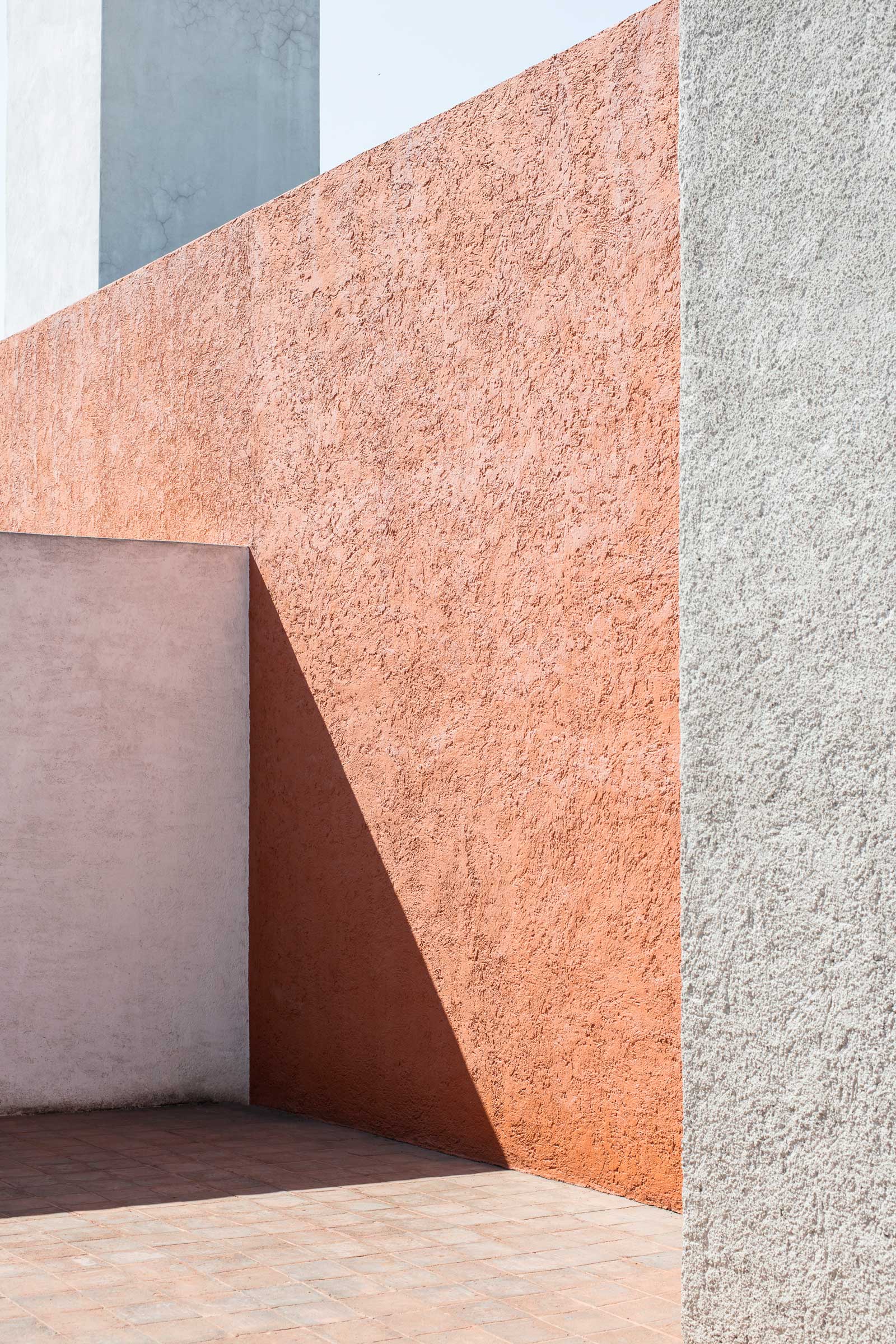
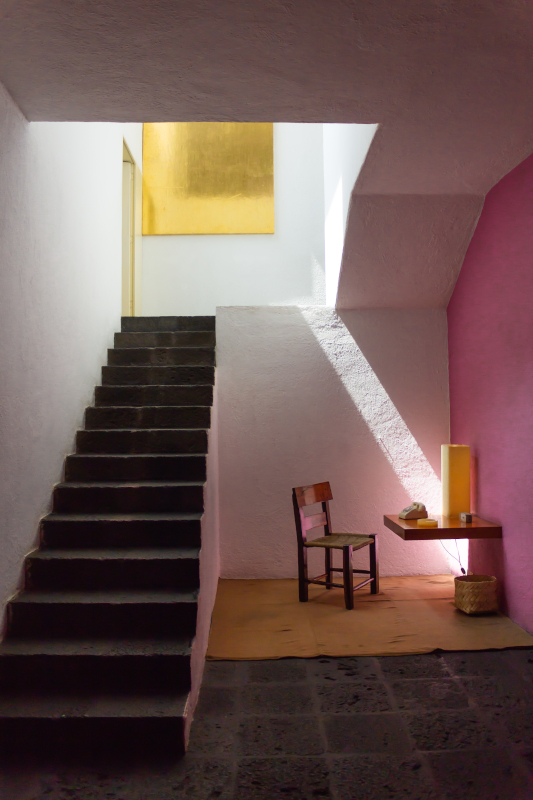
The house was designed and constructed to be Barragan’s private residence and studio, which gives the impression that everything was tailored to his interests, where he could add ideas and concepts that he had seen throughout his travels and what he incorporated into previous designs. One of these concepts incorporated into the house/studio was the dynamic play between light, shadow, and structure made possible by the use of earthen materials, like thick adobe bricks in construction. Some of the colors present in this house, such as the bright oranges and pink, combine with the geometric shapes of the walls, particularly in the use of right angles and cubic shapes which according to some is the representation of an introspective and spiritual symbolism. The use of earth materials, like adobe bricks and rammed earth, in Casa Estudio Luis Barragan showcases a different level of understanding of the natural world, much like traditional architecture did in the past. With the incorporation of these materials, the thick blocks can provide shadow, regulate heat and cold temperatures, and the shapes that these blocks are arranged in, provide a form in which light expands the room. 

Casa Luis Barragan – Adobe

When receiving the Pulitzer Prize, Luis Barragan said, “It is essential to an architect to know how to see—to see in such a way that vision is not overpowered by rational analysis.” When observing his various works and the philosophy through which he carried out his designs, it’s evident that Barragan focuses on the art of seeing, not just the built environment and the final product, but the emotional connection that one has with the design alongside the dynamic relationship between nature, materiality, and the man-made environment. His works inspire the thinking of the connection between life and death, earth and materiality, and nature and the built world, exemplifying how important it is for one to consider the modern and contemporary with, instead of separate from the traditional earth materials and cultural traditions from various places in the world.

Inside Casa Luis Barragan

References

Barragan Foundation. (n.d.). Home. Home | Barragan Foundation. https://www.barragan-foundation.org/ 

Bathurst, M. (2018). Casa Luis Barragán: Architecture of Solitude. Readcereal.com. https://www.readcereal.com/articles/casa-luis-barragan 

Fida, H. (n.d.). Luis Barragan: 15 iconic projects everyone must know. Rethinking the Future. https://www.re-thinkingthefuture.com/know-your-architects/a743-luis-barragan-15-iconic-projects/ 

Fundación de Arquitectura Tapatía Luis Barragán A. C. (n.d.). La Casa Luis Barragán. CASA LUIS BARRAGÁN. https://www.casaluisbarragan.org/ 

González, C. (2022, September 29). Luis Barragán, Maestro de la Luz y del Color. CasaDecor. https://casadecor.es/blog/personajes/luis-barragan-maestro-de-luz-y-color/ 

Pritzker Prize. (n.d.). Luis Barragán: The Pritzker Architecture Prize. Luis Barragán | The Pritzker Architecture Prize. https://www.pritzkerprize.com/laureates/1980#laureate-page-362 

Sun at Six. (2021, December 1). Casa Pedregal by Luis Barragan. https://www.sunatsix.com/blogs/news/luis-barragan?srsltid=AfmBOoo2-PPUqLb-dNASCS4qQ_AnlE3elW93dc0WLQWy0jOiHYgWJwdS 

UNESCO. (2004). Luis Barragán House and Studio. UNESCO World Heritage Convention. https://whc.unesco.org/en/list/1136/

Umweltbildungszentrum: Rammed Earth as a Framework for Environmental Education


Hess / Talhof / Kumierz Website: Umweltbildungszentrum
Augsburg

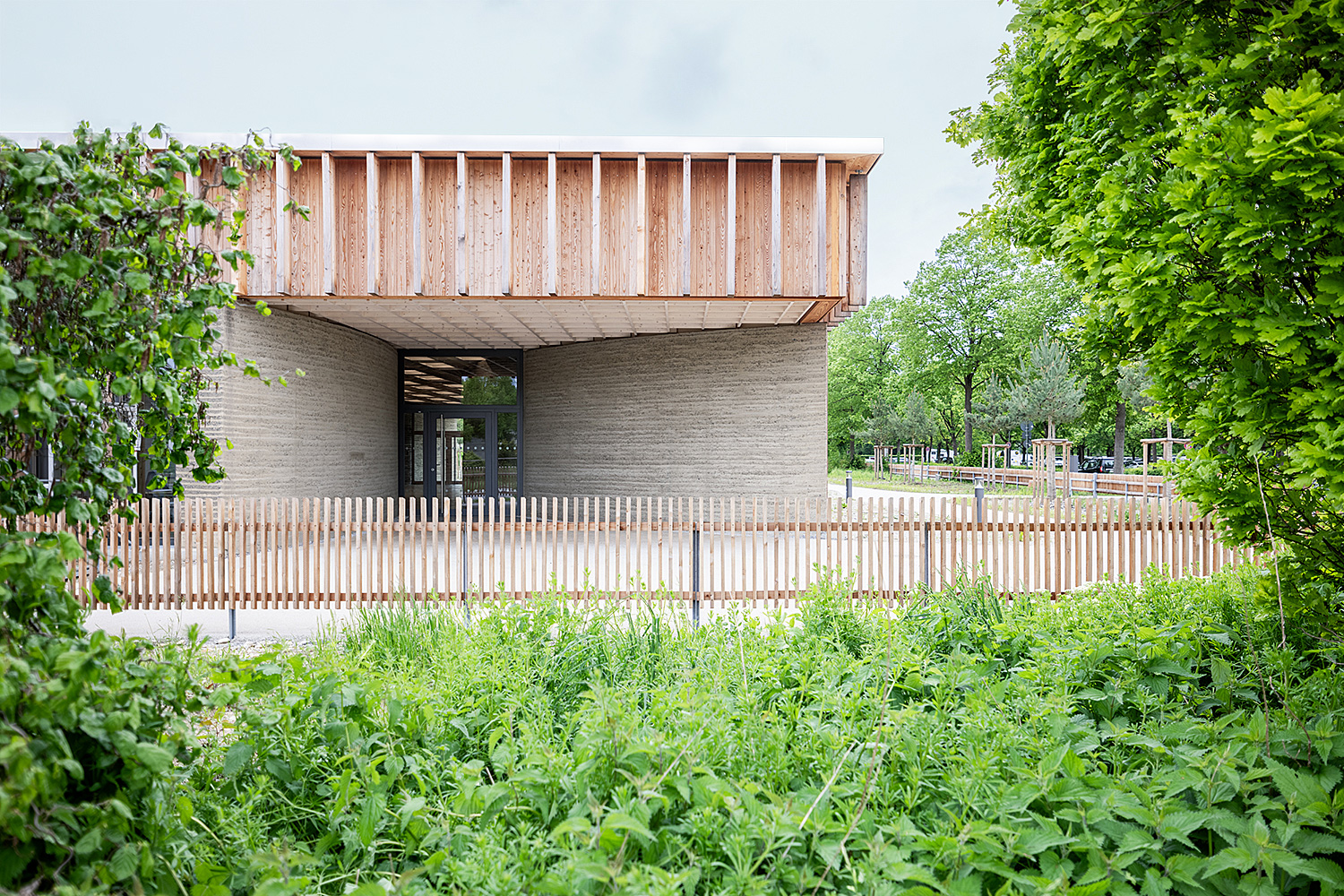
The Umweltbildungszentrum (UBZ) in Augsburg, Germany, is a single-story, rammed earth (Stampflehm) building that realizes sustainable development at multiple scales. The UBZ was designed by the Munich-based firm Hess / Talhof / Kusmierz Architects, led by Thomas Hess and Johannes Talhof. The firm values architecture as an artistic statement that serves as an unmatched expression of aspects of the world which cannot be captured, quantified, or defined. Guided by this conceptual outlook, they believe architecture creates new apertures for understanding. Their work spans a wide range of context-driven projects rooted in community, education, and civic life.

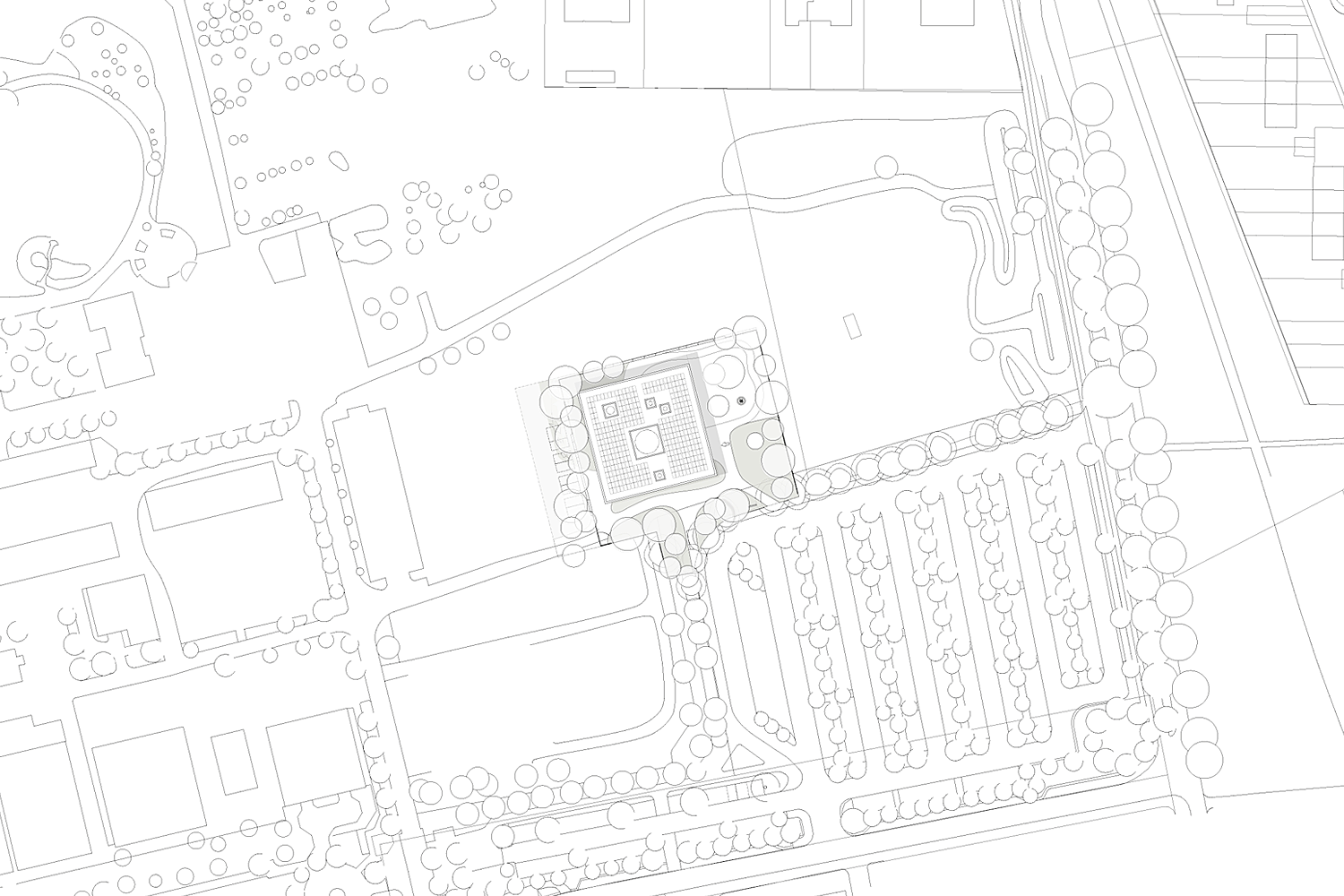
Completed in 2023, the UBZ demonstrates the firm’s commitment to contextually informed practice. This environmental education center for sustainable development serves as a meeting and learning place on the grounds of the Augsburg Botanical Garden. Situated at the transition between city and landscape, it bridges nature and urban life, embodying its role as a landmark of sustainable development.

Hess / Talhof / Kumierz Website: Umweltbildungszentrum
Augsburg Site Plan
Hess / Talhof / Kumierz Website: Umweltbildungszentrum
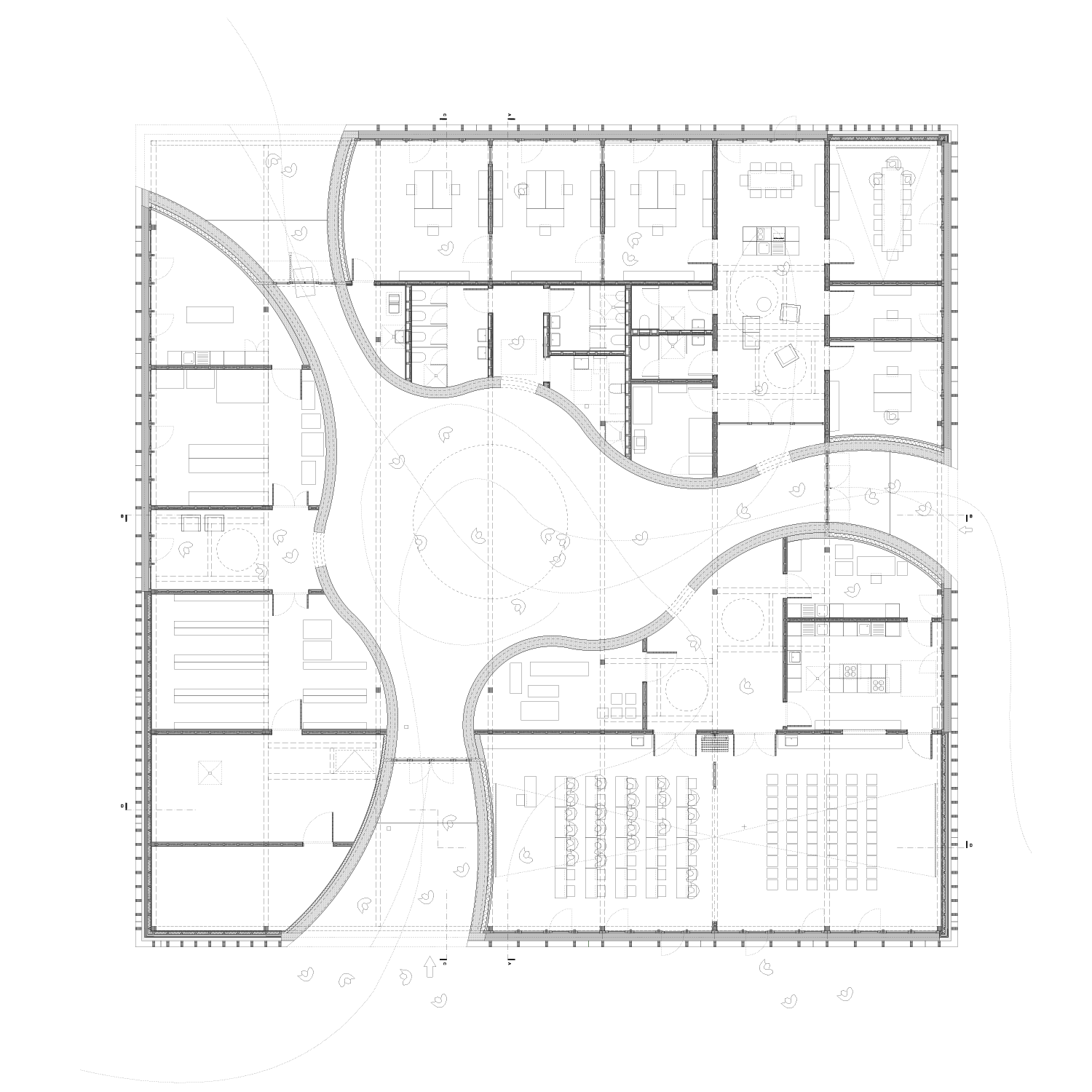
Augsburg  Building Plan

Through workshops, seminars, interactive exhibits, field trips, and community events, the UBZ offers people of all ages opportunities to learn about biodiversity, sustainability practices, and environmental stewardship.

Hess / Talhof / Kumierz Website: Umweltbildungszentrum
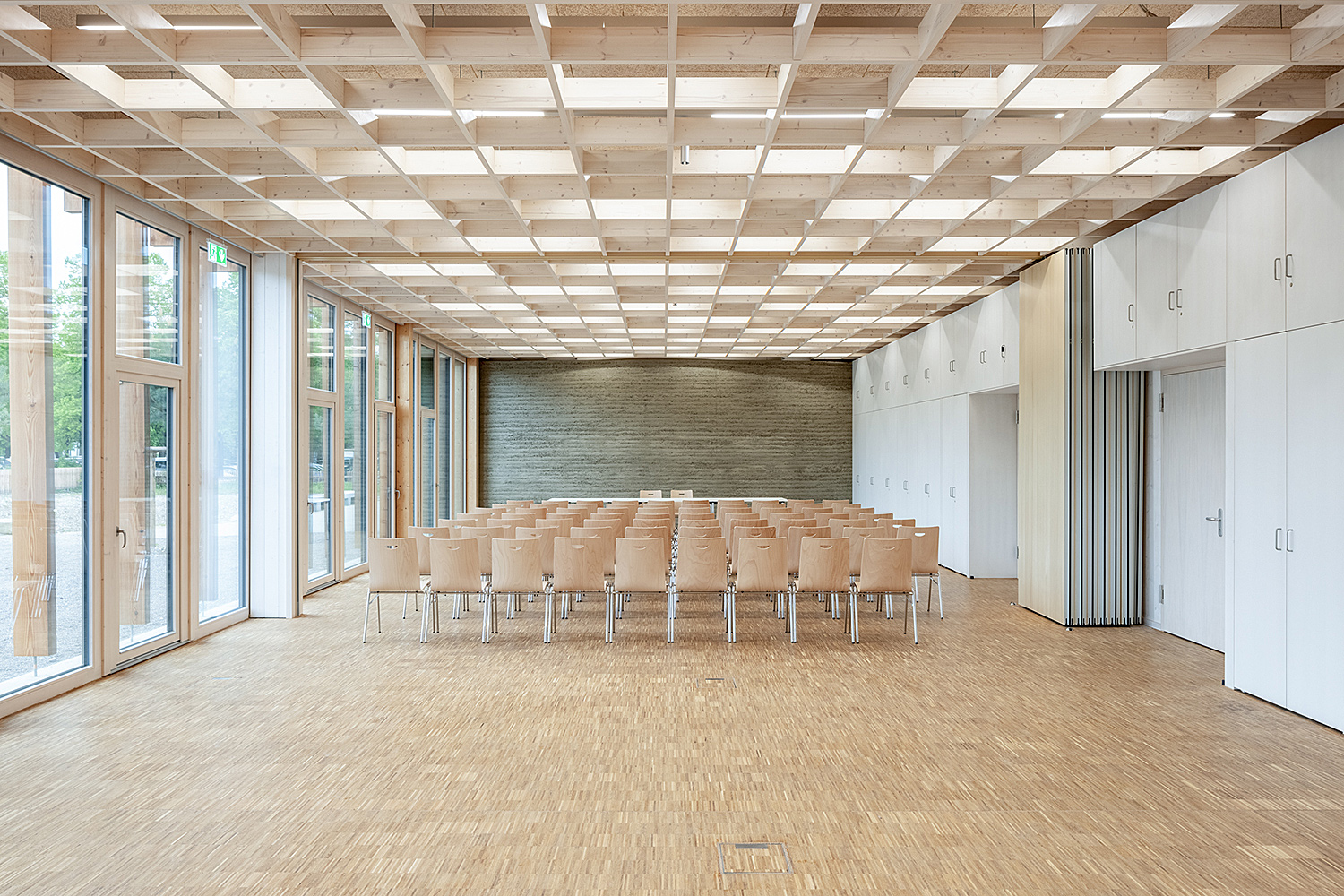
Augsburg Seminar Room

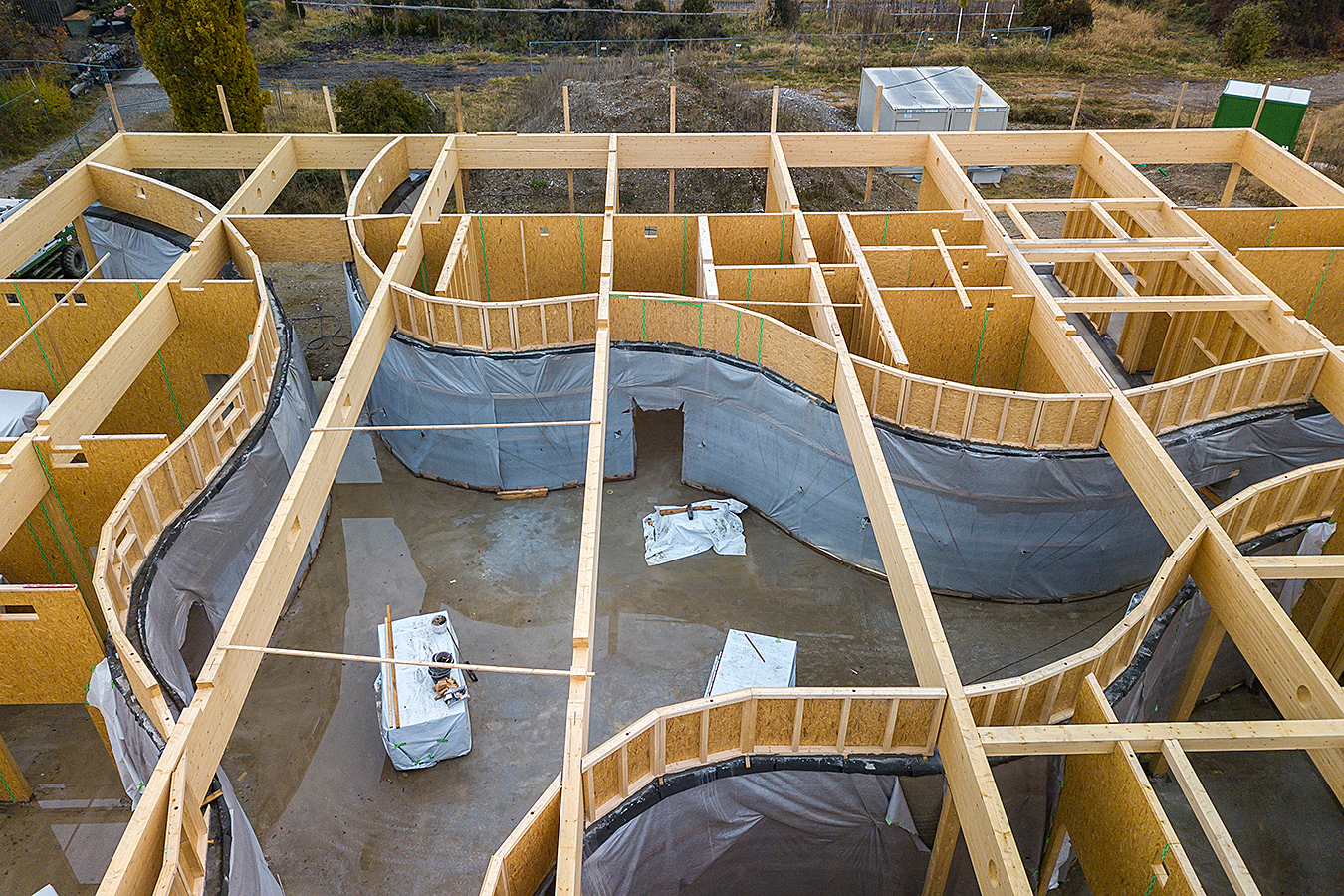
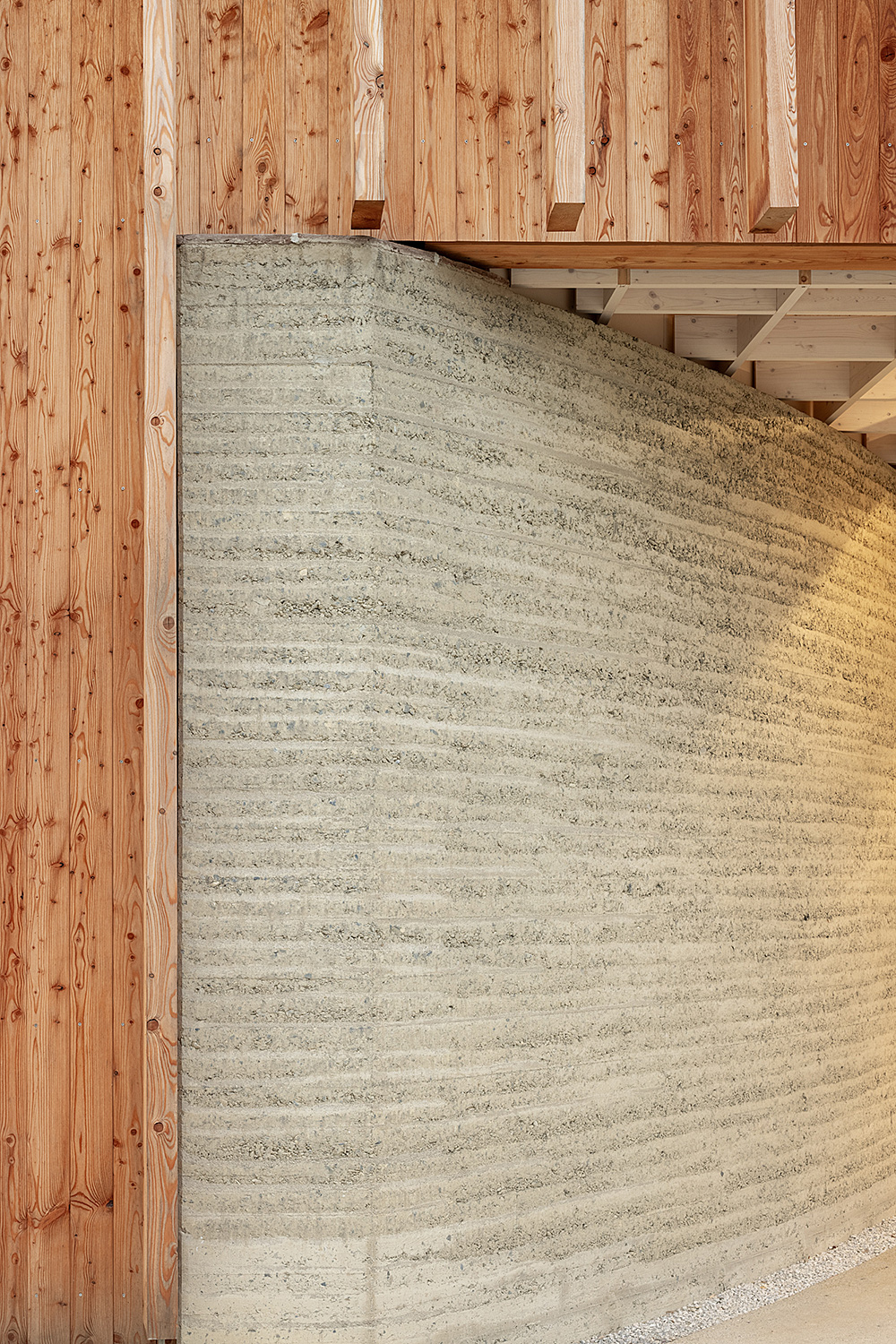
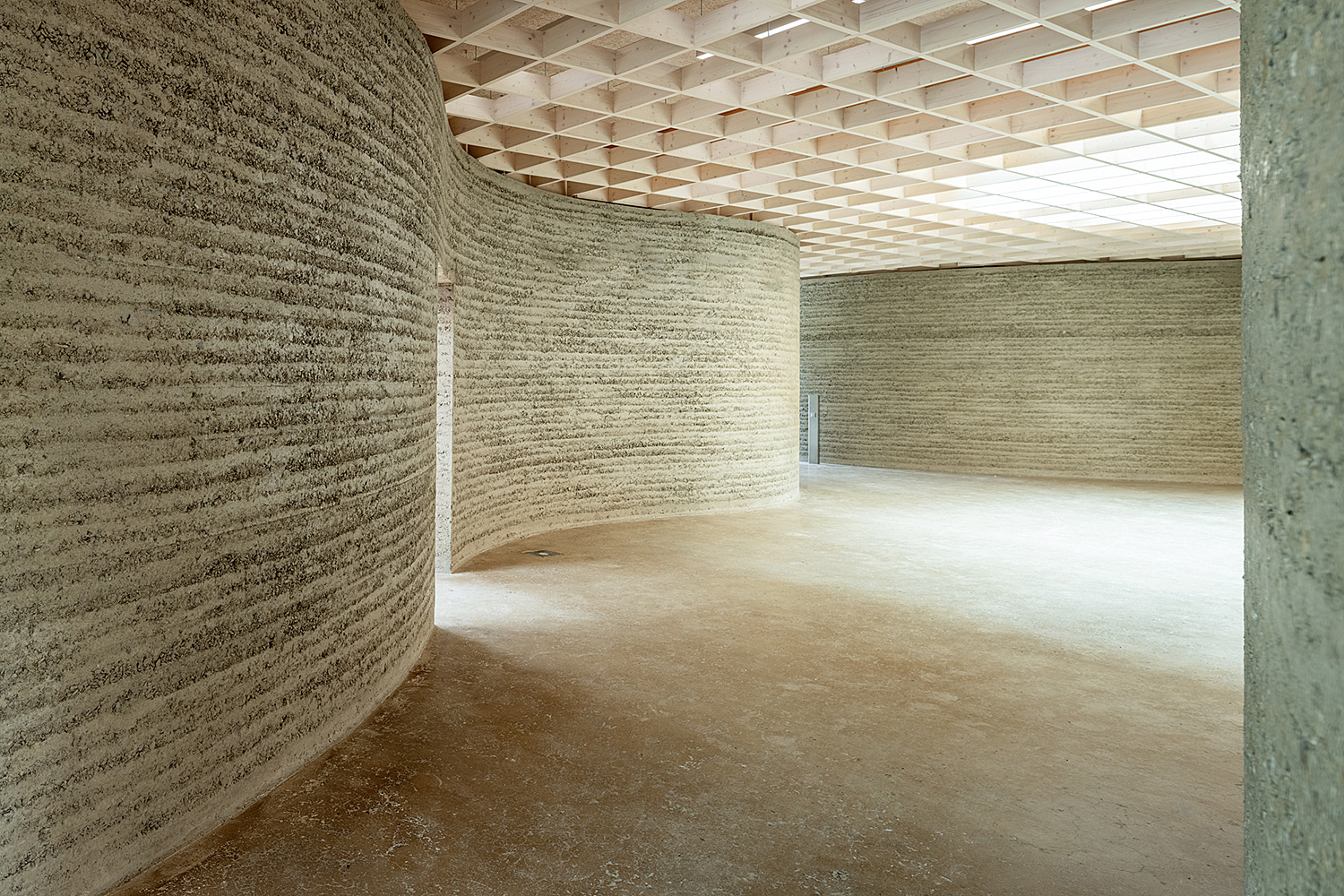
The building’s rammed-earth walls are made from locally sourced material, significantly reducing its embodied carbon footprint. Cast and tamped on site, they showcase a labor-intensive craft process with a low environmental footprint (Fachforum Umweltbildungszentrum).

Hess / Talhof / Kumierz Website: Umweltbildungszentrum
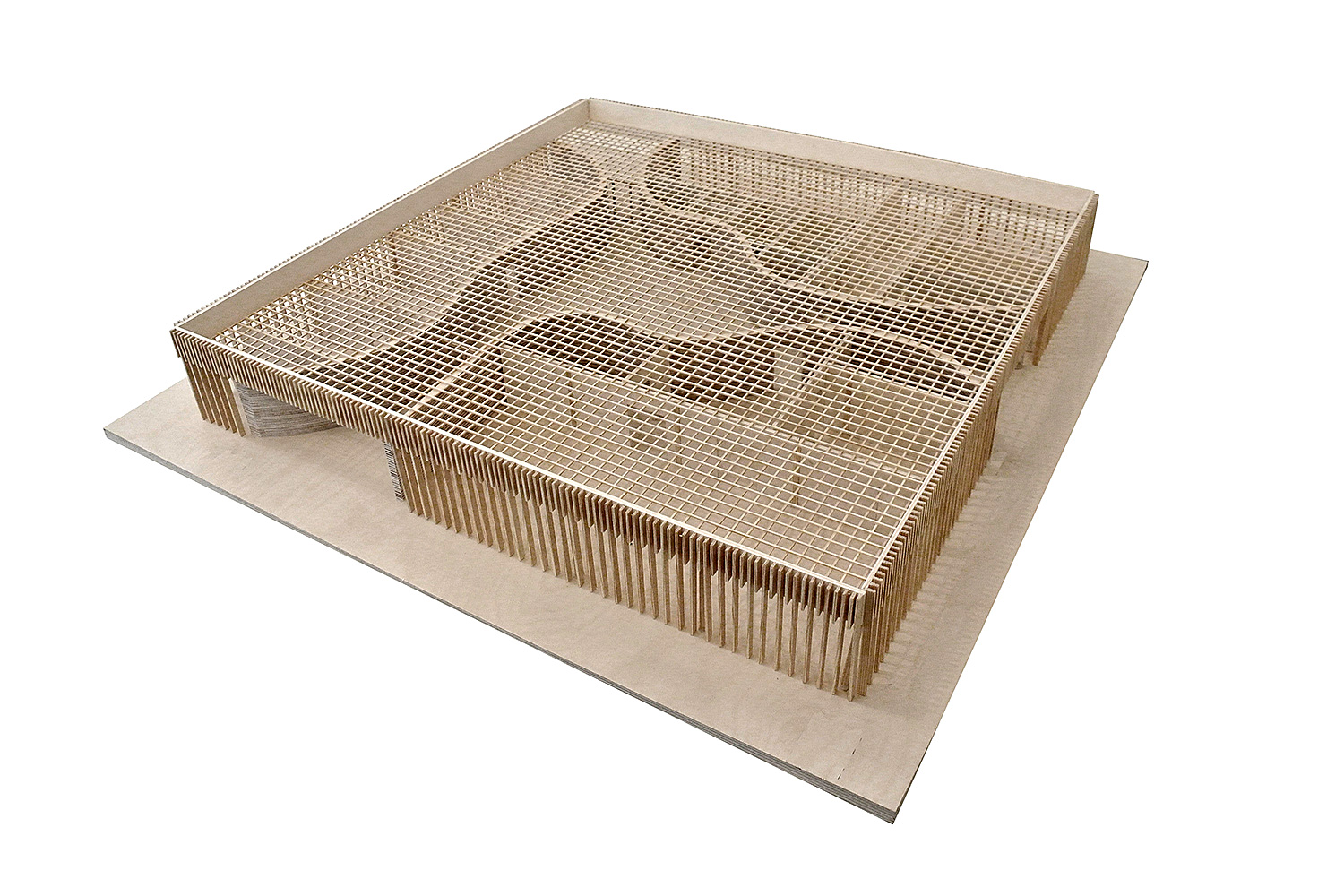
Augsburg Model
Hess / Talhof / Kumierz Website: Umweltbildungszentrum
Augsburg Construction Process


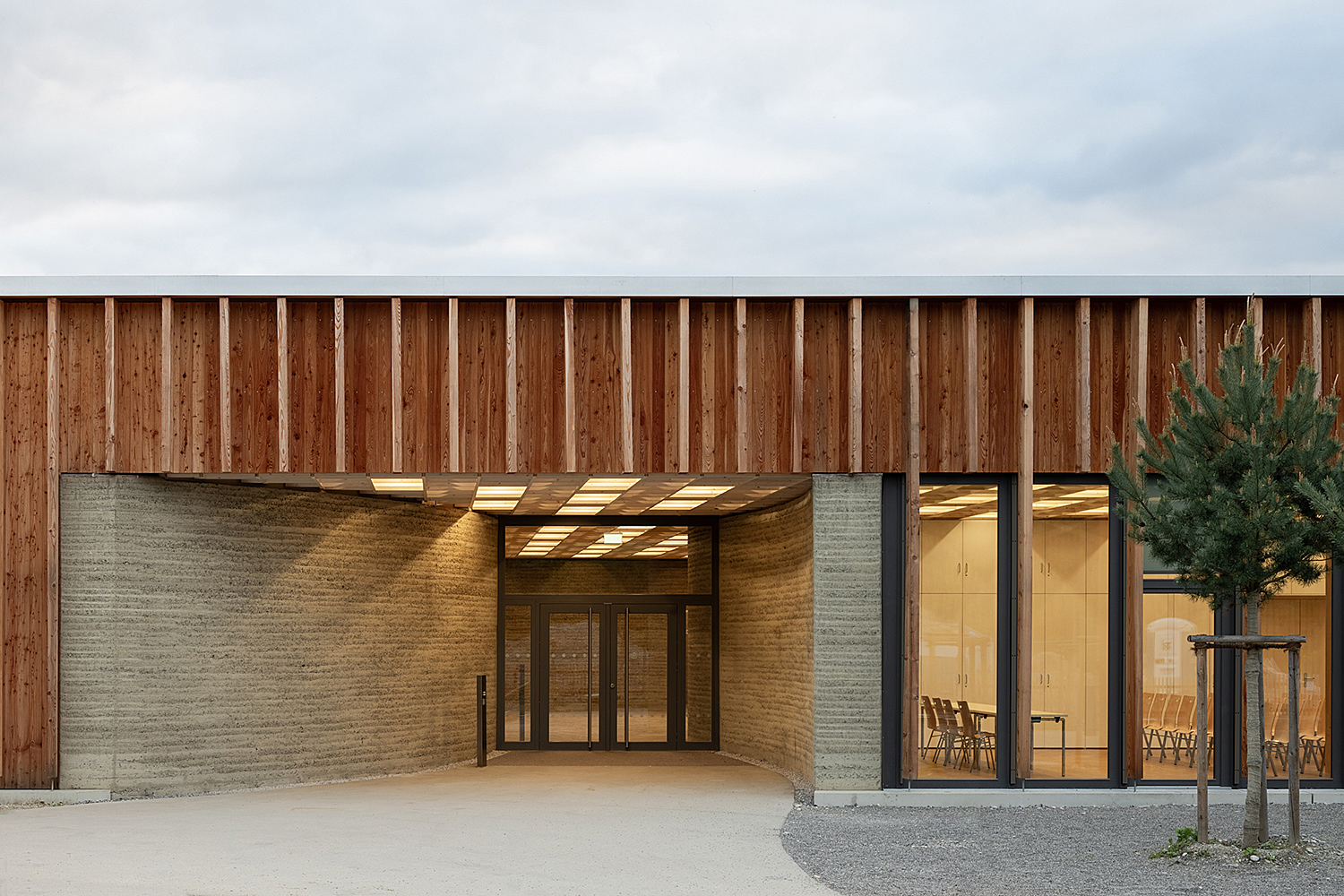
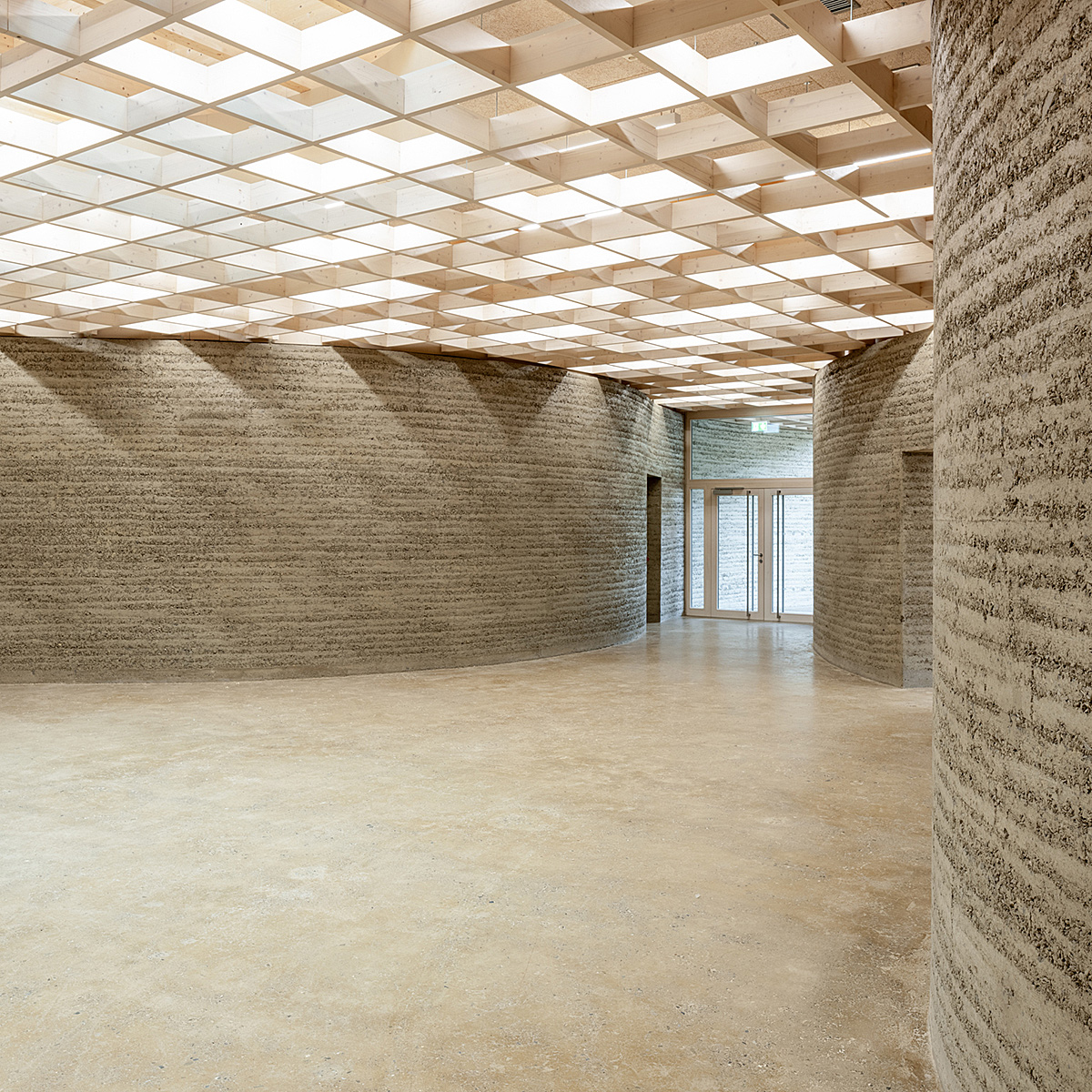
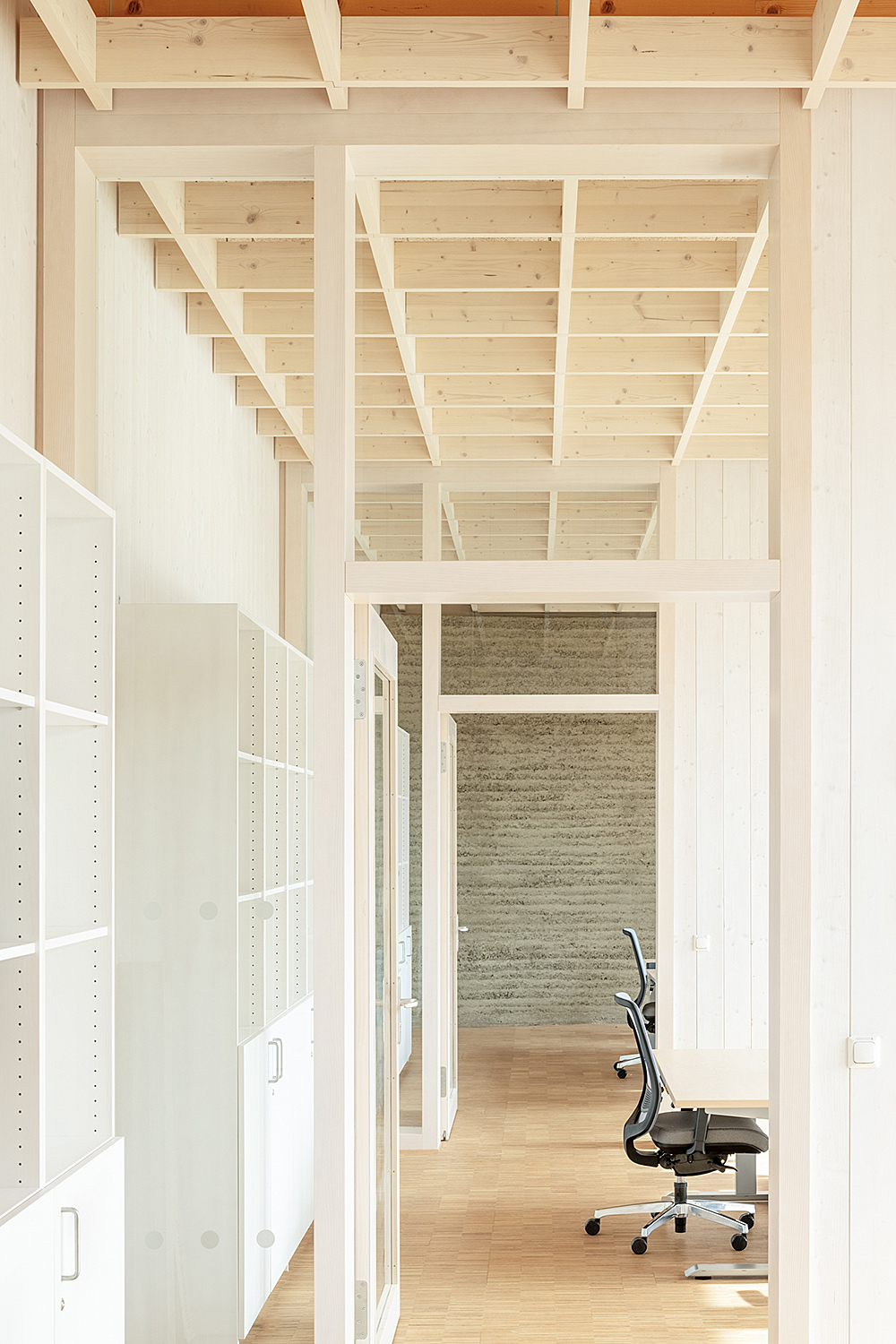
Paired with the rammed-earth walls, wooden ceilings and a timber exterior façade establish a rich two-tone material contrast. A 90 kWp rooftop photovoltaic array further supports the building’s on-site renewable energy strategy  (Lifeguide Augsburg).

Hess / Talhof / Kumierz Website: Umweltbildungszentrum
Augsburg Entrance

The UBZ is organized around a roughly square plan, yet upon entry the space is shaped by its organically flowing rammed-earth walls that express the project’s commitment to natural form and sustainability. 

Hess / Talhof / Kumierz Website: Umweltbildungszentrum
Augsburg Interior


Hess / Talhof / Kumierz Website: Umweltbildungszentrum
Augsburg Interior

Within its approximately 10,700 ft² footprint, the building includes a central foyer and flexible exhibition space, two combinable seminar rooms, a teaching kitchen, offices, a workshop, and storage rooms. 

Hess / Talhof / Kumierz Website: Umweltbildungszentrum
Augsburg Office Space

An additional 32,300 ft² of landscaped outdoor space extends the learning environment beyond the building, reinforcing its educational mission (Das Raumprogramm UBZ).

Hess / Talhof / Kumierz Website: Umweltbildungszentrum
Augsburg – Transition from Botanical Garden